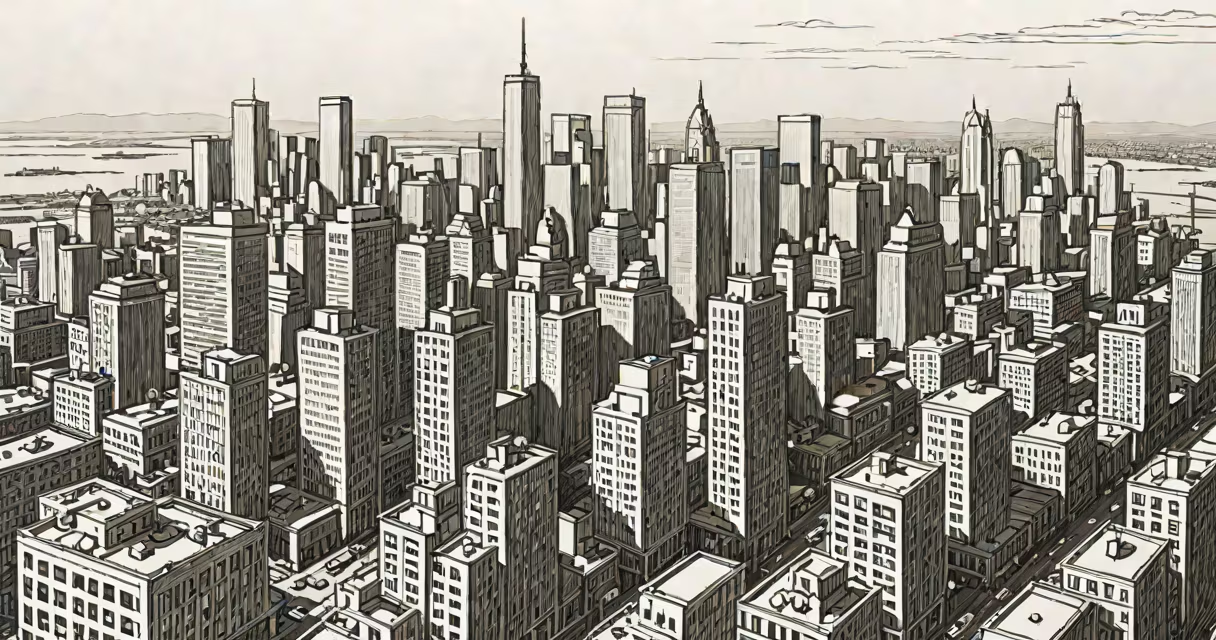
Urban areas are concentrated human settlements with high population density, permanent structures, and developed infrastructure such as roads, utilities, and public services. They form the core of modern economic, cultural, and administrative activity.
These zones typically emerge where people gather for work, trade, education, and social interaction. The United Nations defines urban areas as places with at least 2,000 residents per square kilometer, based on administrative boundaries and census data. This threshold distinguishes them from sparsely populated rural regions.
Urban areas are not just cities-they include suburbs, industrial zones, and mixed-use districts within a larger metropolitan region. A single urban area may span multiple municipalities, connected by transit systems and shared services. For example, the Greater Tokyo Area spans five prefectures and houses over 38 million people, making it the largest urban agglomeration in the world.
Urban areas operate through interconnected systems: transportation networks move people and goods, energy grids power homes and businesses, and water and sewage systems maintain hygiene and health. These systems rely on centralized planning and continuous maintenance.
Land use in urban areas follows zoning laws that separate residential, commercial, and industrial zones. However, many modern cities adopt mixed-use development to reduce commute times and increase walkability. New York City's Midtown Manhattan exemplifies this model-office towers sit beside apartment buildings, retail stores, and subway stations.
Urban economies thrive on proximity. Businesses benefit from access to labor pools, customers, and suppliers. A 2022 World Bank report found that urban centers generate 80% of global GDP despite covering less than 3% of Earth's land surface. This efficiency stems from reduced transaction costs and faster innovation cycles.
Urban areas vary by size, function, and governance. The following table outlines key classifications:
| Type | Population Range | Key Features | Example |
|---|---|---|---|
| Small city | 50,000 - 250,000 | Local government, regional services | Asheville, North Carolina |
| Metropolitan area | 1 million+ | Multiple jurisdictions, major transport hubs | Chicago metropolitan area |
| Global city | 5 million+ | International finance, media, diplomacy | London, United Kingdom |
| Primate city | Often dominates national population | Centralized political and economic power | Paris, France |
Not all urban areas grow organically. Some are planned from the ground up. Brasília, Brazil's capital, was constructed in 1960 as a purpose-built administrative center. Its radial layout and strict zoning reflect modernist urban design principles.
A common misconception is that urban areas are synonymous with "cities." But according to the U.S. Census Bureau, an urban area includes any densely settled territory with at least 50,000 residents. This category includes suburbs and satellite towns that are economically linked to a central city.
People often confuse urban areas with urban centers. An urban center is a specific location-like a downtown district or business hub-while an urban area encompasses the entire built-up zone around it. For instance, downtown Los Angeles is an urban center, but the urban area extends into neighborhoods like West Hollywood and Pasadena.
Another error is assuming all urban areas have high-rise buildings. While skyscrapers define iconic skylines, many urban areas feature low-rise housing, especially in developing nations. Dhaka, Bangladesh, has over 20 million residents in a dense urban footprint, yet most housing consists of multi-story tenements rather than high-rises.
Urban areas also differ from informal settlements. Slums and shantytowns may have high population density but lack formal infrastructure, legal land tenure, or municipal services. The UN estimates that nearly 1 billion people live in such areas globally. These are not classified as official urban areas under standard statistical definitions.
Consider Tokyo's urban area. It covers 6,213 square kilometers and contains 37.4 million people. The city operates through a layered system: central wards like Chiyoda host government and corporate headquarters, while outer districts like Saitama and Kanagawa provide housing and manufacturing.
Transportation is critical. Tokyo's rail network moves over 40 million passengers daily-the highest volume in the world. This system enables people to live far from the city center while maintaining access to jobs. Without this infrastructure, Tokyo's urban area could not sustain its current density.
I once visited Tokyo during rush hour and observed how smoothly commuters moved between train lines. A single transfer at Shinjuku Station involved over 2 million people daily. That level of coordination is only possible because the urban area functions as a single integrated system-not just a collection of neighborhoods.
Urban areas improve, economic growth, and cultural exchange. They concentrate talent and resources, enabling rapid scaling of startups, research institutions, and creative industries. Silicon Valley, located in the San Francisco Bay Area, is a prime example-its urban network supports over 100,000 tech workers and hundreds of venture-backed companies.
Yet urban areas face challenges: congestion, pollution, housing shortages, and inequality. The World Health Organization reports that 90% of urban dwellers breathe air exceeding safe particulate levels. Addressing these issues requires coordinated policy, investment in green infrastructure, and inclusive planning.