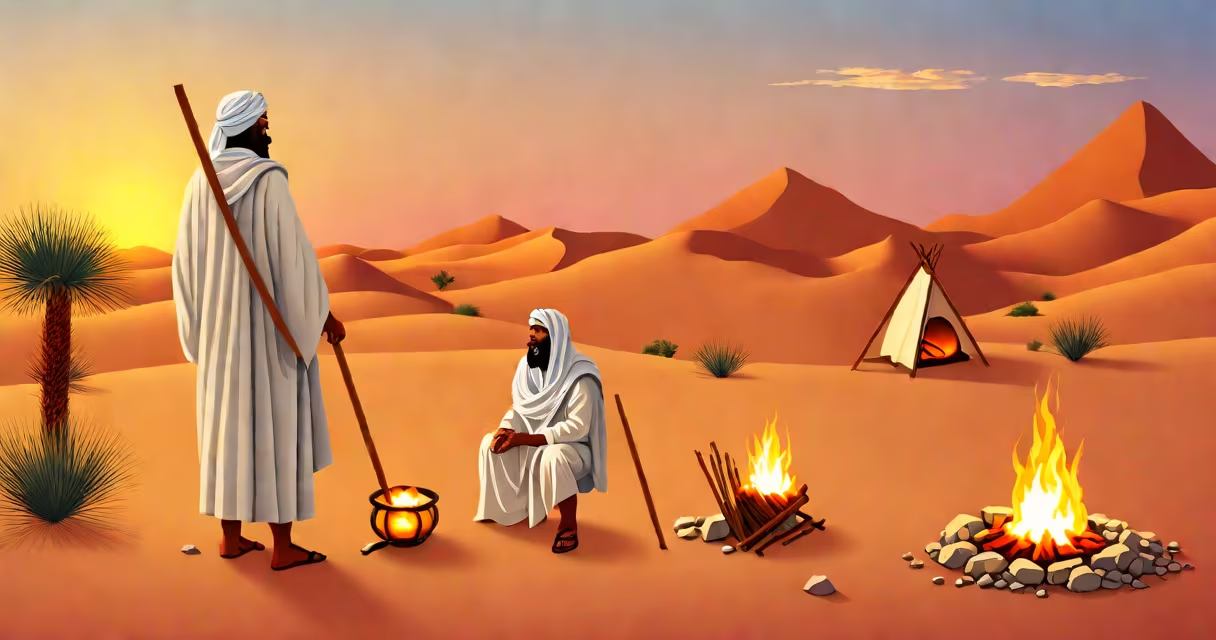
A sojourner in the Bible is a foreigner residing temporarily in Israel, granted legal protection and rights under divine law. The term appears 46 times in the Hebrew Bible, primarily in Leviticus, Deuteronomy, and Exodus, and refers to someone who dwells among God's people without citizenship.
The Hebrew word *ger* (גֵּר) denotes a resident alien or temporary dweller. Unlike a permanent immigrant, a sojourner was not expected to assimilate fully into tribal identity but was included in religious and civil obligations. This distinction matters: sojourners were not citizens, yet they were not excluded from community life.
God commanded Israel to treat sojourners fairly because the Israelites themselves had once been sojourners in Egypt. "Do not oppress a stranger," Leviticus 19:33 states, "for you were strangers in Egypt." This historical memory formed the ethical foundation for inclusion.
Sojourners had access to land, food, and legal protection. They could participate in festivals, pay tithes, and even serve as witnesses in court. Exodus 12:49 says, "The same law applies to both the native-born and the foreigner who resides among you."
Land distribution during Joshua's conquest did not exclude sojourners. While they didn't inherit tribal territory, they could live within it under covenant terms. Numbers 15:15-16 confirms that "the same rules apply to you and the foreigner who resides among you."
When David fled from Saul, he sought refuge in Gath, a Philistine city. He disguised himself as insane to survive. His status as a sojourner-someone outside Israel's borders-meant he had no guaranteed safety. Yet he still relied on God's provision, showing that sojourners were not always protected by human systems.
Sojourners fell into two categories: voluntary and involuntary. Voluntary sojourners, like Ruth the Moabite, chose to join Israel through marriage and faith. Ruth declared, "Your people shall be my people, and your God my God" (Ruth 1:16). She became a model of loyalty and integration.
Involuntary sojourners were displaced due to war, famine, or forced migration. Jacob's family moved to Egypt during a drought. Though they were foreigners, Joseph elevated them to positions of authority. Genesis 47:21-22 records that Pharaoh gave them land and resources, treating them as sojourners under royal protection.
| Type | Origin | Legal Status | Example |
|---|---|---|---|
| Voluntary | Chose to settle | Protected, could own property | Ruth (Moabite) |
| Involuntary | Displaced by crisis | Dependent on host community | Joseph's family in Egypt |
| Temporary | Travelers or traders | Allowed to stay, no long-term rights | Abraham in Canaan |
Abraham, though he lived in Canaan for decades, never owned land outright. He purchased a burial plot from Ephron the Hittite (Genesis 23). This illustrates that even patriarchs were sojourners in the eyes of the law-they resided but did not inherit.
Many assume sojourners were treated as outsiders or servants. But the Bible repeatedly commands fair treatment. Deuteronomy 24:17-18 says, "Do not deprive the foreigner or the fatherless of justice... Remember that you were slaves in Egypt."
Another misconception is that sojourners were always poor or powerless. The story of the Shunammite woman in 2 Kings 4 shows a sojourner who hosted the prophet Elisha. Her son died, and she received miraculous restoration. Her actions demonstrate agency and influence.
A lesser-known fact: sojourners could become part of Israel's worship system. Numbers 9:14 allows a sojourner to observe Passover if circumcised and committed to the covenant. This wasn't mere tolerance-it was inclusion in sacred ritual.
Hebrews 11:13 summarizes the spiritual dimension: "All these people were still living by faith when they died. They did not receive the things promised, but they saw them and greeted them from a distance, acknowledging that they were strangers and aliens on earth."
This verse reframes sojourners not just as social categories but as theological metaphors. The author uses the term "strangers and aliens" to describe believers' relationship to this world. The concept transcends history-it speaks to identity in exile.
I once visited a synagogue in Jerusalem where a rabbi explained that the sojourners' story is central to Jewish ethics. During a Passover seder, participants recite, "In every generation, each person must see themselves as if they personally left Egypt." That includes sojourners-because everyone was once a sojourner.
Understanding what is a sojourner in the Bible reveals a consistent thread: justice, memory, and belonging. The sojourner is not a footnote. They are a mirror held up to the community's character.