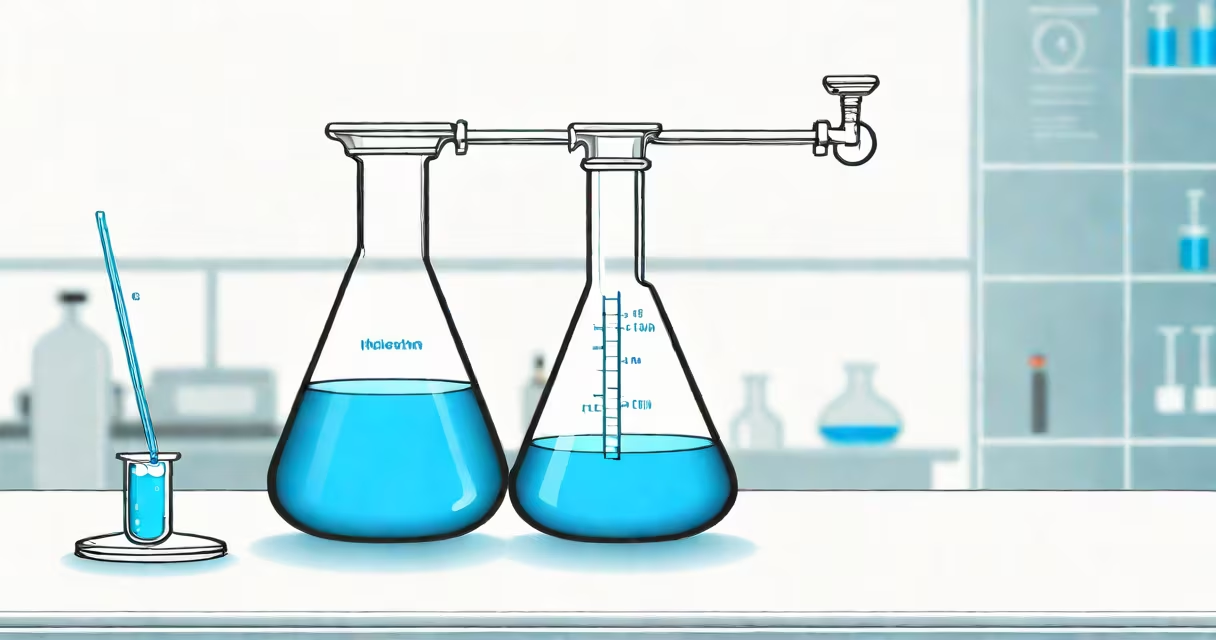
A standard solution in chemistry is a reagent with a precisely known concentration, typically used in titrations to quantify the amount of an analyte in a sample. These solutions are essential for accurate quantitative analysis in laboratories.
Standard solutions are prepared by dissolving a known mass of a pure substance in a solvent and diluting to a precise volume. The concentration is expressed in moles per liter (mol/L), or molarity (M). This precision allows scientists to calculate unknown concentrations using stoichiometric relationships during reactions.
For example, a 0.1000 M sodium hydroxide (NaOH) solution is often used to titrate an unknown concentration of hydrochloric acid (HCl). When 25.00 mL of HCl requires exactly 22.45 mL of the NaOH solution to reach the endpoint, the concentration of HCl can be calculated using the balanced equation and the known molarity of NaOH.
In titration, a standard solution is added gradually to a solution of unknown concentration until the reaction reaches completion-the equivalence point. An indicator or pH meter signals this point. The volume of standard solution used determines the moles of analyte present.
The key requirement is that the reaction between the standard and analyte must be complete, rapid, and have a clear endpoint. For instance, in acid-base titrations, strong acids react completely with strong bases, making them ideal candidates for standard solutions.
Consider a titration where 20.00 mL of acetic acid (CH₃COOH) is titrated with 0.0500 M NaOH. If 18.60 mL of NaOH is required to neutralize the acid, the moles of NaOH used are:
moles = concentration × volume (in L)
= 0.0500 mol/L × 0.01860 L
= 9.30 × 10⁻⁴ mol
Because the reaction is 1:1 (CH₃COOH + NaOH → CH₃COONa + H₂O), the moles of acetic acid are also 9.30 × 10⁻⁴ mol. Dividing by the original volume (0.02000 L) gives a concentration of 0.0465 M.
Standard solutions fall into two categories: primary standards and secondary standards. Primary standards are highly pure, stable compounds with known composition and high molar mass, allowing direct preparation of a solution with exact concentration.
Common primary standards include potassium hydrogen phthalate (KHP) for acid-base titrations and sodium carbonate (Na₂CO₃) for acid titrations. These substances do not absorb moisture, decompose slowly, and have high purity-requirements defined by the National Institute of Standards and Technology (NIST).
Secondary standards are less pure or unstable and must be standardized against a primary standard. Examples include sodium hydroxide (NaOH), which absorbs water and carbon dioxide from air, altering its concentration. A NaOH solution must be titrated against KHP to determine its actual molarity before use.
| Type | Examples | Purity & Stability | Use Case |
|---|---|---|---|
| Primary standard | KHP, Na₂CO₃, oxalic acid dihydrate | High (≥99.9%) and stable | Direct preparation of standard solutions |
| Secondary standard | NaOH, KMnO₄, HCl | Lower; degrades over time | Must be standardized before use |
Using a secondary standard without prior standardization introduces error. For example, a NaOH solution stored for weeks may lose strength due to CO₂ absorption, reducing its effective concentration by up to 5% in humid conditions.
Preparation of a standard solution demands precision. A 1000 mL volumetric flask must be rinsed with distilled water, filled to the calibration mark, and mixed thoroughly. Any deviation in volume or mass leads to inaccurate results.
When preparing a 0.1000 M KHP solution, 2.042 grams of KHP (molar mass = 204.22 g/mol) are dissolved in water and diluted to 1.000 L. The exact mass ensures the solution has the intended molarity. Using a calibrated analytical balance and proper technique prevents errors.
I once prepared a series of standard solutions for a student lab session. One group used a beaker instead of a volumetric flask and reported a 3.2% higher concentration. The error stemmed from improper volume measurement-a common mistake that underscores why only volumetric glassware is acceptable for standard solution preparation.
Many confuse standard solutions with stock solutions. A stock solution is a concentrated solution used to make working dilutions but lacks precise concentration. For example, a 1 M HCl stock solution is used to prepare 0.1 M HCl for titrations-but it is not a standard solution unless its concentration is verified.
Another misconception is that any solution with a label like "0.1 M" qualifies as standard. That label doesn't guarantee accuracy. A solution labeled "0.1 M NaOH" may actually be 0.085 M if not standardized. Only solutions whose concentration has been experimentally confirmed are considered standard.
Standard solutions are not interchangeable across methods. A solution used in redox titrations (like KMnO₄) cannot replace one used in acid-base titrations without recalibration. Each method relies on specific reaction kinetics and endpoint detection.
Standard solutions are important in pharmaceutical quality control. The U.S. Pharmacopeia (USP) specifies that all titrations used in drug assay must employ standard solutions traceable to NIST-certified reference materials. This ensures consistency across labs and regulatory compliance.
In environmental testing, standard solutions measure pollutants like chloride ions in drinking water. A 0.0100 M silver nitrate (AgNO₃) solution is used in argentometric titrations to determine chloride levels. The method requires a standard solution with known molarity to ensure safety thresholds are met.
According to the American Chemical Society (ACS), accurate standardization reduces variability in analytical results by up to 90% in multi-lab studies. This highlights the role of standard solutions in maintaining scientific reliability.
Understanding what is a standard solution in chemistry begins with recognizing its role as a benchmark. It is not just a tool-it is a foundation of quantitative accuracy in experimental science. Whether in academic labs or industrial quality control, standard solutions enable reproducible, trustworthy results.