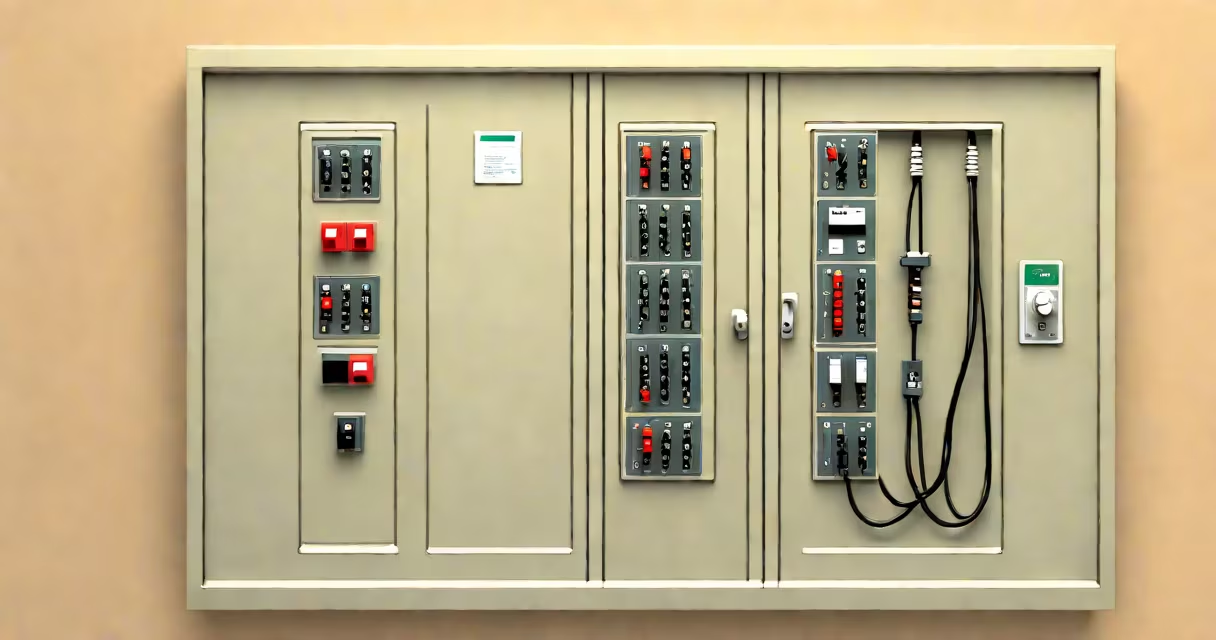
The electric box is formally known as a breaker box, electrical panel, or main service panel. It's the central hub that distributes electricity from the utility line to individual circuits throughout a building. This device contains circuit breakers that automatically shut off power during overloads or short circuits, preventing fire and damage.
Electricity enters a home through a service entrance cable, typically connected to a meter outside. The main disconnect switch and the bus bars inside the panel route current to branch circuits. Each circuit feeds outlets, lights, or appliances. When a fault occurs-like too much current flowing through a wire-the corresponding breaker trips, cutting power instantly.
For example, if a space heater draws more than 15 amps on a 15-amp circuit, the breaker will trip within seconds. This prevents wires from overheating and reduces fire risk. The National Fire Protection Association (NFPA) reports that faulty electrical systems cause about 44,000 home fires annually, many preventable with properly functioning panels.
The panel receives high-voltage alternating current (AC) from the utility company, usually 120/240 volts in North American residential systems. Inside, the incoming lines connect to a main breaker and two hot bus bars-one for 120V and one for 240V. Neutral and ground bars are also present, providing return paths and safety grounding.
Circuit breakers snap onto the bus bars. Each breaker controls one circuit. When a device draws excessive current, internal bimetallic strips heat up and bend, releasing a latch that opens the connection. This action interrupts the flow of electricity. Once reset manually, the breaker restores power if the fault is cleared.
Modern panels often include arc-fault circuit interrupters (AFCIs) and ground-fault circuit interrupters (GFCIs) as part of the breakers themselves. These detect dangerous electrical arcs or leakage to ground-common causes of hidden fires in walls. The U.S. Consumer Product Safety Commission (CPSC) estimates AFCI protection reduces electrical fire deaths by nearly 50% in new construction.
Breaker boxes come in several configurations based on amperage capacity and configuration:
| Type | Amperage Rating | Common Use | Typical Location |
|---|---|---|---|
| Single-phase | 100-200 A | Residential homes | Garage, basement, utility room |
| Three-phase | 200-600 A | Small businesses, workshops | Industrial or commercial settings |
| Panelboard | 100-400 A | Subpanels, additions | Attached to main panel |
Most homes have a single-phase panel rated between 100 and 200 amps. A 200-amp panel supports multiple large loads-central air conditioning, electric ranges, water heaters-without tripping breakers during peak usage.
Inside the panel, you'll find:
One non-obvious fact: the main breaker doesn't always control the entire panel. In some older installations, the main disconnect is separate from the panel itself. This setup was common before 1990 and still exists in older homes. The NEC (National Electrical Code) now requires the main disconnect to be part of the panel for safety and accessibility.
Electrical panels are required in every residential and commercial building connected to public power. They're installed during new construction and replaced during major renovations. The International Residential Code (IRC) mandates that panels be accessible, located within 6 feet of the main entrance, and not behind doors or in confined spaces.
For example, a typical 2,000 sq ft home uses a 200-amp panel with 20-24 circuit breakers. Common circuits include lighting (15A), kitchen outlets (20A), bathroom GFCI (20A), and HVAC (30-60A). Each breaker is labeled -"Kitchen," "Bedroom 2," "Garage"-to identify which area powers what.
When upgrading a home, homeowners may replace an old 100-amp panel with a 200-amp model to support electric vehicles, solar panels, or whole-home generators. This upgrade requires a permit and inspection by a licensed electrician. The cost averages $1,200 to $2,500 depending on labor and materials.
Many people confuse the breaker box with a fuse box. Fuse boxes were standard before the 1960s. They use glass or ceramic fuses that melt when overloaded. Replacing a blown fuse requires buying a new one of the correct amperage. Breaker boxes are preferred because they can be reset without replacement.
Another misconception: the panel is not the source of electricity. It's a distributor and protector. Power originates at the utility transformer, travels through overhead or underground lines, then enters the home via a meter and service panel. The panel doesn't generate power-it manages it.
Some assume that adding more breakers increases available power. That's false. Adding a breaker only allocates existing capacity. A 100-amp panel cannot supply more than 100 amps total, even with 30 breakers. Overloading leads to tripped breakers or, worse, overheated wiring.
I once observed a homeowner install a 30-amp double-pole breaker for a new electric dryer in a 100-amp panel. The panel had only two slots left. After installation, the main breaker tripped during startup. The issue wasn't the dryer-it was that the total load exceeded the panel's capacity. A licensed electrician later confirmed the panel needed upgrading.
Understanding the breaker box connects to other key electrical concepts. For instance, knowing how to safely reset a tripped breaker prevents unnecessary calls to an electrician. Turning off the main breaker isolates all circuits during maintenance. The panel also interfaces with smart home systems, allowing remote monitoring of energy use and alerts for outages.