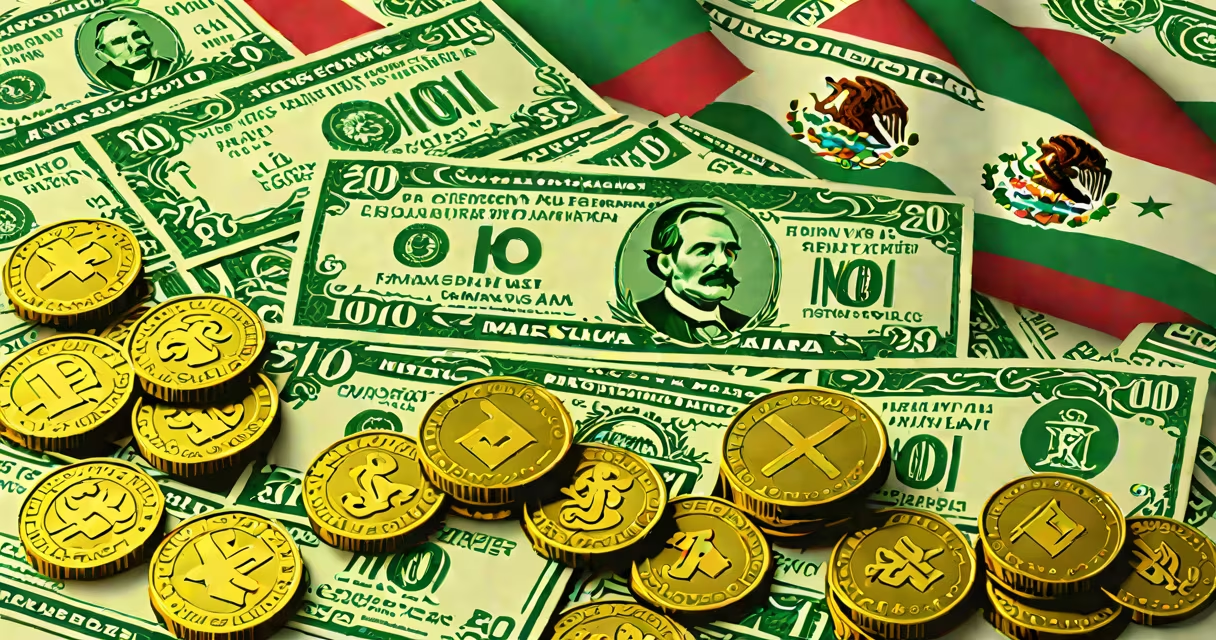
The name of Mexican currency is the peso. It is the official money of Mexico and is represented by the symbol $ or the ISO code MXN. The peso is used in all financial transactions within the country and is among the most actively traded currencies in Latin America.
Each peso is divided into 100 centavos. The currency has been in use since the late 19th century, following Mexico's independence and the establishment of a national banking system. The current version, the Mexican peso (MXN), was introduced in 1993 after a major devaluation of the previous peso, which had lost significant value due to inflation.
The Banco de México, the central bank, issues and regulates the currency. It controls monetary policy, manages foreign exchange reserves, and ensures the stability of the peso. The bank also oversees the production of banknotes and coins through the Casa de Moneda de México, the national mint.
The Mexican peso operates as legal tender throughout Mexico. It is accepted in shops, markets, banks, and online platforms. Transactions are processed through electronic systems like SPEI (Sistema de Pagos Electrónicos Interbancarios), which enables real-time transfers between accounts.
Exchange rates fluctuate daily based on global economic conditions. As of June 2024, the peso trades around 18.5 MXN per US dollar. This rate varies depending on oil prices, U.S. interest rates, and investor confidence in emerging markets. The peso tends to weaken during periods of political uncertainty or global market volatility.
For example, in early 2023, the peso dropped below 20 MXN per USD amid rising U.S. inflation and Federal Reserve rate hikes. By mid-2024, it strengthened to near 18 MXN as Mexico's economy showed resilience and trade with the U.S. remained strong under the USMCA agreement.
The Mexican peso comes in both paper notes and metal coins. The current series of banknotes, issued in 2010 and updated in 2018, features prominent historical figures and cultural landmarks.
| Denomination | Color | Front Design | Back Design |
|---|---|---|---|
| $20 | Green | Benito Juárez | Palacio Nacional |
| $50 | Blue | Leona Vicario | Monumento a la Revolución |
| $100 | Red | José María Morelos | Templo Mayor |
| $200 | Purple | Francisco I. Madero | Chapultepec Castle |
| $500 | Orange | Emiliano Zapata | San Juan de los Lagos |
| $1,000 | Yellow | Andrés Manuel López Obrador | Palacio Nacional |
Coins are issued in denominations of 1, 2, 5, 10, 20, and 50 centavos, and 1, 2, 5, 10, 20, and 50 pesos. The 1-peso coin features the national coat of arms, while higher-value coins often depict indigenous leaders or scenes from Mexico's history.
Security features include watermarks, microprinting, and holograms. The 2018 redesign added tactile elements for visually impaired users, such as raised edges and distinct shapes on certain denominations.
The peso is used in everyday commerce across Mexico. It is accepted in cities like Mexico City, Guadalajara, and Monterrey, as well as in rural towns and border zones. Tourists often exchange dollars or euros for pesos at authorized exchange offices or ATMs.
International trade relies heavily on the peso. Mexico is the 15th largest economy in the world by nominal GDP and a key player in North American supply chains. The country exports vehicles, electronics, and agricultural goods, all priced in pesos or converted via foreign exchange.
A notable example is the automotive industry. In 2023, Mexico produced over 4 million vehicles, many exported to the U.S. and Canada. These exports are invoiced in U.S. dollars, but the local costs-labor, parts, taxes-are paid in pesos. Fluctuations in the peso-dollar exchange rate directly affect profit margins for manufacturers.
Some people confuse the Mexican peso with the Argentine peso or the Colombian peso. While all are called "peso," they are separate currencies with different values, symbols, and issuing authorities. The Mexican peso is MXN; Argentina's is ARS; Colombia's is COP.
Another misconception is that the peso is unstable. While it has experienced sharp drops-such as the 2008 crisis when it fell to 16.5 MXN/USD-the Central Bank of Mexico has maintained long-term stability through inflation targeting and foreign exchange reserves. Since 2010, the average annual inflation rate has stayed below 5%, according to the World Bank.
There's also confusion about the symbol. The $ sign is used globally, but in Mexico, it specifically represents the peso. In financial contexts, MXN is preferred to avoid ambiguity. For example, a price listed as $100 in Mexico means 100 pesos, not U.S. dollars.
I once visited a small market in Oaxaca where vendors refused credit cards and only accepted cash. When I handed over a $100 U.S. bill, the vendor looked at me confused. He didn't recognize the denomination. I realized then that even within Mexico, understanding the local currency is essential. The vendor eventually exchanged the bill at a nearby bank, but the process took 20 minutes and cost me a 5% fee.
The name of Mexican currency is the peso. It is a stable, widely used currency with a rich history and modern security features. Understanding its structure, denominations, and role in trade helps travelers, investors, and locals alike make informed decisions. analyzing cross-border trade flows, knowing the peso is fundamental.