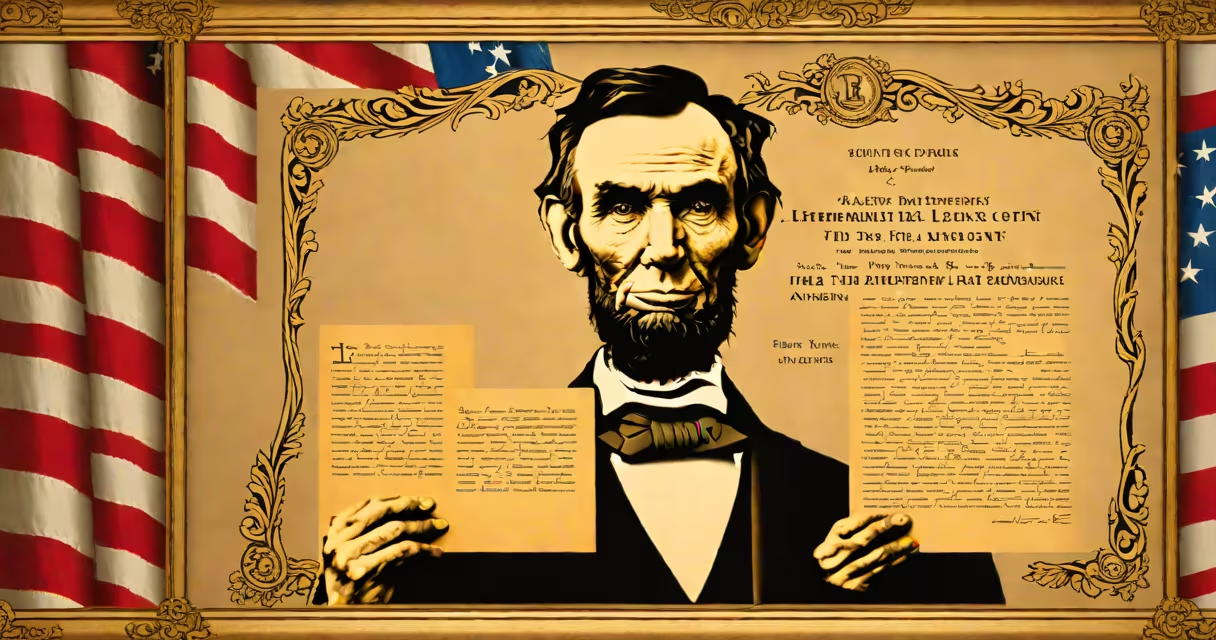
The Abraham Lincoln Thirteenth Amendment abolished slavery throughout the United States following the Civil War. Ratified in December 1865, it permanently outlawed involuntary servitude except as punishment for a crime.
Lincoln did not draft the amendment himself, but his administration actively promoted it. He saw it as essential to preserving the Union and fulfilling the moral purpose of the war. The amendment passed Congress in January 1865, months before Lincoln's assassination, and was ratified by the required three-fourths of state legislatures by December 1865.
Slavery had existed in the U.S. since colonial times, legally sanctioned in most states until the Civil War. The Emancipation Proclamation of 1863 freed enslaved people in Confederate states, but it did not end slavery nationwide. The 13th Amendment did. It amended the Constitution to make slavery illegal in every state and territory.
The amendment's language is concise: "Neither slavery nor involuntary servitude, except as a punishment for crime whereof the party shall have been duly convicted, shall exist within the United States, or any place subject to their jurisdiction."
This clause removed slavery as a legal institution across the entire country. It applied to all states, including those that had remained in the Union during the war. Before this, some Northern states still permitted forms of indentured labor or restricted rights for Black citizens.
The amendment's enforcement came through federal authority. Once ratified, it gave Congress power to pass laws enforcing the ban. This led to the Civil Rights Act of 1866 and later the 14th and 15th Amendments, which expanded citizenship and voting rights.
The amendment was part of a series of constitutional changes known as the Reconstruction Amendments. These were designed to rebuild the nation after the Civil War and change freedom and equality under law.
Three key amendments emerged from Reconstruction:
These amendments were intended to dismantle the legal foundations of racial hierarchy. The 13th Amendment laid the groundwork by removing the central institution of oppression.
The 13th Amendment was used to challenge laws and practices that resembled slavery. Courts have interpreted the amendment to prohibit peonage-the practice of forcing people to work to pay off debts-and other forms of coerced labor.
In 1915, the Supreme Court ruled in United States v. Classic that the 13th Amendment could be invoked to prevent states from using forced labor in prisons. More recently, in United States v. Kozminski (1988), the Court held that domestic servitude involving psychological coercion fell under the prohibition of involuntary servitude.
Modern applications include cases involving human trafficking. Federal prosecutors cite the 13th Amendment to justify charges against traffickers who exploit victims through threats, debt bondage, or physical confinement. Between 2007 and 2022, U.S. attorneys filed over 1,200 federal trafficking cases under the 13th Amendment's structure, according to the Department of Justice.
Many assume the Emancipation Proclamation ended slavery. It did not. The proclamation only freed enslaved people in states that had seceded from the Union. It did not apply to border states like Maryland or Kentucky, which remained in the Union. Slavery continued legally in those areas until the 13th Amendment took effect.
Another misconception is that the amendment passed easily. It did not. The House of Representatives rejected it in 1864. Lincoln personally lobbied members of Congress, using political favors and appeals to national unity. His efforts helped secure the necessary votes in January 1865.
A lesser-known fact: the amendment was not signed by Lincoln. He supported it, but the formal signing occurred after his death. The original document was signed by Secretary of State William Seward on January 31, 1865, and submitted to the states for ratification.
After the 13th Amendment passed, Southern states exploited the exception clause: "except as a punishment for crime." They enacted laws targeting Black men for minor offenses and leased them out to private companies for labor.
Between 1865 and 1900, over 100,000 Black prisoners were leased to railroads, mines, and plantations. The system persisted because courts upheld it under the 13th Amendment's loophole. It wasn't until the 1940s that the U.S. Supreme Court began to limit such practices.
In United States v. Price (1966), the Court ruled that convict leasing violated the spirit of the 13th Amendment when it amounted to forced labor. This decision helped dismantle the system, though traces remain in modern prison labor programs.
I stood before the original 13th Amendment document in the National Archives Rotunda in Washington, D.C. The ink was faded, the paper brittle. A small plaque noted it was "signed" by Seward, not Lincoln. The contrast between Lincoln's vision and the amendment's implementation struck me. The document was preserved not as a symbol of completion, but as a reminder of ongoing struggle.
| Fact | Source |
|---|---|
| The 13th Amendment was ratified on December 6, 1865. | National Archives |
| Over 1,200 federal trafficking cases were prosecuted under the 13th Amendment between 2007 and 2022. | U.S. Department of Justice |
| Convict leasing systems operated in 11 Southern states from 1865 to 1920. | PBS American Experience |
Understanding the Abraham Lincoln Thirteenth Amendment requires recognizing both its achievement and its limits. It ended legal slavery, but the fight for true freedom continues through enforcement, education, and policy reform.