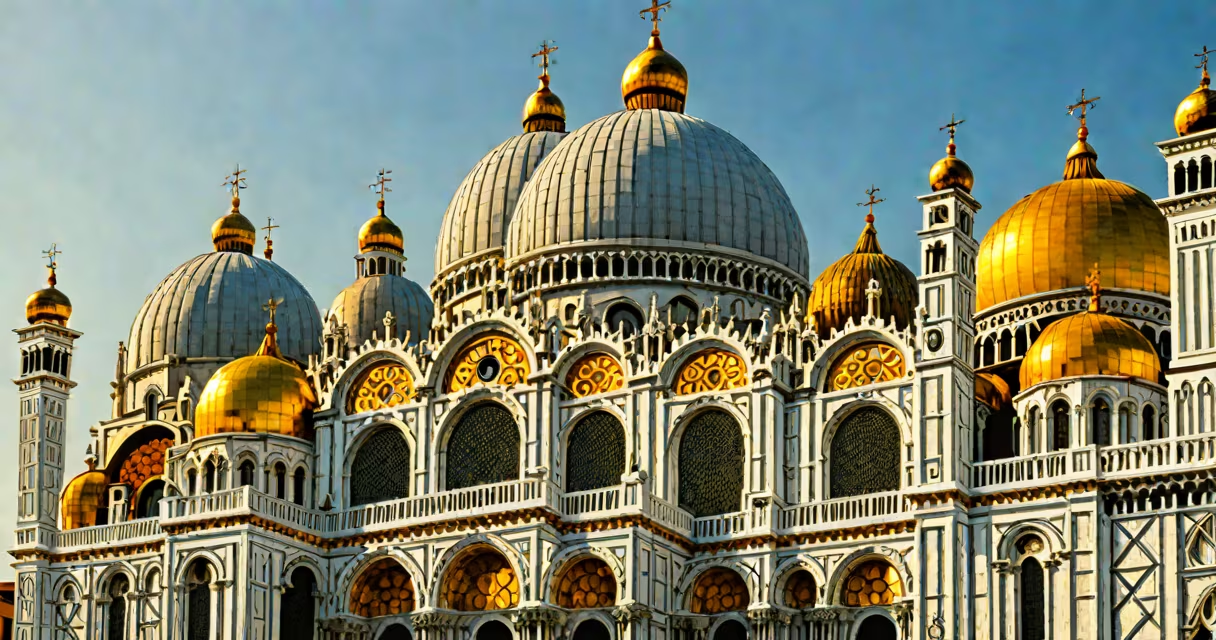
St. Mark's Basilica in Venice is a 11th-century cathedral combining Byzantine, Romanesque, and Gothic elements, built to house the relics of Saint Mark and serve as the ceremonial heart of the Republic of Venice.
The basilica stands on the Piazza San Marco, the city's central square, and functions as both a place of worship and a symbol of Venice's historical power. Its design reflects centuries of trade with the Eastern Mediterranean, particularly Constantinople, which supplied the gold leaf and mosaic techniques used throughout the interior.
Architectural features include five domes arranged in a cross-shaped layout, a marble-clad exterior with alternating red and white stone bands, and a vast interior covered in over 8,000 square meters of gold-leaf mosaics. The structure was consecrated in 1094 and expanded through the 13th and 14th centuries, incorporating additions like the Cappella d'Oro and the Porta della Carta.
St. Mark's Basilica operates as a functioning Catholic church under the jurisdiction of the Patriarchate of Venice. It hosts daily Mass, major liturgical events such as Easter and Christmas services, and state ceremonies tied to Venice's historical traditions.
Unlike typical cathedrals, it never served as the seat of a bishop. Instead, it functioned as the private chapel of the Doge-the elected ruler of the Republic-and later became the de facto religious center of the city-state. This dual role shaped its architectural layout: the main altar faces east, but the Doge's throne sits near the entrance, emphasizing political authority alongside religious function.
Modern visitors enter through the Porta del Paradiso, a bronze door crafted in 1275. Inside, the floor is paved with porphyry and marble from ancient Rome and the Eastern Empire. The space is divided into five aisles separated by columns of rare stone-green serpentine from Greece, red granite from Egypt-to create a sense of grandeur and sacred distance.
The basilica's construction relies on materials sourced across Europe and the Mediterranean. The exterior uses Istrian stone from modern-day Croatia, quarried for its durability and resistance to salt air. Interior columns come from ancient Roman temples, repurposed during the Middle Ages.
Mosaics dominate the interior. Over 8,000 square meters cover walls and ceilings, using tesserae (tiny pieces) of glass, gold leaf, and colored stone. These were assembled by skilled artisans known as *mosaicisti*, many trained in Constantinople. The gold background creates a luminous effect, making figures appear to float in divine light.
One key feature often overlooked is the absence of a single dominant dome. Instead, five smaller domes rise above the nave and transepts, creating a layered skyline. This design avoids the centralized focus seen in churches like the Pantheon, reflecting Byzantine influence where multiple altars and shrines coexist within one space.
| Type | Location | Key Feature | Historical Context |
|---|---|---|---|
| Byzantine | Interior mosaics | Gold backgrounds, stylized figures | Reflected trade ties to Constantinople after 1000 CE |
| Romanesque | Western façade | Arched portals, blind arcades | 11th-century foundation phase |
| Gothic | Upper galleries, ribbed vaults | Pointed arches, flying buttresses | 13th-14th century additions |
Today, basilica di san marco venezia remains a site of pilgrimage, cultural heritage, and civic ritual. It hosts over 2 million visitors annually, according to the Museo di San Marco, the institution managing its collections.
Its primary use is liturgical: daily Mass is held in Latin and Italian, and major feast days draw large crowds. The basilica also serves as a venue for art exhibitions, including rotating displays of medieval manuscripts and Renaissance paintings from the Venetian school.
Public events tied to Venice's history occur here. The Doge's procession to the basilica during the Feast of the Redeemer was historically reenacted until the 18th century. Modern versions of this event are staged during the annual Festa del Redentore, drawing thousands to the Rialto Bridge and culminating in a fireworks display visible from the basilica's steps.
Many assume St. Mark's Basilica is a cathedral because of its size and status. It is not. The official cathedral of Venice is San Pietro di Castello, located on the island of Giudecca. St. Mark's was never the seat of a bishop, though it holds the title of "patriarchal basilica" due to its historical role.
Another misconception is that the basilica's design is purely Byzantine. While its origins lie in Eastern Christian tradition, successive renovations introduced Western European styles. The 14th-century addition of the Cappella d'Oro-a gilded chapel housing Saint Mark's relics-features Gothic tracery and ribbed vaults, blending styles in ways that reflect Venice's cosmopolitan identity.
A lesser-known fact: the basilica's bell tower, the Torre dell'Orologio, was rebuilt after collapsing in 1902. The current version includes a clock mechanism from 1550, originally installed in the Doge's Palace. The clock still shows the phases of the moon and the zodiac signs, a nod to Renaissance astrology.
I visited basilica di san marco venezia during a winter morning in February 2023. The interior was dim, lit only by candlelight and the glow from the mosaics. As I approached the altar, I noticed that the gold tesserae shifted color depending on the angle of sunlight entering through high windows. At 10:17 a.m., a beam struck the Virgin Mary's cloak, turning it from amber to deep gold.
This effect is intentional. Mosaic artists in the 12th century understood that light alters perception. They placed certain colors to catch the sun at specific times of day, aligning with prayer cycles. The Virgin's robe, for example, was designed to reflect golden light during the morning Angelus bell, reinforcing the idea of divine presence at dawn.
Another detail: the floor tiles near the altar are worn down to the bedrock in places. These areas mark where the Doge once walked during coronation ceremonies. The wear pattern corresponds exactly to the recorded path of the 13th-century Doge Enrico Dandolo, whose funeral procession passed through the basilica in 1205.
basilica di san marco venezia is not merely a building-it is a living archive of faith, empire, and artistic exchange. Its mosaics, materials, and rituals reveal how Venice transformed imported styles into something uniquely its own. For travelers, scholars, and believers alike, it remains a destination defined by light, gold, and centuries of meaning.
Understanding this space requires seeing beyond aesthetics. The basilica's enduring presence lies in its ability to hold multiple truths: a place of worship, a monument to power, and a canvas of cultural fusion. The next time you stand beneath its domes, notice how the light moves-not just across the walls, but across time.