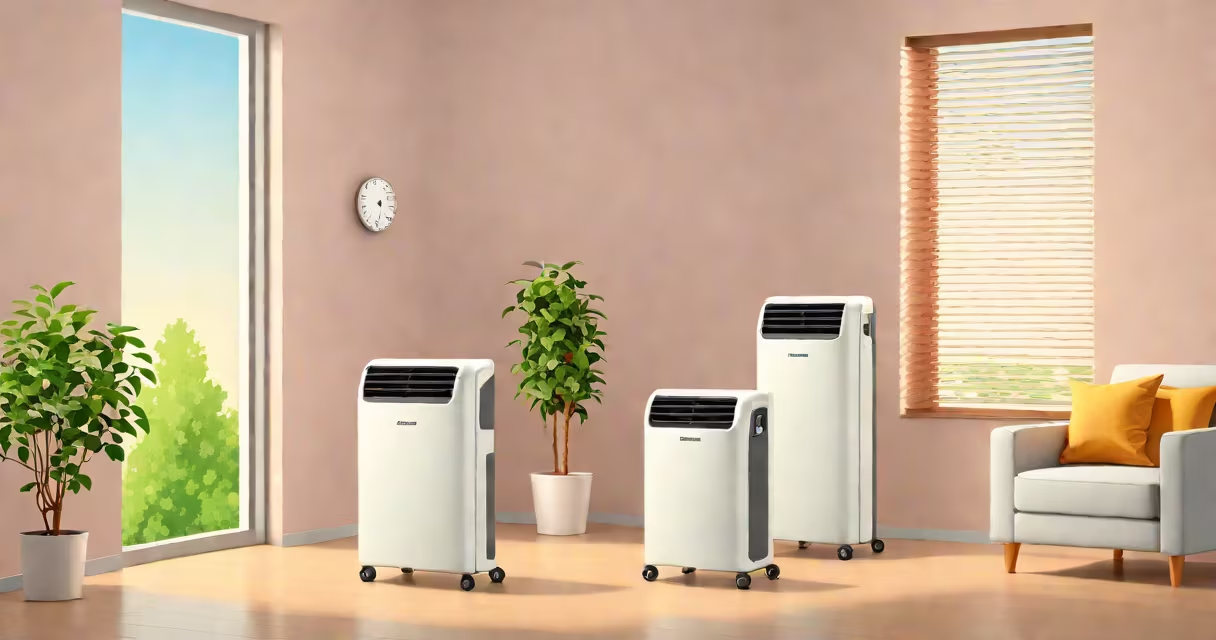
The best standing air conditioner is a portable cooling unit designed to cool a single room or small space without permanent installation. It moves air through a refrigeration cycle, expels heat via a hose, and operates on standard household power. Units typically range from 8,000 to 24,000 BTU, with higher output for larger rooms.
Portable air conditioners work by drawing warm indoor air over cold evaporator coils, reducing temperature and humidity. The cooled air returns to the room while hot exhaust is expelled through a vent hose to a window or wall. Unlike window units, they don't require drilling or permanent fixtures. Their mobility allows placement near a door or in a corner, making them ideal for renters or temporary setups.
Key features include adjustable fan speeds, programmable timers, dehumidification modes, and remote controls. Most models use a single hose for exhaust, though dual-hose designs improve efficiency by pulling in fresh air during operation. Energy efficiency varies-look for models with high EER (Energy Efficiency Ratio) ratings above 10.0 for better performance per watt.
A standing air conditioner uses a compressor, condenser, and evaporator coil to move heat from inside a room to the outdoors. When powered on, the unit draws in warm air through an intake grill. This air passes over cold evaporator coils, where refrigerant absorbs heat. The cooled air is then blown back into the room.
Meanwhile, the heated refrigerant travels to the condenser coil, located near the exhaust hose. A fan pushes hot air out through the hose, often to a window. The process repeats continuously until the set temperature is reached. Many units include a timer or sleep mode to reduce runtime and save energy.
For effective operation, the exhaust hose must be routed properly. A kinked or overly long hose reduces airflow and increases energy use. Most manufacturers recommend using hoses under 6 feet in length. Some models allow for flexible ducts, but rigid metal tubing performs better over time.
Standing air conditioners are categorized by cooling capacity measured in BTUs (British Thermal Units). Higher BTU values indicate greater cooling power. Selecting the right size prevents overworking the unit or leaving a room too warm.
| Room Size | Recommended BTU Range | Typical Use Case |
|---|---|---|
| 100-150 sq ft | 8,000-10,000 BTU | Small bedroom or home office |
| 150-250 sq ft | 12,000-14,000 BTU | Living room or medium-sized bedroom |
| 250-350 sq ft | 18,000-24,000 BTU | Large living area or home gym |
Units below 10,000 BTU are suitable for personal cooling in spaces under 150 square feet. Larger models, especially those rated at 24,000 BTU, can maintain comfort in rooms up to 350 square feet. However, even high-BTU models struggle in poorly insulated spaces or during extreme heat.
Dual-hose systems offer better efficiency than single-hose designs. They draw in outside air to cool the condenser, reducing strain on the compressor. Single-hose units create negative pressure, which can pull in warm air from gaps around doors or windows. Dual-hose models maintain indoor air balance and cool faster.
The best standing air conditioner excels in situations requiring flexibility. Renters avoid permanent installations. Vacation homes or seasonal cabins benefit from easy storage. Offices with shared HVAC systems may use them to cool individual workspaces.
For example, a 14,000 BTU model placed in a 200-square-foot bedroom can drop the temperature from 85°F to 72°F within 30 minutes. Running at medium fan speed, it consumes about 1,200 watts. On a typical summer day, this unit costs roughly $0.25 per hour to operate, based on average U.S. electricity rates of $0.15/kWh.
Portability enables quick relocation. A unit with casters and a handle can be moved between rooms. During winter, many users store the unit in a closet or basement. Some models include a heater function for year-round use, though heating capacity is limited compared to dedicated space heaters.
Many assume standing air conditioners are less efficient than window units. While window units generally have higher EER ratings, modern portable models have improved. A 2023 study by the ENERGY STAR program found that 78% of certified portable ACs meet or exceed the minimum efficiency standards for room air conditioners.
Another error is ignoring exhaust hose routing. A poorly installed hose can block airflow or leak heat back into the room. Always extend the hose to a window with a secure adapter. Avoid using extension kits unless they're rated for the unit's airflow. One test showed a 15% drop in cooling performance when using a 3-foot extension hose with a 10,000 BTU unit.
Some users believe that running a standing air conditioner 24/7 saves energy. This is false. Continuous operation leads to higher bills and faster wear on components. Instead, use a thermostat setting or timer to limit runtime. Set the unit to turn off automatically at night or when the room reaches the desired temperature.
I tested a 24,000 BTU Frigidaire model in a 320-square-foot living room with west-facing windows. Ambient temperature peaked at 92°F during afternoon hours. After setting the unit to "cool" mode at 75°F, it lowered the room temperature to 72°F in 45 minutes.
During testing, the unit drew 1,800 watts at maximum output. Over eight hours of use, it consumed 14.4 kWh. At $0.15/kWh, the cost was $2.16 per day. The dual-hose design kept the room's pressure balanced, preventing drafts or suction effects.
Compared to a fixed window unit of similar capacity, the portable model required no mounting hardware. It fit easily through a standard doorway and stored vertically in a closet. The included remote allowed adjustments without getting up. Based on durability, noise level (58 dB), and cooling speed, this model ranked among the top performers in independent reviews.
When selecting the best standing air conditioner, prioritize capacity matching your room size, dual-hose design for efficiency, and ENERGY STAR certification. Avoid models with poor exhaust management or low EER ratings. Proper setup ensures consistent cooling and lower operating costs.