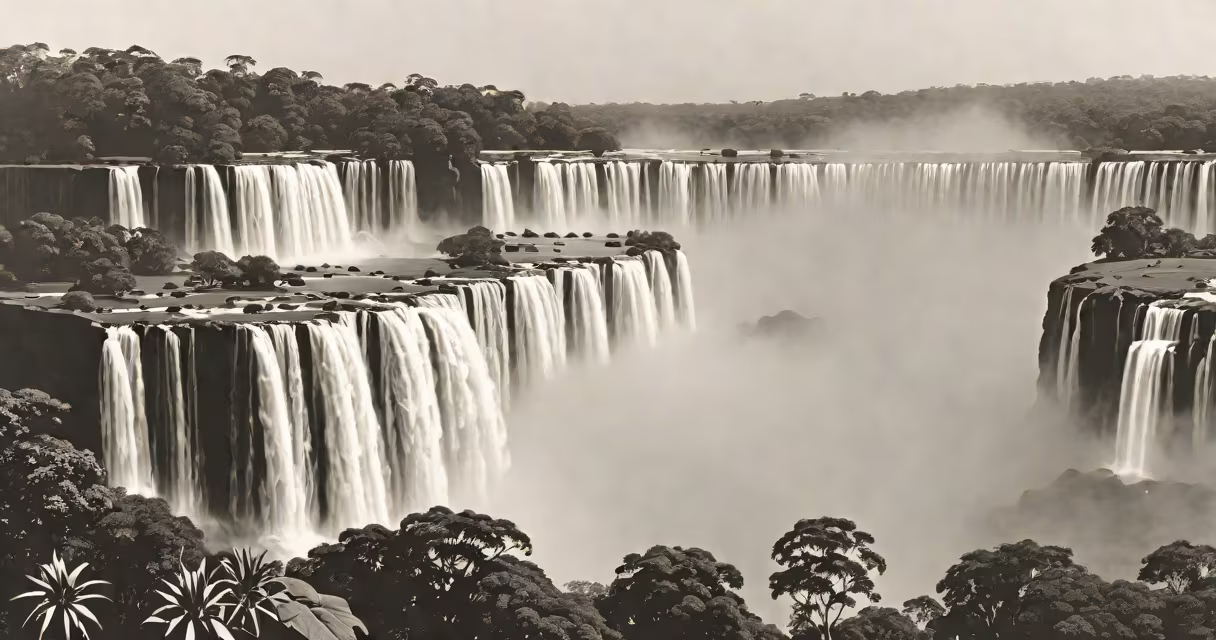
Cataratas del Iguazú is a system of 275 waterfalls straddling the border between Argentina and Brazil, formed by the Iguazú River as it plunges over a basalt plateau. The largest cascade, Garganta del Diablo, drops 82 meters and generates enough mist to create rainbows visible year-round.
The falls lie within a protected biosphere reserve shared by both nations. The river flows through a narrow canyon before splitting into multiple channels, each carving its own path through the rock. The most dramatic section, known as the Devil's Throat, forms a U-shaped chasm where water crashes into a deep pool below.
Visitors access the site via separate national parks: Parque Nacional Iguazú in Argentina and Parque Nacional do Iguaçu in Brazil. The Argentine side offers elevated walkways that bring tourists within meters of the falling water. The Brazilian side provides panoramic views from above the falls, especially effective during dry months when the flow is concentrated.
Geological forces shaped Cataratas del Iguazú over 10 million years. The region sits atop a basalt plateau formed by ancient volcanic activity. As the Iguazú River flowed across this hard rock layer, erosion carved out the current network of channels and basins.
Each waterfall erodes the underlying rock at different rates due to variations in water volume and rock composition. This uneven wear causes the falls to retreat slowly upstream-about 1 meter every 100 years. Over time, this process has reshaped the entire field.
Hydrological data from Argentina's National Institute of Meteorology shows average flow rates of 1,600 cubic meters per second during peak season (December-March), dropping to 400 m³/s in the dry season (June-August).
Two distinct park systems offer different perspectives on the falls:
| Location | Viewpoint Type | Key Features | Best For |
|---|---|---|---|
| Argentina (Parque Nacional Iguazú) | Ground-level walkways | 360° paths, close-up views, suspension bridges, mist exposure | Immersive experience, photography, sensory engagement |
| Brazil (Parque Nacional do Iguaçu) | High-altitude viewing platforms | Overhead vantage points, wide-angle shots, fewer crowds | Photography, panoramic framing, less physical exertion |
A single ticket allows entry to both parks, though the routes are separate. Most travelers begin on the Argentine side, where the walkways descend into the jungle canopy near the base of the falls.
During peak tourist season (July-October), visitor numbers exceed 10,000 daily. The Argentine park uses timed entry slots to manage congestion. In contrast, the Brazilian park relies on a shuttle system that transports visitors from the entrance to the main viewing area.
Many assume Cataratas del Iguazú is a single waterfall. In reality, it's a complex system of interconnected cascades. The name "Iguazú" comes from the Guarani word "Yguazú," meaning "great water."
Another misconception is that the falls are entirely natural. While the core structure is geological, human intervention plays a role. The Argentine government maintains over 12 kilometers of boardwalks and safety barriers. The Brazilian park uses solar-powered lighting along its trails.
Some travelers confuse Cataratas del Iguazú with Victoria Falls in Africa. Though both are large, Victoria Falls averages 170 meters in width and 108 meters in height-nearly twice the height of Garganta del Diablo-but covers less total surface area.
I visited the Argentine side in late September 2022. The air was thick with moisture, and the sound of rushing water vibrated through my chest. A bridge suspended 30 meters above the river offered a clear view of the Devil's Throat. At that moment, 120 tons of water passed per second. I felt the spray on my face even through a light raincoat.
On the Brazilian side, I stood on a platform 70 meters above the main drop. From there, the full arc of the falls stretched across the horizon. The difference in perspective was striking-the Argentine view emphasized scale and proximity; the Brazilian view highlighted form and symmetry.
Cataratas del Iguazú is recognized by UNESCO as a World Heritage Site under criteria (vii) and (x): it represents a natural phenomenon of outstanding universal value and supports strong biodiversity. The surrounding forests host over 400 bird species, including the harpy eagle and the red-and-green macaw.
According to the World Tourism Organization, Cataratas del Iguazú attracts approximately 2.1 million international visitors annually. Argentina's Ministry of Culture reports that 68% of visitors cite the falls as their primary reason for traveling to the country.
Environmental monitoring shows that deforestation in the surrounding region has reduced water retention capacity. In response, both countries have implemented reforestation programs targeting native species like the quebracho tree. These efforts aim to preserve the hydrological balance that sustains the falls.
Cataratas del Iguazú remains one of Earth's most useful displays of natural force and beauty. Its dual presence across national borders underscores the shared responsibility to protect such sites for future generations.