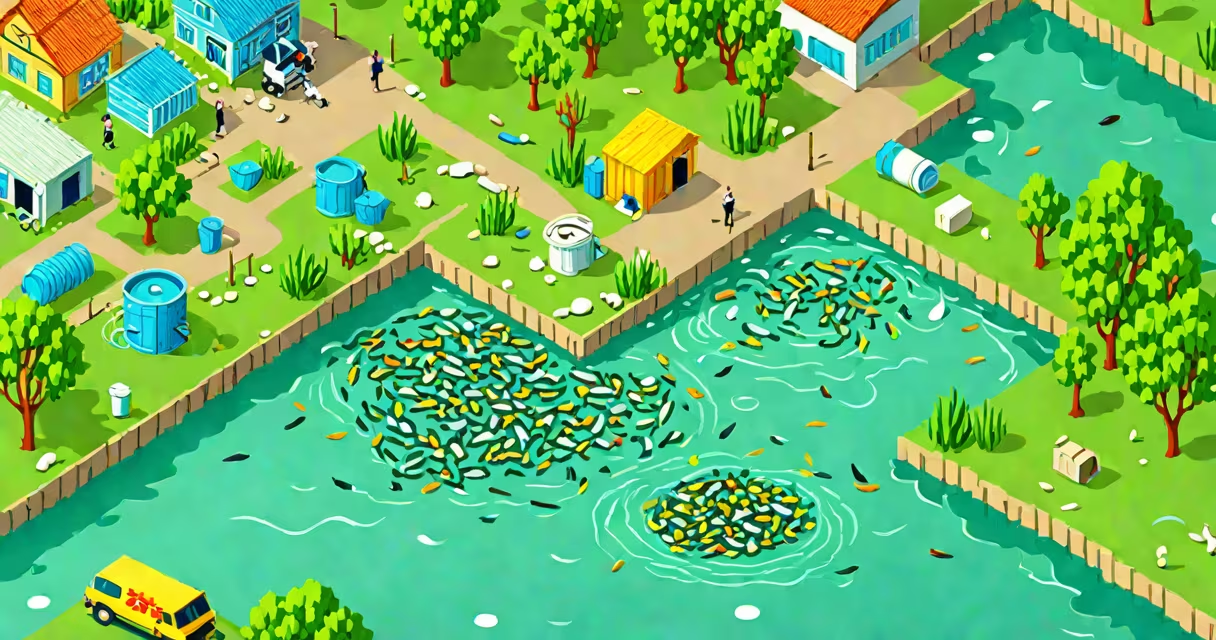
Garbage in water pollution refers to solid waste-especially plastics, chemicals, and untreated sewage-that enters aquatic environments, degrading water quality and harming ecosystems. This contamination arises from urban runoff, industrial discharges, and improper disposal of household and agricultural waste.
When garbage enters rivers, lakes, or oceans, it doesn't vanish. Instead, it persists for decades, breaking into microplastics that infiltrate food chains. The United Nations Environment Programme reports that 14 million tons of plastic enter oceans annually, with 8 million originating from land-based sources.
Plastic waste accounts for over 80% of marine litter, according to the UNEP. Items like bottles, bags, and fishing nets accumulate in ocean gyres-vast swirling currents where debris concentrates. The Great Pacific Garbage Patch, spanning an area twice the size of Texas, contains an estimated 1.8 trillion pieces of plastic.
Waste enters water systems through direct dumping, stormwater runoff, and accidental spills. Rainfall washes debris from streets into storm drains, which often empty directly into rivers or coastal zones. Industrial facilities may discharge effluents containing heavy metals, solvents, and synthetic compounds without adequate treatment.
Once in water, garbage undergoes physical and chemical changes. Plastics fragment under UV radiation and wave action, forming microplastics smaller than 5 millimeters. These particles absorb toxins like PCBs and DDT from surrounding water, then enter organisms that ingest them. A 2021 study in *Environmental Science & Technology* found microplastics in 94% of tested fish species in commercial markets.
Biological processes further degrade water quality. Organic waste such as food scraps and sewage fuels bacterial growth, consuming oxygen in the process. This leads to hypoxia-low-oxygen conditions-where fish and other aquatic life suffocate. Dead zones, like the one in the Gulf of Mexico covering 6,000 square miles, result from nutrient-rich runoff causing algal blooms.
Different waste streams contribute uniquely to water contamination. The table below outlines major categories, their sources, and environmental impacts.
| Type | Common Sources | Environmental Impact |
|---|---|---|
| Plastic debris | Single-use packaging, fishing gear, synthetic textiles | Entanglement, ingestion by wildlife; microplastic accumulation |
| Industrial effluent | Chemical plants, textile factories, metal refineries | Heavy metal contamination (lead, mercury); toxic sludge |
| Sewage and greywater | Urban drainage, septic systems, wastewater treatment failures | Nutrient overload; pathogen spread; eutrophication |
| Agricultural runoff | Fertilizers, pesticides, animal waste from feedlots | Nitrates and phosphates trigger algal blooms; groundwater contamination |
One overlooked contributor is tire wear particles. A 2023 study published in *Nature Communications* found that tires shed up to 1.5 grams of rubber per kilometer driven. These particles wash into storm drains and persist in sediments, releasing harmful chemicals like zinc and polycyclic aromatic hydrocarbons (PAHs).
High-density urban areas and industrial zones show the highest levels of garbage in water pollution. Cities like Jakarta, Manila, and Lagos report severe river contamination due to inadequate waste collection and treatment infrastructure. In Jakarta, the Ciliwung River carries over 100 tons of garbage daily, much of it plastic and organic waste.
Developing nations face disproportionate challenges. According to the World Bank, 90% of wastewater in low-income countries flows untreated into waterways. In contrast, high-income nations have stricter regulations but still struggle with legacy pollution. The U.S. Environmental Protection Agency estimates that 40% of monitored water bodies fail to meet clean water standards due to persistent contaminants.
Even remote regions aren't immune. Microplastics have been detected in Arctic ice cores and deep-sea sediments. A 2022 study in *Science Advances* identified microplastics in 90% of samples taken from the Mariana Trench, the deepest known oceanic trench.
Many assume that "biodegradable" materials dissolve harmlessly in water. But bioplastics-often labeled as eco-friendly-require specific industrial composting conditions to break down. In natural water environments, they degrade slowly and still release microplastics. A 2020 study in *Environmental Pollution* showed that bioplastic bags took over 18 months to decompose in seawater, with significant leaching of additives.
Another myth is that recycling eliminates pollution risk. While recycling reduces landfill waste, only 9% of all plastic ever produced has been recycled globally. The rest ends up in landfills, incinerators, or the environment. Even recycled plastic can shed microfibers during washing, contributing to water pollution.
Garbage in water pollution isn't limited to visible trash. Invisible pollutants-like pharmaceutical residues, flame retardants, and per- and polyfluoroalkyl substances (PFAS)-enter water via sewage and industrial outflows. PFAS, known as "forever chemicals," resist degradation and have been found in drinking water supplies across 46 U.S. states.
The Ganges River in India receives approximately 1.5 billion liters of untreated sewage daily. Along its 2,500-kilometer course, millions of people bathe, wash clothes, and dispose of waste directly into the river. Religious rituals involve burning offerings, which release ash and unburned material into the water.
Testing by the Indian Institute of Technology Delhi revealed fecal coliform levels exceeding 100,000 colony-forming units per 100 mL-over 1,000 times the safe limit. Plastic waste includes sachets, wrappers, and bottles. A 2021 survey found 200 pieces of plastic per meter of riverbank sampled.
Despite government cleanup efforts like the Namami Gange Project, progress remains slow. The project's 2023 annual report noted that only 40% of planned sewage treatment plants were operational. Without systemic infrastructure upgrades, garbage in water pollution will continue to degrade the river's health.
Garbage in water pollution is not a single issue-it's a complex web of human activity, infrastructure failure, and ecological consequence. Addressing it requires regulation, innovation, and public awareness. Prevention begins with reducing waste at source, improving treatment systems, and enforcing accountability.