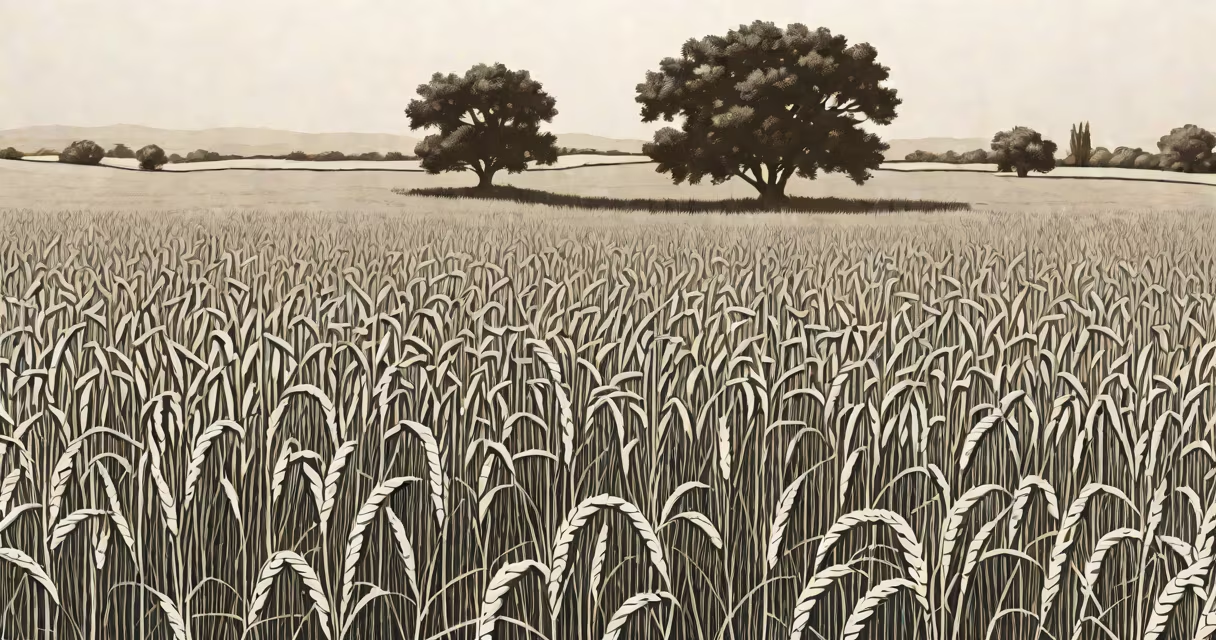
The glean definition in the Bible refers to the act of leaving unharvested portions of crops-specifically the corners of fields and fallen stalks-for the poor, widows, and foreigners, as commanded in Leviticus 19:9-10. This practice was both a legal obligation and a moral imperative within ancient Israelite society.
Gleaning was not charity in the modern sense. It was a structured system embedded in agricultural law. Farmers were required to leave behind part of their harvest rather than collect every last grain. The command appears in Leviticus 19:9-10: "When you reap the harvest of your land, do not reap to the very edges of your field or gather the gleanings of your harvest. Do not go over your vineyard a second time or pick up the fallen grapes. Leave them for the poor and the foreigner."
This directive applied to both grain fields and vineyards. In Deuteronomy 24:19-22, the instruction expands: "When you harvest your crops in the field, and forget a sheaf in the field, do not go back to get it. Leave it for the foreigner, the fatherless, and the widow." The repetition across books shows this was not a suggestion-it was a covenant-based requirement tied to Israel's identity as a people set apart.
Landowners did not manually sort out leftover grain. Instead, they harvested their fields completely, then left the edges and remnants untouched. The poor, widows, and strangers were permitted to enter the fields after the official harvest to collect what remained. This created a predictable, low-risk way for vulnerable people to access food.
For example, in the Book of Ruth, Ruth, a Moabite widow, goes to glean in Boaz's field. She is not begging. She is legally entitled to enter the field and collect fallen ears of grain. Boaz notices her and ensures she is protected and given extra food. His actions reflect the spirit of the law-not just compliance, but care.
Ruth 2:2 states: "She went to the field and began to glean behind the reapers." The term "glean" here is the Hebrew word *qalal* (קָלַל), which means "to gather what is left." It is not about picking through piles-it's about collecting what was intentionally left behind.
Gleaning applied to multiple crop types and stages. The most common forms included:
| Type | What Was Left | Biblical Source |
|---|---|---|
| Field corners | Unharvested edges of grain fields | Leviticus 19:9-10 |
| Fallen stalks | Grain dropped during harvesting | Deuteronomy 24:19 |
| Leftover clusters | Unpicked grapes in vineyards | Leviticus 19:10 |
| Forgotten sheaves | Sheaves accidentally left behind | Deuteronomy 24:19 |
These categories show that gleaning wasn't limited to one moment or one crop. It spanned the entire harvest cycle. The law assumed that even skilled laborers would drop grain or miss a few stalks-those were not lost, but designated for others.
Gleaning was not just about feeding the hungry. It reinforced social cohesion and spiritual accountability. The land belonged to God, not the individual. By leaving part of the harvest, owners acknowledged divine ownership and shared stewardship.
Leviticus 25:23 states: "The land is mine, and you are but aliens and tenants." This verse frames land use as temporary trust, not permanent possession. Gleaning was a daily reminder that wealth came from God and should serve others.
A lesser-known fact: gleaning was not optional for the poor. They had rights. If a landowner tried to restrict access, it was considered theft under Mosaic law. The poor weren't passive recipients-they were beneficiaries of a system designed to protect them.
Many assume gleaning was a form of voluntary giving or religious ritual. It was neither. It was a binding legal obligation. Failure to comply carried consequences under the covenant. The poor were not being pitied-they were being empowered.
Another error is thinking gleaning only applied to grain. It extended to fruit, wine, and even livestock. In Numbers 18:21-24, priests received portions of offerings, but the rest of the tithe was passed to Levites, who then gave to the poor. Gleaning was part of a larger redistribution system.
Some confuse it with almsgiving in later Judaism or Christianity. While both emphasize helping the poor, biblical gleaning was distinct: it was not based on personal generosity, but on collective responsibility. You didn't give because you wanted to-you gave because you were commanded.
Today, the glean definition in the Bible offers a model for economic justice. Organizations like the Food Bank of Central New York run "gleaning programs" that send volunteers to farms to collect surplus produce. These efforts mirror the ancient practice-though modern systems lack the legal force of Levitical law.
In my own experience, I visited a community garden in rural Ohio where farmers agreed to leave 10% of their harvest for local food pantries. The program reduced waste and increased access. One woman told me, "I've never had fresh kale in winter until this." That moment echoed Ruth's story-food not as charity, but as justice.
When we read "glean" in the Bible, we often skip past the legal weight. But the term carries moral authority. It's not about what we give-it's about what we're required to leave behind.