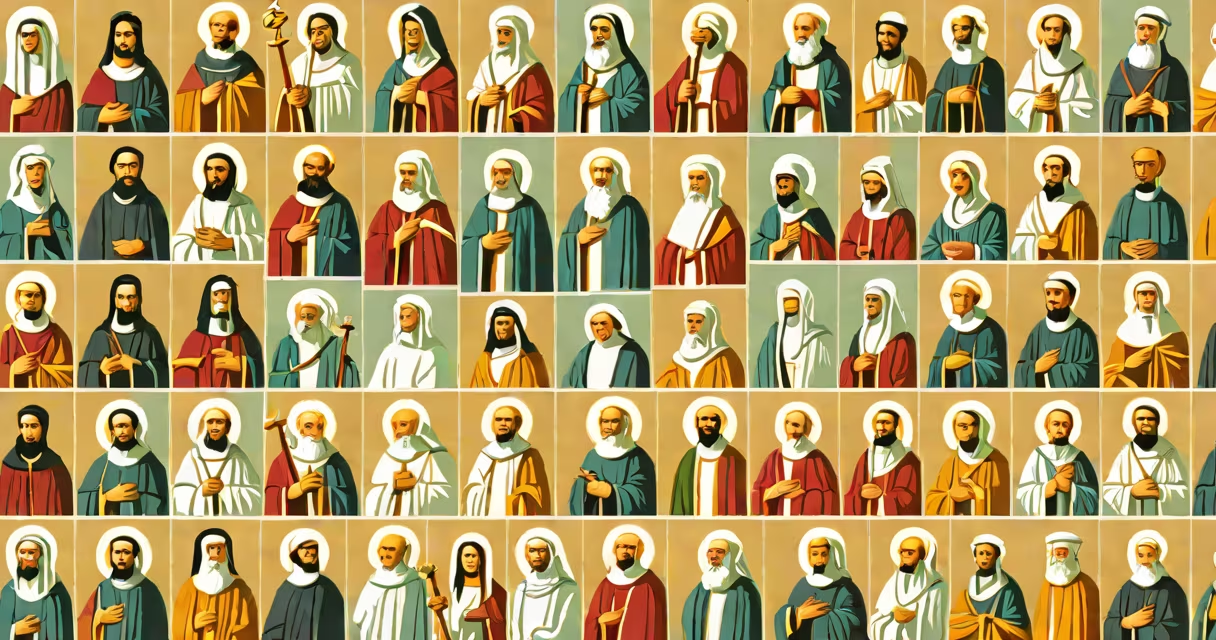
The list of Catholic saints comprises individuals formally recognized by the Roman Catholic Church for living lives of strong virtue and holiness, with formal canonization occurring through a multi-step process involving investigation, miracles, and papal approval.
Catholic saints are not chosen based on popularity or personal devotion. The Church requires documented evidence of heroic virtue, often spanning decades, and at least one verified miracle attributed to the intercession of the candidate after death. This process helps only those who lived exemplary lives and whose prayers have demonstrably affected others are included in the official list.
For example, Saint Teresa of Calcutta (Mother Teresa) was beatified in 2003 and canonized in 2016. Her beatification required proof of a miracle-specifically, the healing of a Brazilian woman from a rare abdominal condition after prayer to her. The miracle was validated by medical panels and theologians before being approved by Pope Francis. Only then was she officially declared a saint.
Canonization begins with a local bishop opening an investigation into a person's life. This includes gathering testimonies, reviewing writings, and examining moral conduct. If the findings support further action, the cause is sent to the Dicastery for the Causes of Saints in Rome.
The Dicastery evaluates the candidate's life against Church teachings. If the person is deemed to have lived with heroic virtue, they are titled "Venerable." The next step-beatification-requires one verified miracle. After beatification, the individual is called "Blessed." Final canonization requires a second miracle, confirmed by the Church's medical and theological experts.
Since 1983, the current Code of Canon Law has standardized this process. Before that, many saints were proclaimed through popular acclaim or royal decree. Today, the Church maintains strict criteria to prevent error and ensure credibility.
Saints are grouped by role, time period, and recognition level. The most common categories include:
| Type | Description | Examples |
|---|---|---|
| Ordinary saints | Formally canonized by the Pope. Recognized globally. | St. Francis of Assisi, St. Augustine, St. John Paul II |
| Blessed (Beatified) | Declared "Blessed" after one miracle. Not yet canonized. | St. Maximilian Kolbe, St. Oscar Romero |
| Venerable | Recognized for heroic virtue. Miracle pending. | St. John Henry Newman, St. Elizabeth Ann Seton |
| Patron saints | Assigned to protect specific groups, places, or causes. | St. Joseph (families), St. Anthony (lost items), St. Jude (hopeless cases) |
Some saints are known primarily through tradition rather than formal documentation. For instance, Saint Nicholas-historical basis for Santa Claus-was never formally canonized by the modern Church but is widely venerated due to his reputation for generosity and charity.
Many assume saints are only those who died long ago. In reality, the Church continues to canonize people in modern times. Pope John Paul II canonized 482 saints during his pontificate (1978-2005), including several from Africa and Asia. This reflects the global nature of the Church's recognition.
Another myth is that saints are always perfect. The Church recognizes saints not for sinlessness but for repentance, transformation, and enduring commitment to Christian values. Saint Mary Magdalene, once described as a sinner, is now honored as a model of penance and devotion.
A lesser-known fact: the Church does not recognize saints based on religious affiliation. A person must have lived a life consistent with Catholic doctrine. Non-Catholics cannot be canonized, even if they exhibit notable virtue. The Church emphasizes doctrinal alignment over personal merit alone.
The official list of Catholic saints is maintained by the Vatican's Dicastery for the Causes of Saints. It is updated annually and published in the Annuario Pontificio, the official directory of the Church. The list is used in liturgical calendars, church services, and religious education.
Each day of the year is associated with one or more saints. For example, June 29 is the feast day of Saints Peter and Paul. Parishes around the world celebrate this day with Masses, processions, and special prayers. The calendar helps saints remain part of daily spiritual life, not just historical memory.
I once attended a parish Mass in rural Italy where the priest referenced Saint Lucy-patron of sight-during a service for the visually impaired. The connection between her story (martyred for refusing to renounce Christianity, reportedly losing her eyes) and the community's needs made the list of Catholic saints feel immediate and relevant, not distant or abstract.
The list of Catholic saints is not a complete record of all holy people. The Church does not claim to know every virtuous individual who has lived. Many faithful are believed to be in heaven but not formally recognized. These are referred to as "anonymous saints" or "unknown saints."
Also, the list is not interchangeable with other religious traditions. While Protestant churches may honor biblical figures or reformers, they do not canonize saints in the Catholic sense. The Catholic Church's process is unique in its structure, authority, and sacramental significance.
Finally, the list is not static. New causes are opened regularly. As of 2023, over 1,000 individuals were under investigation for possible sainthood. Among them: Sister Josemaría Escrivá, founder of Opus Dei, and Father Damien of Molokai, who served lepers in Hawaii. Their cases reflect ongoing efforts to identify holiness in modern contexts.
One critical distinction often missed: canonization does not make someone divine. Saints are human beings who lived in relationship with God. They are not worshipped-they are venerated. Catholics pray to saints, asking for their intercession, not worshiping them as gods.
According to the Catechism of the Catholic Church (paragraph 2674), "The saints have already entered the glory of heaven, and they are our intercessors before God." This reflects the belief that saints continue to participate in God's work through prayer.
Another fact: the Church does not allow the canonization of anyone still alive. Even if a person is widely admired, such as a public figure or political leader, they cannot be declared a saint until after death. This rule preserves the integrity of the process and prevents politicization.
For comparison, the term "saint" in everyday language often refers to someone exceptionally kind or generous. But in Catholic theology, it denotes a specific legal and spiritual status conferred by the Church. A person may be called "a saint" informally-but only those on the official list are considered saints in Church law.
Understanding the list of Catholic saints involves recognizing both the rigor of the selection process and the enduring role of these figures in spiritual life. The Church maintains a clear standard: holiness must be proven, not assumed.