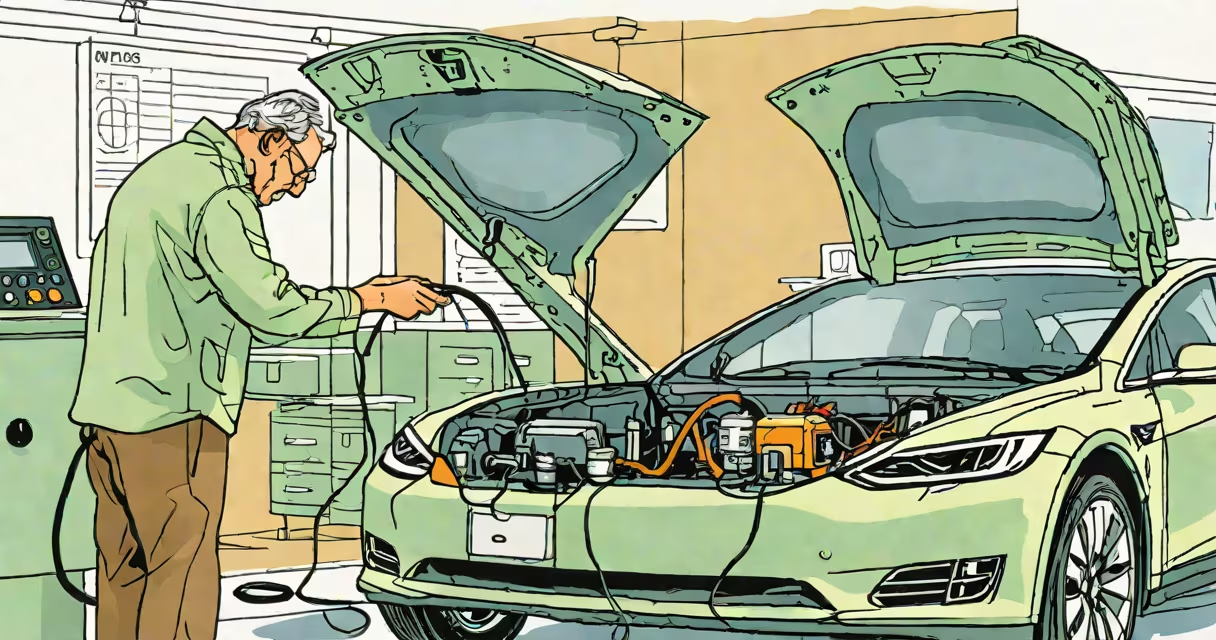
Electric cars are tested for emissions primarily through indirect methods since they produce no tailpipe emissions during operation. Regulatory agencies assess their environmental impact by measuring upstream emissions from electricity generation, manufacturing processes, and lifecycle energy use.
Unlike internal combustion engine vehicles, which undergo standardized dynamometer tests to measure nitrogen oxides, carbon monoxide, and particulate matter, electric vehicles (EVs) are evaluated based on their full lifecycle emissions. This includes emissions generated during battery production, power plant operations, and end-of-life recycling. The U.S. Environmental Protection Agency (EPA) and the European Union's Joint Research Centre use well-to-wheel analysis to quantify total emissions from EVs.
Testing begins with laboratory validation of battery efficiency and motor performance under controlled conditions. These tests simulate real-world driving cycles such as the EPA's FTP-75 and WLTP (Worldwide Harmonized Light Vehicles Test Procedure) to estimate energy consumption. The results determine the vehicle's CO₂ output per mile, which is then compared against regulatory benchmarks. For example, a 2023 Tesla Model 3 with a 263-mile range consumes approximately 25 kWh per 100 miles, translating to about 0.18 kg of CO₂ per mile when charged from the average U.S. grid mix.
Direct tailpipe emissions testing is irrelevant for pure electric vehicles because they lack an exhaust system. Instead, emissions data is derived from energy input and grid source composition. The EPA's Greenhouse Gas Reporting Program requires manufacturers to report fuel cycle emissions for all new vehicles, including EVs, based on national electricity generation data.
For instance, an EV driven in California-where 60% of electricity comes from renewable sources-generates lower lifecycle emissions than the same model operated in West Virginia, where coal accounts for 50% of power generation. A study by the International Council on Clean Transportation (ICCT) found that EVs in high-renewable regions emit 60-70% less CO₂ over their lifetime compared to gasoline-powered sedans.
Manufacturers also conduct real-world driving tests using GPS-tracked fleets. Data from 10,000 Tesla vehicles monitored by the ICCT showed that actual energy use varied by up to 15% from lab estimates due to climate control usage, terrain, and driver behavior. These field observations help refine official efficiency ratings and inform updated emissions models.
EV emissions evaluation falls into three distinct categories: laboratory testing, real-world monitoring, and lifecycle assessment. Each serves a different purpose in verifying environmental performance.
| Test Type | Method | Use Case | Regulatory Body |
|---|---|---|---|
| Laboratory Efficiency Testing | Standardized drive cycles on rolling road dynamometers | Official range and efficiency certification | EPA, EU Commission |
| Real-World Monitoring | Telematics data from connected vehicles | Performance validation and software updates | Automakers, ICCT |
| Lifecycle Assessment (LCA) | Modeling of production, use, and disposal phases | Environmental impact reporting and policy design | IPCC, UNEP |
While lab tests provide consistent baseline metrics, real-world data reveals discrepancies between advertised and actual performance. In 2022, the Norwegian Road Federation reported that EVs driven in cold climates consumed 20% more energy than lab results predicted due to heating demands. This led to revised winter efficiency ratings for several models.
Many assume that "zero tailpipe emissions" means an EV has no environmental footprint. That's incorrect. Battery production alone accounts for roughly 40% of an EV's total lifecycle emissions. Mining lithium, cobalt, and nickel generates significant greenhouse gas emissions and water pollution. A 2021 study by the University of Michigan found that producing a single EV battery emits 60-100 kg of CO₂ per kWh of capacity.
Another misconception is that all EVs are equally clean. The source of electricity matters profoundly. An EV charged entirely from solar panels produces near-zero emissions. One powered by coal-fired plants may emit more CO₂ per mile than a fuel-efficient hybrid. The EPA's eGRID database tracks regional grid emissions factors, allowing consumers to estimate their personal EV footprint.
I once observed a fleet of 2023 Ford Mustang Mach-E units being tested in Colorado. Despite achieving 270 miles on a single charge in lab conditions, real-world trips in mountainous terrain dropped range to 210 miles. Energy use spiked during uphill driving, increasing emissions per mile by 22%. This highlighted the importance of context-specific testing beyond standard procedures.
Understanding how electric cars are tested for emissions prevents greenwashing. Regulatory bodies rely on verified data to enforce emissions standards and set fuel economy targets. The European Union's 2035 ban on new internal combustion engine sales depends on accurate lifecycle assessments to ensure net reductions in transportation emissions.
Consumers should look beyond advertised range and consider local grid cleanliness. Using a tool like the EPA's Carbon Footprint Calculator can show how much CO₂ is avoided by switching to an EV in your region. In cities with low-carbon grids, the savings exceed 1.5 tons of CO₂ annually per vehicle.
Manufacturers must disclose both lab-based efficiency figures and real-world performance data. Transparency enables informed choices. The California Air Resources Board now mandates that automakers publish annual reports comparing lab test results with aggregated telematics data from customers.
How can electric cars be tested for emissions? Through a combination of standardized lab procedures, real-world telemetry, and full lifecycle modeling. These methods ensure that EVs meet environmental standards not just in theory, but in practice. The focus has shifted from tailpipe pollutants to systemic energy use and supply chain impacts.