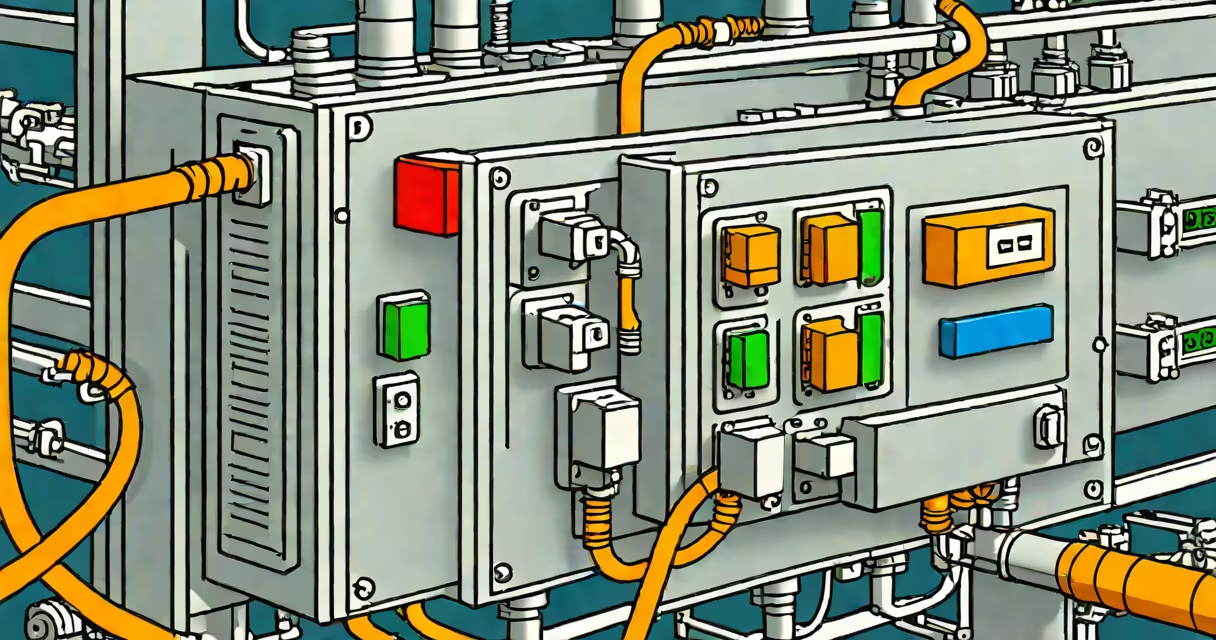
An industrial ethernet connector is a ruggedized, shielded electrical interface engineered to maintain reliable data transmission in demanding environments such as factories, oil rigs, and outdoor infrastructure. Unlike standard RJ45 connectors, it resists vibration, dust, moisture, and extreme temperatures while supporting high-speed Ethernet protocols like 10/100/1000 Mbps.
These connectors are built for continuous operation under stress. They feature metal housings, locking mechanisms, and sealed boots to prevent contamination. They're commonly used in machine-to-machine communication, PLC systems, and sensor networks where downtime is costly. The most common form is the M12 circular connector with a 4-pin or 8-pin configuration, though M8 and M23 variants exist for smaller or larger applications.
They differ from consumer-grade ethernet components. Standard wall jacks fail within months in dusty or wet conditions. Industrial versions meet IP67 or higher ratings, meaning they're dust-tight and can withstand temporary submersion. They also support shielded twisted-pair cables (STP) and often include grounding pins to reduce electromagnetic interference (EMI).
Industrial ethernet connectors transmit data using differential signaling over twisted pairs inside shielded cabling. The connector mates with a corresponding socket on a device-such as a PLC, camera, or I/O module-via a threaded coupling. This screw-lock mechanism prevents accidental disconnection during machine movement or maintenance.
Signal integrity relies on proper shielding and grounding. The connector's metal shell acts as a Faraday cage, blocking external EMI from motors, relays, or radio transmitters. Internal contacts are gold-plated for low resistance and long-term reliability. A keyway or pin alignment ensures correct orientation during mating, preventing damage from misinsertion.
For example, a Siemens S7-1500 PLC uses an M12 X-coded connector (Type D) to connect to a proximity sensor. The connector's 8-pin design supports both power and data over a single cable. When installed in a steel fabrication plant, it maintains a stable 1 Gbps link despite nearby welding arcs and ambient temperatures ranging from -25°C to +70°C.
Connectors are classified by size, pin count, coding, and environmental rating. The most widely adopted standard is IEC 61076-2-101, which defines dimensions and mating interfaces.
| Type | Pins | Coding | Common Use | IP Rating |
|---|---|---|---|---|
| M12 x4 | 4 | Code A (round) | Power and 100 Mbps Ethernet | IP67 |
| M12 x8 | 8 | Code D (square) | 1 Gbps Ethernet, PROFINET, EtherNet/IP | IP67 |
| M8 x4 | 4 | Code B (oval) | Low-voltage sensors, compact devices | IP65 |
| M23 x8 | 8 | Code C (hexagonal) | Heavy-duty machinery, mining equipment | IP68 |
Code refers to the physical keying pattern that prevents mismatched connections. Code D (square) is standard for 1 Gbps industrial ethernet. Using a Code A plug in a Code D socket causes mechanical failure and signal loss.
Field-installable models allow technicians to terminate cables on-site using crimp tools. These connectors accept stranded or solid conductors and include color-coded wiring diagrams. For example, a technician installing a Cat 6A cable to a robotic arm controller uses a field-installable M12 connector with a 4-pin configuration. After stripping 10 mm of insulation, they insert wires into designated terminals and secure them with a 5 N·m torque wrench.
Industries requiring uninterrupted connectivity rely on industrial ethernet connectors. Automotive assembly lines use them to link vision systems, grippers, and motion controllers. In wind turbines, they carry SCADA data from nacelle sensors to ground stations through harsh weather and constant vibration.
They're essential in process control systems where data latency must be below 1 ms. A chemical plant uses M12 connectors with shielded Cat 6 cables to connect pressure transducers to a distributed control system (DCS). The connectors' IP67 rating allows installation in areas exposed to coolant sprays and steam cleaning.
A common mistake is assuming all M12 connectors are interchangeable. A misaligned plug can bend pins or cause intermittent faults. Always verify the coding and pinout before installation. Some manufacturers label connectors with laser-etched codes and part numbers-e.g., Phoenix Contact 1750684-so replacements match exactly.
Many confuse industrial ethernet connectors with standard RJ45 jacks. While both carry Ethernet signals, RJ45 plugs lack locking features and are not rated for environmental exposure. An RJ45 jack in a server room works fine-but fails in a warehouse where forklifts pass nearby.
Another misconception is that higher pin counts always mean faster speeds. An 8-pin M12 connector supports 1 Gbps, but a 4-pin version can handle 100 Mbps. Speed depends on the protocol and cable quality, not just pin count. Using a 4-pin connector for a 1 Gbps application results in dropped packets and reduced throughput.
Also, not all industrial connectors are waterproof. IP65-rated M8 connectors resist splashing water but fail if submerged. Only IP67 or IP68 units survive immersion. A recent incident at a wastewater treatment facility involved a failed M8 connector due to improper selection-water ingress caused a control loop failure and a 12-hour shutdown.
One non-obvious fact: many industrial ethernet connectors are backward compatible with legacy protocols. A Type D M12 connector can carry Profinet, EtherNet/IP, and Modbus TCP over the same physical layer. This reduces cabling costs during system upgrades. The protocol is determined by software configuration, not hardware differences.
I once replaced a series of M12 connectors on a packaging line that had failed after six months. The original installers used standard RJ45 modules in a plastic enclosure. Vibration loosened the connections, causing intermittent network drops. Replacing them with IP67-rated M12 connectors resolved the issue. The new setup ran continuously for over two years without failure.
These connectors work with specific cabling and termination tools. Field-installable models require crimping pliers and wire strippers. For permanent installations, molded cables with pre-terminated connectors simplify deployment. Some designs integrate with DIN rail mounting systems for easy panel integration.
For panel-level connections, use modular connectors with multiple ports. These allow daisy-chaining of devices and reduce cable clutter. A control cabinet may house a single 16-port M12 block connector feeding five I/O modules and two HMIs.
Finally, verify that your chosen connector supports the required cable gauge. Most M12 connectors accept 22-26 AWG conductors. Using a thinner wire risks overheating and signal degradation. Always follow the manufacturer's specifications for current-carrying capacity and bending radius.
Understanding the role of an industrial ethernet connector is critical for building resilient automation systems. It's not just a cable adapter-it's a performance enabler in environments where failure is not an option.