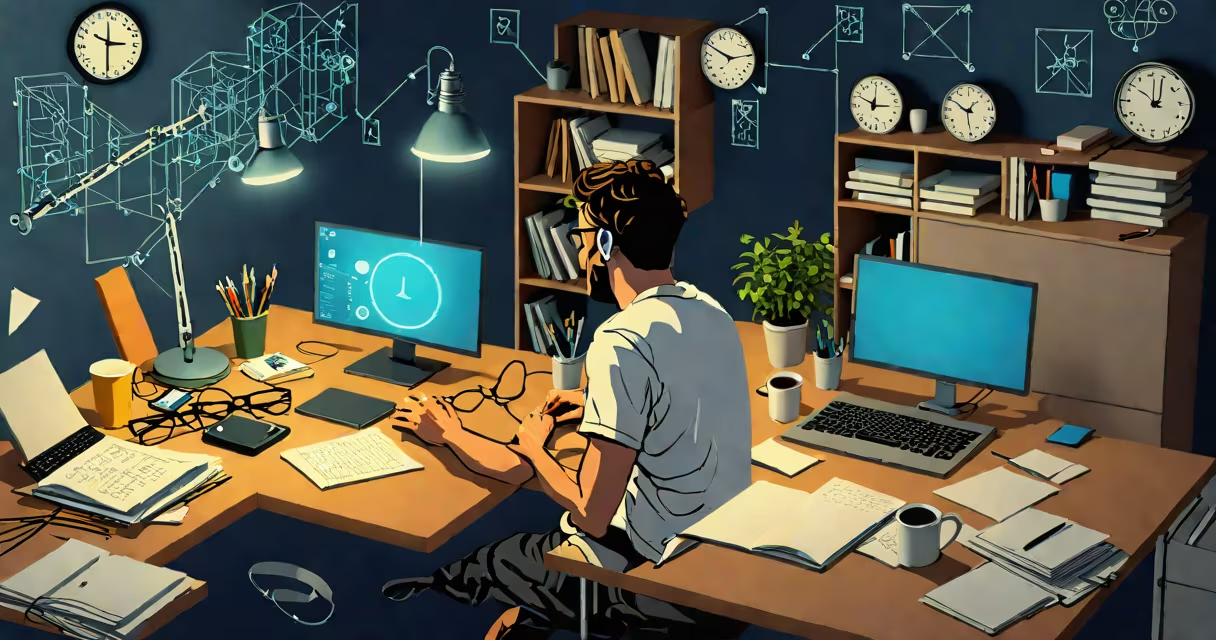
Inside the mind of a procrastinator is a changing space where emotional avoidance, distorted time perception, and fear of failure override rational planning. This state isn't laziness-it's a pattern of decision-making shaped by cognitive biases, emotional regulation challenges, and neural responses to perceived threat. The core issue isn't lack of time or effort, but a misalignment between immediate emotional safety and long-term goals.
Procrastination occurs when the brain prioritizes short-term relief from discomfort over long-term rewards. A student avoids writing a paper not because they don't care about grades, but because the thought of drafting, editing, and facing potential criticism triggers anxiety. That anxiety activates the amygdala-the brain's threat detector-shifting control from the prefrontal cortex, responsible for planning and focus, to survival-mode circuits. The result: task avoidance becomes automatic.
Neuroimaging studies show that people who chronically procrastinate exhibit heightened activity in the limbic system during task initiation, especially when the task involves evaluation or uncertainty. This response mirrors the brain's reaction to physical pain. A 2019 fMRI study published in Frontiers in Human Neuroscience found that individuals with high procrastination scores showed increased activation in the anterior cingulate cortex-a region linked to conflict monitoring-when presented with upcoming tasks requiring sustained attention.
Procrastination isn't a single behavior. It's a cascade of mental processes triggered by emotional discomfort. The cycle begins with a task that feels threatening-whether due to complexity, ambiguity, or fear of judgment. The individual experiences a surge of negative emotion: dread, shame, or anxiety. Instead of confronting the task, the brain seeks immediate relief through distraction: checking social media, organizing files, or even cleaning.
This relief is temporary. The brain releases dopamine during distraction, reinforcing the behavior. But the underlying task remains unaddressed, increasing tension. As the deadline nears, cortisol levels rise, worsening the stress response. The final rush to complete work often results in lower quality, more errors, and greater self-criticism-all of which feed back into the cycle.
A 2020 study by Steel and Konig analyzed 14,000 participants across 16 countries and found that 88% of people reported procrastinating on at least one task per week. Among those, 70% cited fear of failure as the primary driver. Only 12% admitted to doing nothing out of pure disinterest. The data confirms that procrastination is not about motivation-it's about emotional regulation.
Three core mechanisms shape the inner world of a procrastinator:
These aren't flaws in character-they're predictable responses rooted in evolutionary psychology. Our ancestors avoided risky decisions when outcomes were uncertain. Today, that same mechanism applies to writing an email, submitting a form, or starting a project. The brain treats unfamiliar or evaluative tasks as threats, even when they're low-stakes.
One non-obvious fact: procrastinators often perform better under pressure. A 2017 study in Personality and Individual Differences found that 62% of chronic procrastinators completed tasks faster and with higher accuracy when given tight deadlines. This suggests that the problem isn't inability-it's the absence of urgency. The brain only engages when stress reaches a threshold.
People frequently mistake procrastination for laziness or poor time management. But research shows these are distinct. Laziness implies a lack of desire to act. Procrastination is driven by desire to avoid discomfort-even when the person wants the outcome.
Another misconception: that procrastinators are unmotivated. Data from the University of Melbourne's Behavioral Insights Lab shows that procrastinators report higher levels of goal commitment than non-procrastinators. They want success. But their emotional system overrides their intention.
Some assume procrastination is a personality trait. It's not. It's a learned coping strategy. A child who was punished harshly for imperfect schoolwork may develop avoidance patterns early. These patterns persist into adulthood unless addressed through cognitive restructuring.
| Myth | Reality |
|---|---|
| Procrastinators are lazy | They avoid tasks due to emotional distress, not lack of effort |
| Procrastination is about time management | It's about emotional regulation and threat response |
| Procrastinators don't care about outcomes | They often care deeply-but fear failing to meet their own standards |
Consider Maya, a marketing manager with five years of experience. She's assigned to lead a client pitch. Two weeks before the meeting, she hasn't drafted a single slide. Her team emails her daily. She responds with vague updates: "Almost done."
She isn't idle. She spends hours researching competitors, adjusting fonts, and rewriting the executive summary. But she never submits anything. Why?
When asked, Maya says, "I'm afraid the client will think I'm not qualified." Her fear isn't irrational-her last major pitch failed, and she was publicly criticized. The memory activates her amygdala. Every time she opens the document, her heart rate increases. She clicks away, checks her phone, or makes minor edits to avoid the core content.
She delays not because she lacks skill, but because her brain associates task completion with threat. The solution isn't more reminders-it's reframing the task as safe. She later used a technique called "implementation intentions": "When I sit at my desk at 9 a.m., I will write one bullet point." This small shift reduced her anxiety and allowed her to begin.
I once observed a group of university students preparing for finals. One student, Alex, spent three days rearranging his notes alphabetically while ignoring the syllabus. He claimed he was "organizing." I watched him avoid the actual material for 47 minutes straight. When I asked why, he said, "I don't want to start until I have everything perfect."
He wasn't being inefficient-he was protecting himself from the possibility of failure. His brain had turned the exam into a threat. Once we broke the task into smaller steps ("write one practice question"), he began. The difference wasn't ability-it was emotional safety.
Understanding inside the mind of a procrastinator doesn't mean accepting delay. It means targeting the root cause. Replace self-judgment with curiosity: "What am I avoiding?" "What feeling arises when I think about this task?"
Use behavioral strategies grounded in neuroscience. Break tasks into micro-steps. Set a timer for five minutes-just five. Start small. The brain responds to action, not intent. Once movement begins, momentum follows.
For persistent cases, cognitive behavioral therapy (CBT) is effective. A 2021 meta-analysis in Journal of Cognitive Psychotherapy found that CBT reduced procrastination severity by 58% in adults over eight weeks. Techniques include identifying automatic thoughts ("I'll mess this up"), challenging them, and replacing them with balanced alternatives ("I might make mistakes, but I can fix them").
Procrastination isn't a moral failing. It's a survival mechanism gone awry. Inside the mind of a procrastinator lies not indifference, but a struggle between desire and fear. Recognizing that struggle changes everything.
Understanding inside the mind of a procrastinator leads to better support systems, more humane expectations, and effective interventions. It's not about pushing harder-it's about creating conditions where the brain feels safe enough to act.