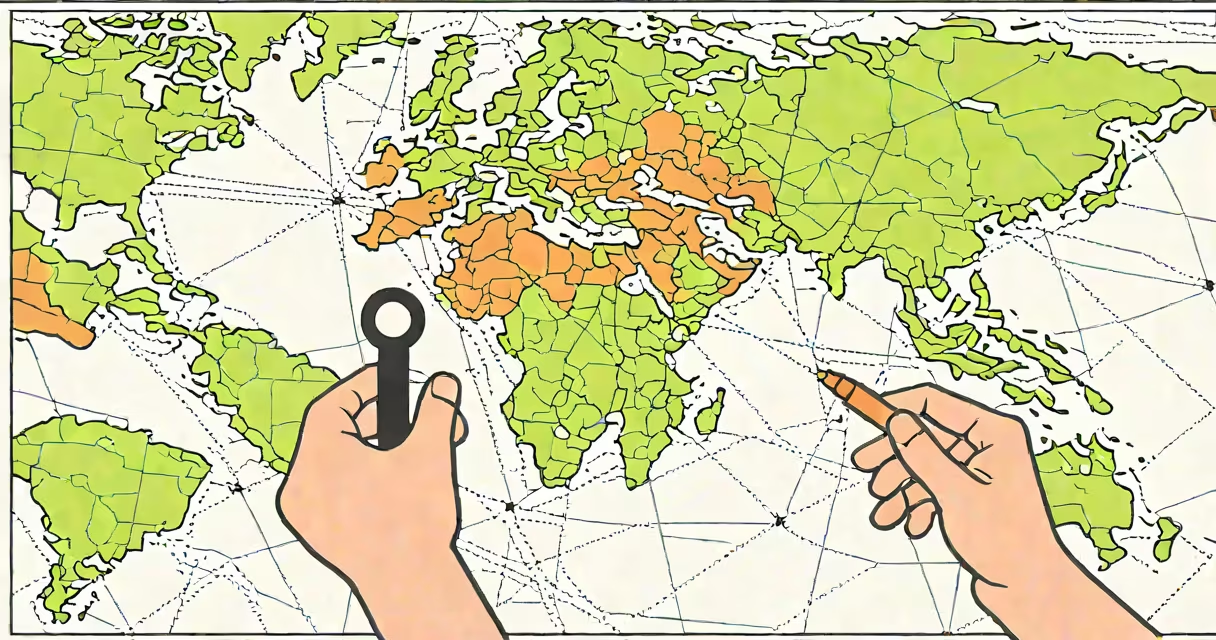
Spatial meaning describes how location, distance, direction, and physical arrangement influence perception, communication, and thought. It's the mental structure we use to understand where things are relative to each other and ourselves.
When someone says "The book is behind the chair," they're using spatial meaning. The words aren't about the book's color or size-they're about position. This concept underpins navigation, object manipulation, and even how we describe events. It's not just about maps or geometry-it's how the mind organizes physical reality.
Spatial meaning operates across multiple domains. In language, prepositions like "on," "between," and "above" carry spatial weight. In neuroscience, the parietal lobe processes spatial input from vision, touch, and balance. In design, spatial meaning shapes how users interact with apps and environments. It's foundational to human cognition.
The brain constructs spatial meaning through sensory integration. Visual cues show where objects are. Proprioception tells your body where limbs are. Vestibular input from the inner ear tracks head movement. These signals converge in the posterior parietal cortex, which builds a changing internal model of space.
For example, when you reach for a cup on a table, your brain calculates distance, angle, and hand trajectory in real time. You don't think about the math-you act based on spatial meaning already encoded in neural circuits. This happens in milliseconds, often without conscious effort.
Even abstract ideas rely on spatial meaning. Research shows people associate "up" with positive emotions and "down" with negative ones. A study published in Cognitive Science found participants judged moral actions as "higher" than immoral ones when described in spatial terms-even when the task had nothing to do with physical space.
Spatial meaning isn't uniform. It varies by context, modality, and cognitive load. The following table outlines key categories:
| Type | Description | Example |
|---|---|---|
| Relative | Position defined by reference to another object | "The keys are inside the bag." |
| Absolute | Position defined by fixed coordinates (e.g., cardinal directions) | "The museum is north of the river." |
| Body-centered | Reference frame tied to the observer's body | "The light is to my left." |
| Object-centered | Reference frame tied to the object itself | "The handle is on the right side of the door." |
These systems aren't mutually exclusive. When you give directions, you mix absolute (turn left at Main Street) and relative (the store is behind the bank) references. The brain switches between them automatically based on context.
Navigation relies heavily on spatial meaning. GPS systems convert geographic coordinates into verbal instructions using relative and absolute frames. A route like "Drive 200 meters, then turn right onto Oak Avenue" combines distance, direction, and object-based landmarks.
In education, spatial reasoning predicts success in STEM fields. A 2021 study by the National Center for Education Statistics found students who scored in the top quartile on spatial reasoning tests were 2.3 times more likely to pursue engineering degrees. Spatial tasks-like mental rotation or perspective-taking-are taught in early math curricula to build foundational skills.
Design also depends on spatial meaning. User interfaces use layout, proximity, and alignment to imply hierarchy and function. A button placed near a form field suggests it triggers submission. Misplaced elements confuse users because they violate spatial expectations.
People often assume spatial meaning is purely visual. But it's multisensory. Blind individuals develop spatial awareness through sound, touch, and memory. A 2019 study in NeuroImage showed blind participants activated the same parietal regions during spatial tasks as sighted people-proving spatial meaning isn't dependent on eyesight.
Another misconception is that spatial meaning is innate. While humans have evolved to process spatial information efficiently, the ability develops through experience. Children learn "left" and "right" through repeated labeling and physical practice. By age 6, most can reliably distinguish them-but younger children often reverse them due to underdeveloped spatial mapping.
Some confuse spatial meaning with spatial language. The former is cognitive; the latter is linguistic. You can understand spatial relationships without naming them. A dog knows where its food bowl is without saying "behind the couch." Language adds precision, but isn't required for spatial understanding.
Hospitals use spatial meaning to reduce patient stress. A 2020 audit of 12 major U.S. hospitals found that those with clear spatial signage-using consistent icons, color coding, and directional arrows-had 37% fewer patient complaints about getting lost.
One hospital redesigned its emergency department using a radial layout. All departments (triage, imaging, treatment rooms) were arranged around a central hub. Signage used body-centered references: "Walk straight ahead, then turn left at the blue wall." Patients reported feeling oriented within 15 seconds of entering.
This design succeeded because it aligned with natural spatial cognition. Humans process paths better when they match body movement and visual flow. The system didn't require complex maps-just consistent spatial meaning embedded in the environment.
I once watched a child struggle to assemble a puzzle. She kept rotating pieces without checking their fit. After guiding her to look at the edges and compare angles, she paused, then placed the piece correctly. Her mistake wasn't lack of attention-it was incomplete spatial meaning. She hadn't internalized how shapes relate in space. Once she connected the visual pattern to spatial constraints, the solution emerged.
This moment reinforced that spatial meaning isn't passive. It's built through interaction, feedback, and practice. Even adults improve spatial skills with targeted exercises-like solving jigsaw puzzles or playing 3D video games.
People mix up spatial and temporal meaning. Both involve ordering, but spatial refers to physical location; temporal refers to sequence in time. Saying "The meeting happened after lunch" uses temporal meaning. Saying "The meeting room is next to the kitchen" uses spatial meaning.
Yet both systems share neural pathways. fMRI scans show overlapping activation in the prefrontal cortex during tasks involving time and space. This overlap explains why people use spatial metaphors for time: "We're approaching the deadline," "That idea is far off."
Understanding this difference prevents miscommunication. In project planning, confusing "next week" (temporal) with "next to the printer" (spatial) leads to errors. Clear language separates the two domains.