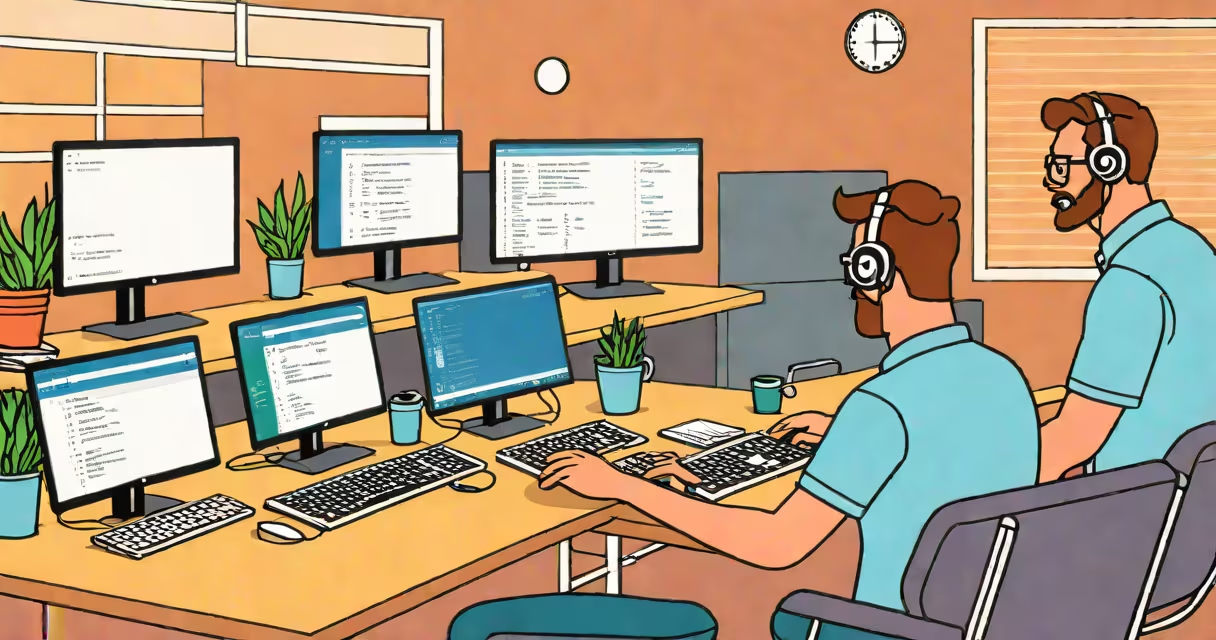
An online code interview is a remote technical assessment where candidates solve programming problems in real time, typically via a shared digital editor, to evaluate coding ability, algorithmic thinking, and debugging under time constraints. This format is standard in software engineering hiring at major tech firms.
These interviews simulate real-world development scenarios. Candidates receive a problem-like reversing a linked list or validating a palindrome-and must write working code within 30 to 60 minutes. The interviewer observes, asks clarifying questions, and may suggest improvements. The environment often includes syntax highlighting, error detection, and automatic test cases.
Platforms like Codility and HackerRank host many such assessments. They support multiple languages including Python, Java, and C++. Interviews may be conducted live with a human evaluator or recorded for later review. Some companies use automated systems that score submissions based on correctness, efficiency, and edge-case handling.
Candidates access a secure web-based coding interface through a link sent by the employer. The session starts with a brief introduction, then the candidate receives a problem statement. They write code directly in the browser, with no local setup required. The system runs predefined test cases against their solution instantly.
For example, a problem might ask: "Given a list of integers, return the index of the first duplicate." A correct solution in Python would be:
def find_first_duplicate(nums):
    seen = set()
    for i, num in enumerate(nums):
        if num in seen:
            return i
        seen.add(num)
    return -1
The system checks this against inputs like [1, 2, 3, 2, 4] and expects output 3. If the function returns -1 for this input, the submission fails. Test cases cover normal behavior, edge cases (empty list), and performance limits (large inputs).
Interviewers may pause to ask about time complexity. For the above, the expected answer is O(n) average time with O(n) space. A candidate who writes a brute-force O(n²) solution without optimization would be flagged for inefficiency-even if it passes tests.
Online code interviews fall into three main formats: live pair programming, timed coding challenges, and take-home assignments.
| Format | Duration | Use Case | Example Platform |
|---|---|---|---|
| Live coding with interviewer | 45-60 min | Final-round screening for senior roles | Google Meet + CodeSignal |
| Timed challenge (self-paced) | 60-90 min | Initial screening for entry-level positions | HackerRank, Codility |
| Take-home project | 24-72 hours | Assessing full-stack or complex problem solving | GitHub-based tasks |
Live sessions are most common in final rounds. They allow evaluators to observe communication, debugging strategy, and collaboration. Timed challenges are used at scale-especially for bootcamp graduates or applicants from non-target schools. Take-home projects assess deeper design and implementation skills but carry higher risk of plagiarism.
A key distinction: live interviews focus on process. A candidate who explains their thought process aloud while writing code scores higher than one who silently produces correct output. According to Google's 2013 study on hiring practices, behavioral cues during coding sessions were better predictors of job success than raw test scores alone.
Many assume online code interviews test memorization. They do not. You won't be asked to recite the Fibonacci sequence in assembly. Instead, they assess structured thinking under pressure. A candidate who pauses to clarify requirements, breaks problems into steps, and validates assumptions performs better than one who dives into code without planning.
Another myth: "I need to know every algorithm." This is false. Most problems involve basic patterns-two pointers, sliding window, hash map lookups-not advanced topics like maximum flow or suffix arrays. The goal is not to recall obscure algorithms but to apply fundamentals creatively.
For example, a recent interview at a fintech startup asked candidates to group transactions by user ID and calculate daily totals. The solution required iterating through a list, using a dictionary to accumulate values, and formatting output. No prior knowledge of financial systems was needed-just clean logic and attention to detail.
I once observed a candidate fail a live session not because their code was wrong, but because they didn't ask questions. When given a problem about finding missing numbers in a sorted range, they began coding immediately. After 15 minutes, the interviewer stopped them: "What's your assumption about duplicates?" The candidate hadn't considered whether the input could contain repeats. That gap in reasoning cost them the role.
Prepare by practicing on platforms like LeetCode and TopCoder. Focus on 100-200 medium-difficulty problems. Time yourself. Simulate real conditions: no IDE autocomplete, no debug logs, just a blank editor.
Always start with a verbal explanation. Say: "I'll use a hash set to track seen elements. Loop through the range. If I see a number already in the set, return its index." This shows reasoning, not just results.
Test edge cases out loud: "If the input is empty, return -1. If the duplicate is the first element, handle that." Interviewers expect this.
When stuck, ask for hints. Saying "I'm unsure how to handle null inputs-should I assume they're absent?" shows engagement. Silence is interpreted as confusion or lack of awareness.
After solving, improve. Ask: "Can I reduce space usage?" or "Is there a way to avoid scanning twice?" Even if you don't improve the solution, showing awareness of trade-offs improves evaluation.
Do not copy-paste solutions from forums. Platforms detect similarity across submissions. A 2022 report by Coursera's course on technical interviewing found that 38% of failed candidates had reused code from public repositories without understanding it.
Avoid over-engineering. A simple loop with a set is better than a custom class with inheritance unless the problem explicitly requires it. Keep code readable. Use descriptive variable names: user_id not u.
Never skip the initial clarification step. One candidate I watched skipped the problem statement, assumed the task was to reverse a string, and spent 20 minutes writing a function that did nothing relevant. The interviewer stopped them early.
An online code interview is not a test of perfection-it's a test of progress. Employers want to see how you think, not how fast you type. A candidate who explains their approach, handles edge cases, and adapts to feedback earns more trust than one who outputs flawless code in silence.
Understanding the structure, purpose, and expectations behind the online code interview gives you a clear path forward. It's not about knowing everything-it's about demonstrating how you learn, adapt, and solve problems under pressure.