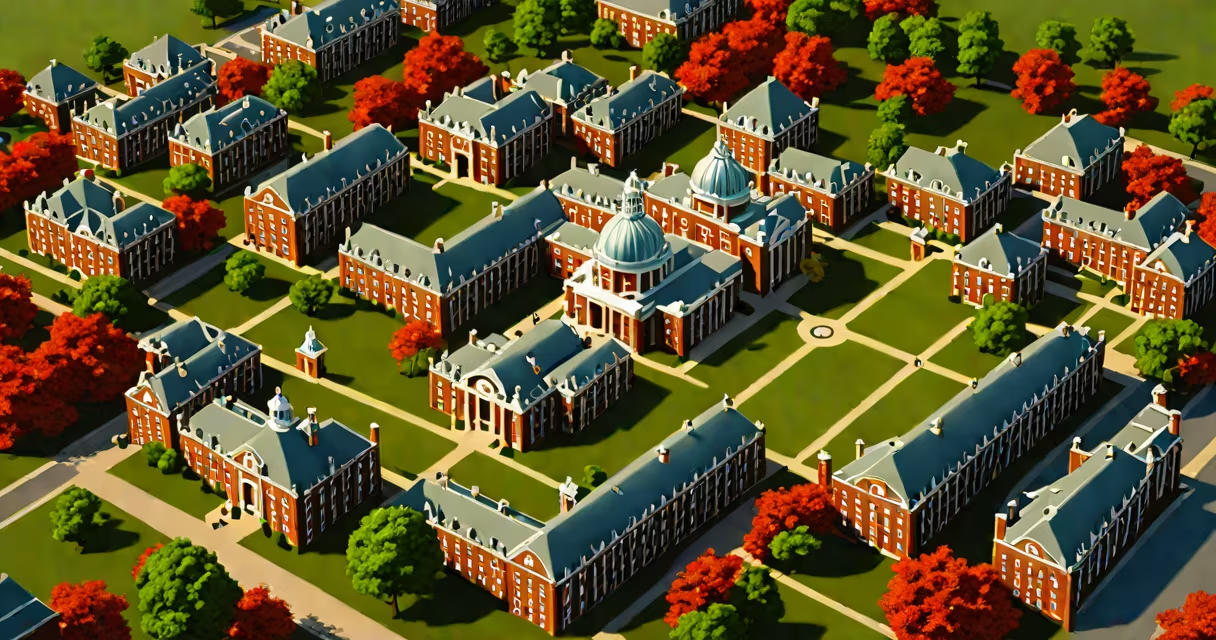
Oxford College of Emory University is a residential liberal arts campus located in Oxford, Georgia, serving as the primary undergraduate division for students seeking a structured, community-based education within Emory University's broader academic structure. It offers a four-year curriculum emphasizing critical thinking, writing, and interdisciplinary study through small seminars and close mentorship.
Founded in 1836 as Emory College, the institution relocated to Oxford in 1838 and operated independently until 1915, when it merged with Emory University in Atlanta. The Oxford campus was reestablished in 1985 as a residential liberal arts college under Emory's umbrella, designed to provide a distinct academic experience separate from the Atlanta campus. Today, it enrolls approximately 400 students annually and maintains a student-faculty ratio of 8:1.
Students at Oxford College complete a core curriculum centered on literature, philosophy, science, mathematics, and social sciences. All courses are taught in seminar format, with most classes limited to 15 students. The college requires students to live on campus for all four years, fostering a tight-knit academic community. Students earn a Bachelor of Arts degree from Emory University upon graduation, with their diploma issued under the university's name.
The college operates on a semester system, with fall and spring terms. Academic advising is highly personalized-each student is assigned a faculty advisor who guides course selection and long-term goals. There are no formal majors at Oxford College; instead, students explore broad fields of study and declare a major during their junior year after transferring to the Atlanta campus.
Classes begin at 8:00 a.m. and end by 4:00 p.m., with evening study hours reserved for group work and faculty office hours. The college calendar includes regular chapel services, weekly guest lectures, and cultural events hosted by the Office of the Dean. Students participate in a mandatory orientation program called "First Year Experience," which includes team-building exercises, academic workshops, and peer mentoring.
Academic integrity is enforced through a student-led honor code. Violations result in referral to a judicial board composed of faculty and students. The college reports a 95% retention rate for first-year students and a 98% graduation rate among those who remain enrolled.
Oxford College follows a fixed curriculum based on the Great Books tradition. Core courses include:
These courses are taught by full-time faculty members, none of whom hold adjunct or visiting appointments. Faculty members are required to live on campus during the academic year, enabling daily interaction with students beyond class time. A 2023 report from the American Council on Education noted that Oxford College's model of faculty residence correlates with higher student engagement scores compared to similar institutions.
Students take 12 credit hours per semester, totaling 48 credits over four years. They may enroll in one elective course per year, selected from a list of approved offerings in fine arts, foreign languages, or computer science. These electives are taught in the Atlanta campus's online platform and require travel to Atlanta for exams.
Oxford College is often mistaken for Oxford University in England. While both share the name "Oxford" and have historic architecture, they are entirely separate institutions. Emory's Oxford College is located in Georgia and is part of a U.S. private research university. Oxford University is a collegiate public university in the UK with over 30 colleges and a centuries-old tradition.
A common confusion arises around the term "college." Oxford College is not a standalone institution-it is a division of Emory University. Students do not apply separately to Oxford College; admission is granted through Emory's central admissions process. However, acceptance to Oxford College guarantees a spot in the residential program and access to its unique academic structure.
Another misconception is that Oxford College is less academically rigorous than the Atlanta campus. Data from the National Survey of Student Engagement (NSSE) shows that Oxford students report higher levels of academic challenge, deeper interactions with professors, and greater confidence in writing skills than their Atlanta counterparts. This is attributed to the seminar-based format and the requirement to live on campus.
In 2022, a student named Elena Ramirez entered Oxford College with a focus on environmental policy. Her first-year coursework included "The Ethics of Climate Change" and "Foundations of Scientific Inquiry." She lived in the historic West Hall, where she participated in weekly discussion groups led by her professor.
During her sophomore year, she took "Global Histories of Power" and completed a research paper on water rights in the American South. Her advisor helped her secure a summer internship at the Environmental Protection Agency's regional office in Atlanta. By her junior year, she transferred to Emory's Atlanta campus to pursue a major in political science and environmental studies.
Elena graduated in 2026 with honors and was accepted into a master's program at Yale University. Her application highlighted her Oxford experience, particularly her capstone project on sustainable urban planning in rural Georgia counties.
The following table outlines key differences between Oxford College and Emory's Atlanta undergraduate programs:
| Feature | Oxford College | Atlanta Undergraduate Programs |
|---|---|---|
| Location | Oxford, Georgia | Atlanta, Georgia |
| Residency Requirement | Mandatory for all four years | Optional; many students live off-campus |
| Class Size | Max 15 students | Varies; large lecture courses up to 200 students |
| Advising Model | Faculty advisor assigned at enrollment | Advisor assigned by department; changes possible |
| Curriculum Structure | Fixed core; no declared major until transfer | Flexible; students declare major in first year |
| Graduation Degree | Bachelor of Arts from Emory University | Bachelor of Arts from Emory University |
Despite structural differences, both pathways lead to the same degree. Students who transfer from Oxford to Atlanta typically perform above average in GPA and extracurricular involvement, according to Emory's Office of Institutional Research.
I visited Oxford College in October 2023 during a campus tour. Walking through the quad, I noticed students gathered under oak trees discussing a passage from Plato. One group debated whether Socrates' trial was justified. The conversation lasted nearly 45 minutes, with no instructor present. That moment confirmed the college's commitment to dialogue-driven learning-a practice absent in larger lecture halls.
When I spoke with a faculty member, he emphasized that the goal is not to teach facts, but to train students to ask better questions. He said, "We don't want graduates who know answers. We want them to recognize when the question itself is flawed."
oxford college of emory university is a residential liberal arts campus that provides a distinctive undergraduate experience within Emory University's academic structure. It emphasizes small classes, close faculty-student relationships, and a structured curriculum rooted in the humanities and sciences. Students live on campus, engage in daily academic discourse, and transfer to the Atlanta campus to complete their major. Its model differs from traditional four-year colleges and is not synonymous with Oxford University in England. For students seeking a focused, community-centered education, Oxford College offers a rare alternative within the U.S. higher education field.