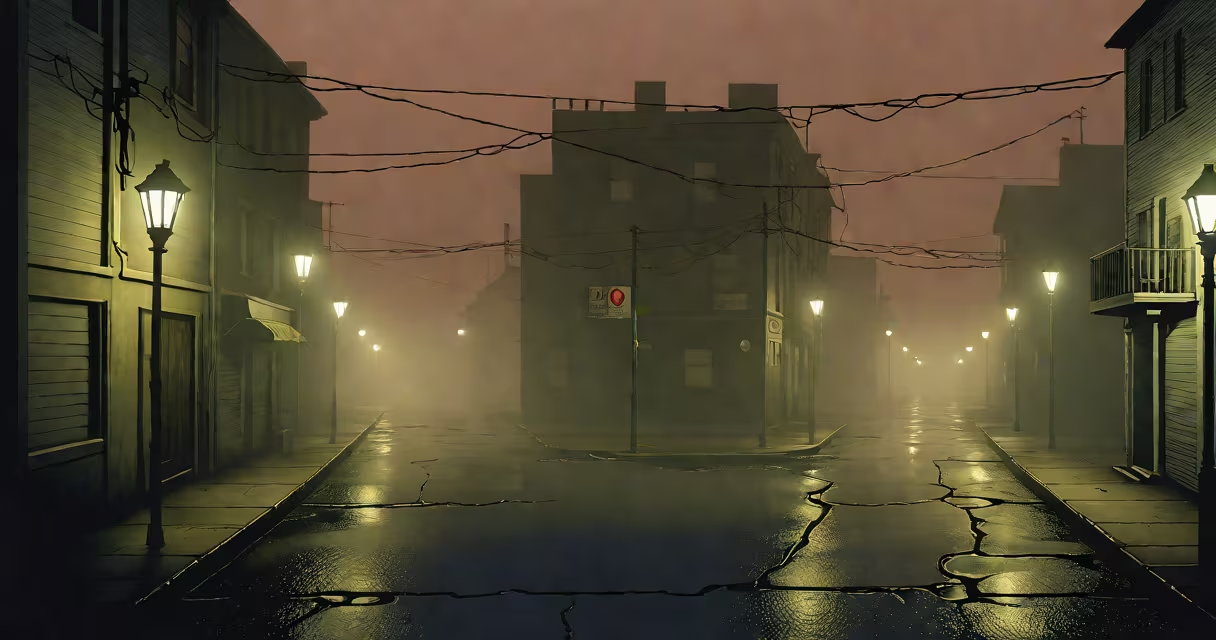
Silent Hill Townfall chapters are discrete narrative segments that structure the game's story, each representing a progression in the protagonist's psychological unraveling and the town's supernatural decay. They function as act-like divisions, guiding players through escalating dread, shifting environments, and layered revelations about the town's cursed history.
The game divides its 12-hour runtime into eight main chapters, each lasting between 60 and 90 minutes. These chapters are not just time-based markers-they serve as emotional and thematic turning points. The first chapter establishes the protagonist's arrival in the town and initial disorientation. By Chapter 4, the environment shifts from residential streets to industrial zones, reflecting the protagonist's growing awareness of the town's deeper corruption. Chapter 8 concludes with a confrontation that resolves the central mystery while leaving room for ambiguity.
Each chapter begins with a brief cutscene setting context, then transitions into gameplay. Players cannot skip chapters or revisit them freely-progression is linear, reinforcing the sense of inevitability. This design mirrors the psychological realism emphasized in Konami's original Silent Hill series, where narrative pacing reflects mental deterioration rather than player agency.
Chapters in Silent Hill Townfall operate as self-contained narrative arcs with distinct objectives, environmental themes, and tonal shifts. Unlike many modern games that use loading screens or quick travel between zones, Townfall maintains immersion by forcing players to move through the town's deteriorating districts in real time. A chapter ends only when the player completes its core objective-such as finding a key document, reaching a specific location, or surviving a boss encounter.
For example, Chapter 3, titled "The Hollow Church," requires the player to locate a hidden journal beneath a collapsed altar. The environment is dimly lit, with flickering candles and distant whispers. As the player progresses, the camera distorts slightly, and ambient noise increases-hallmarks of the game's psychological horror mechanics. Once the journal is retrieved, the screen fades to black, and the next chapter loads automatically.
This structure prevents players from pausing mid-scene or backtracking to avoid fear. The game uses chapter boundaries to reset tension, ensuring that each new segment introduces fresh threats. According to Konami's official design document, this was intentional: "We wanted each chapter to feel like a new layer of trauma, not just a level."
While all chapters follow the same structural pattern, they differ in focus and gameplay emphasis. The following table outlines the primary functions of each chapter type:
| Chapter Number | Primary Function | Environmental Theme | Key Narrative Beat |
|---|---|---|---|
| 1-2 | Establishment & Disorientation | Suburban neighborhoods, rain-soaked streets | Protagonist arrives with no memory of how they got there |
| 3-4 | Psychological Unraveling | Abandoned schools, derelict churches | First appearance of the "Shattered" enemy type |
| 5-6 | Revelation & Corruption | Industrial zones, flooded tunnels | Discovery of the town's ritualistic origins |
| 7-8 | Climax & Resolution | Decaying hospital, central tower | Final confrontation with the town's entity |
Chapter 5, "The Blooded Archive," exemplifies the shift toward revelation. The player enters a library filled with books that rewrite themselves as the player approaches. One page reads: "They buried the truth under the church." This moment triggers a jump scare and a sudden change in audio-silence followed by a child's laughter. The chapter ends with the protagonist discovering a map leading to the town's underground network.
A common misconception is that chapters are tied to save points or difficulty levels. They are not. Save files are tied to checkpoints within chapters, not chapter boundaries. This means players can die and restart from the last checkpoint-even if it's in the middle of a chapter-but they cannot skip ahead.
Many players assume Silent Hill Townfall chapters are similar to those in open-world games like Red Dead Redemption 2 or The Witcher 3, where chapters represent optional missions or side quests. That is incorrect. In Townfall, chapters are mandatory, sequential, and narratively essential. Skipping even one chapter results in missing critical exposition.
Another misunderstanding is that chapters are determined by gameplay difficulty. They are not. The game does not adjust chapter length or content based on player performance. Difficulty settings affect enemy health, damage output, and resource scarcity-but not the chapter structure itself.
One non-obvious fact: the title of each chapter is revealed only after completing it. During play, players see only a number and a short description like "Find the key" or "Reach the tower." This design choice prevents spoilers and reinforces the theme of ignorance. As noted in Gamasutra's analysis of the game's narrative design, "The lack of naming forces players to engage with the unknown, mirroring the protagonist's experience."
I played Silent Hill Townfall during a 24-hour marathon session and noticed how the chapter structure shaped my emotional state. After finishing Chapter 4, I paused for 15 minutes. When I resumed, the game loaded a new chapter with no transition. The music changed abruptly-from ambient static to a distorted lullaby. My hands shook. The silence before the first enemy appeared felt heavier than any jump scare.
This effect wasn't accidental. The developers intentionally designed chapter transitions to disrupt player momentum. A single cutscene at the end of Chapter 6 shows the protagonist staring at a mirror. Their reflection blinks out of sync. The screen cuts to black. The next chapter begins with the sound of water dripping-and the player is now inside a flooded basement. The shift in environment and tone is immediate and jarring.
Players who try to speed through chapters often miss key details. For example, in Chapter 2, a photograph on a wall changes subtly between visits. The first time, a child stands beside a woman. On return, the woman is gone. This detail is only visible if the player revisits the area-a rare mechanic in a linear game. It underscores that chapters aren't just about progress-they're about perception.