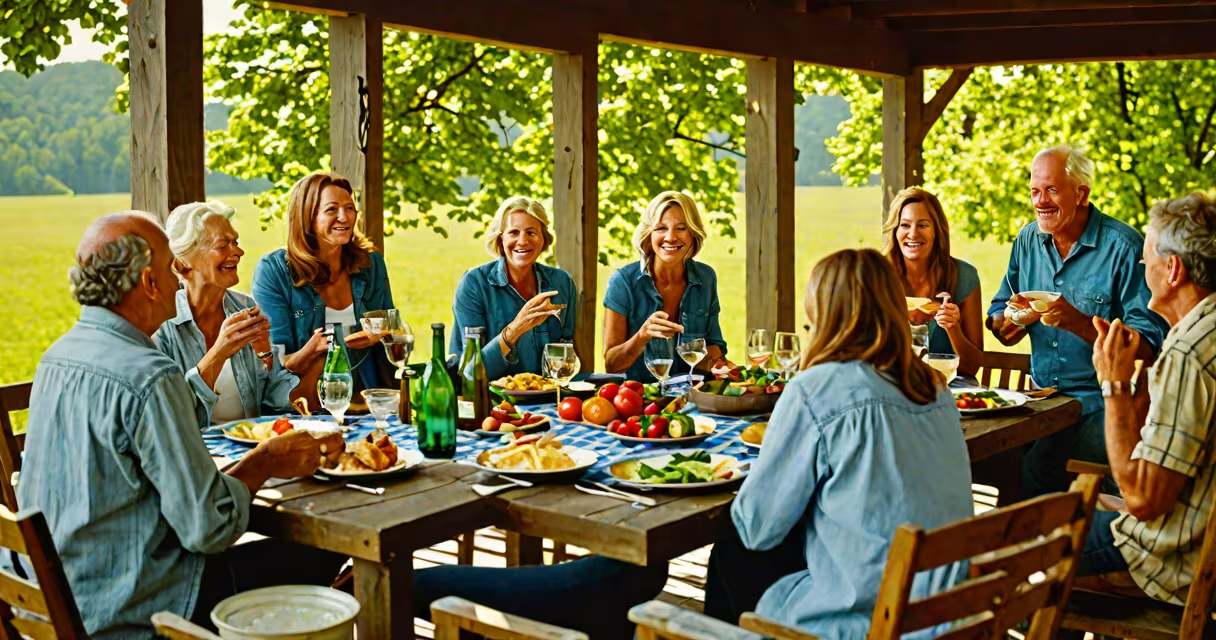
A commune is a residential community where individuals share living spaces, resources, and decision-making, typically based on mutual values such as sustainability, equality, or spiritual beliefs. These groups often reject conventional capitalism and private property ownership in favor of collective ownership and cooperative labor.
Communes emerged prominently in the 1960s and 1970s as part of countercultural movements in North America and Europe. They were frequently formed by young adults seeking alternatives to mainstream society, often inspired by ideals of peace, environmental stewardship, and social justice. Today, while fewer in number than during their peak, communes still exist worldwide, ranging from small rural homesteads to larger intentional communities with formal governance structures.
Modern examples include Twin Oaks Community in Virginia, founded in 1967, which operates on consensus-based decision-making and allocates work hours equally among members. Another is The Farm in Tennessee, established in 1971 by former hippies who adopted a vegetarian diet, sustainable agriculture, and nonviolent conflict resolution. Both continue to function as functioning societies with internal economies, education systems, and healthcare arrangements.
Communes operate through shared responsibilities rather than individual ownership. Daily tasks such as cooking, cleaning, farming, and childcare are distributed among members based on ability, interest, or rotation schedules. Decisions about housing, finances, and community direction are made collectively, often using consensus or voting models.
Financial systems vary. Some communes maintain a single pooled fund managed by a committee, while others use individual accounts tied to contribution hours. In Twin Oaks, members earn "time credits" for work performed, which they can exchange for goods or services within the community. This system prevents wealth accumulation and ensures equitable access to resources.
Conflict resolution is critical. Many communes hold regular meetings to discuss grievances, mediate disputes, and review policies. The Farm uses a structured process called "The Circle," where participants speak one at a time, listen without interruption, and focus on solutions rather than blame. This method reduces emotional escalation and promotes accountability.
Communes differ widely in structure, ideology, and scale. The following table outlines major categories:
| Type | Core Values | Example | Key Feature |
|---|---|---|---|
| Spiritual | Religious practice, meditation, asceticism | Findhorn Foundation (Scotland) | Emphasis on intuition and nature-based spirituality |
| Eco-Village | Sustainability, renewable energy, organic farming | Ecovillage at Ithaca (New York) | Net-zero energy homes, rainwater harvesting |
| Political/Anarchist | Anti-authoritarianism, direct democracy | Freedom Hill (California) | Non-hierarchical leadership; rotating roles |
| Artistic/Experimental | Creative expression, performance, improvisation | Artpool (Hungary, 1970s) | Used art as political tool; hosted underground exhibitions |
Not all communes are rural. Urban communes exist in cities like Portland, Berlin, and Tokyo, where residents rent shared apartments and organize cultural events, skill swaps, and mutual aid networks. These urban variants often emphasize accessibility and integration with city life rather than isolation.
Many assume communes are inherently chaotic or doomed to fail due to idealism. While early 1970s communes had high dropout rates-some estimates suggest 70% dissolved within five years-modern ones have higher survival rates due to better planning and legal frameworks. According to a 2019 study by the Institute for Intentional Communities, 68% of surveyed communes reported stable membership over ten years.
Another misconception is that communes require complete surrender of personal identity. In reality, most functional communes balance group cohesion with individual autonomy. Members retain privacy rights, personal property (within limits), and freedom to leave. Twin Oaks allows members to opt out at any time with a 90-day notice period and receive a refund of their accumulated time credits.
Some confuse communes with co-ops or housing collectives. While both involve shared living, co-ops usually focus on affordable housing and may not share decision-making beyond rent and maintenance. A commune goes further: it integrates daily life, ethics, and long-term vision into a unified social model. A co-op might share a kitchen; a commune shares meals, values, and responsibility for each other's well-being.
Twin Oaks, located in Louisa County, Virginia, began in 1967 with 12 people who left mainstream society to build a self-sustaining community. Today, it hosts around 100 residents across 20 households. All members contribute 30 hours per week to essential tasks-gardening, food prep, childcare, or administrative duties.
Each member receives a monthly allocation of time credits based on their work. These credits can be used to purchase goods from the community store, attend workshops, or request personal services like repairs or tutoring. There is no money exchanged between members; instead, the system functions as a barter economy scaled to human effort.
Decision-making happens in weekly General Meetings. Proposals are discussed openly, and votes are taken only after all concerns are addressed. A proposal passes if no one objects-this is known as the "consensus without consensus" rule. It encourages compromise and ensures no one feels forced into agreement.
When I visited Twin Oaks in 2022, I observed a morning meeting where a resident raised concern about noise levels near the garden shed. After discussion, the group agreed to install soundproofing panels and relocate heavy tools to a separate building. The solution was implemented within two weeks. No one was blamed. No hierarchy was invoked. The issue was resolved through shared responsibility.
As climate instability increases and economic inequality widens, communes offer practical models for resilience. Research from the University of California, Berkeley (2021) shows that intentional communities consume 40% less energy per capita than average U.S. households and generate 60% less waste. Their shared infrastructure reduces resource duplication and supports circular economies.
Communes address mental health challenges common in isolated urban life. A 2020 survey by the National Alliance on Mental Illness found that 62% of commune members reported lower anxiety levels compared to similar demographics living independently. Social connection, predictable routines, and mutual support appear to buffer against depression and burnout.
Understanding what is a commune requires moving past outdated stereotypes. It is not a relic of the 1970s. It is a living, evolving form of social organization rooted in cooperation, sustainability, and human dignity. Whether in rural forests or city neighborhoods, communes demonstrate that alternative ways of living are not only possible-but proven.
What is a commune? It is a deliberate attempt to live differently, together.