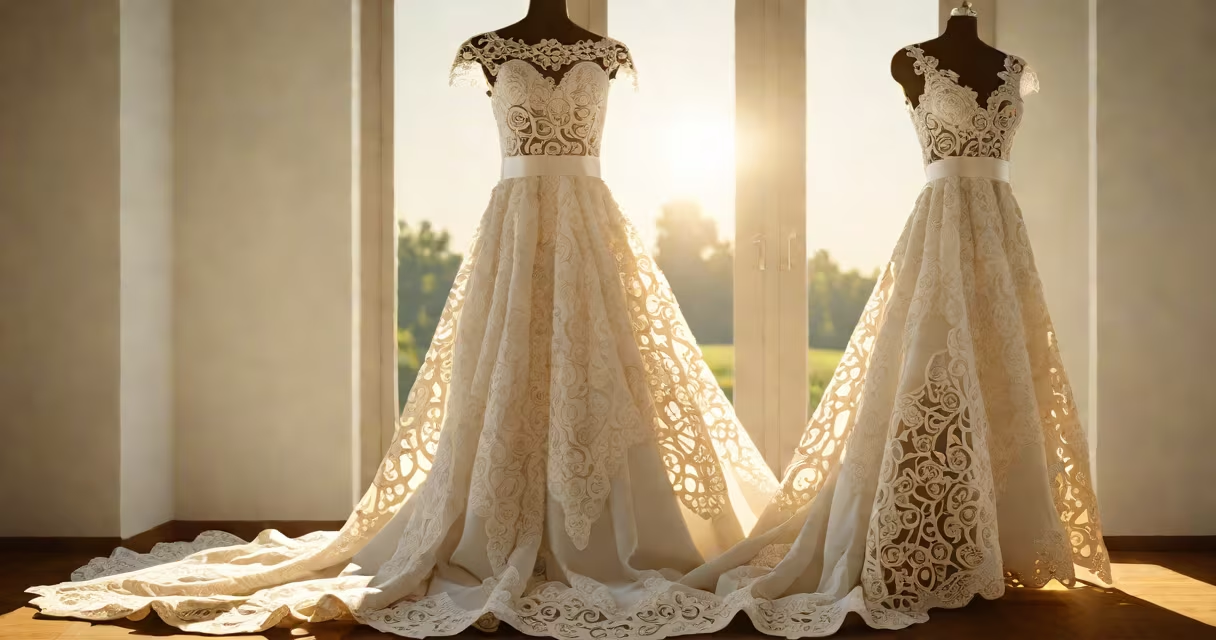
After your wedding, your dress becomes a personal artifact-preserved through careful storage, altered into new forms, or transformed into meaningful keepsakes. Options include professional cleaning and archival storage, converting the fabric into heirloom pieces, or donating it for reuse.
Most brides don't wear their wedding dress again. Yet the garment often remains emotionally useful. The average American bride spends $1,400 on her wedding dress, according to The Knot's 2023 Real Weddings Report. That investment deserves thoughtful handling beyond hanging it in a closet.
Proper preservation prevents yellowing, fiber degradation, and mold. The process begins with professional cleaning within 30 days of the wedding. Home cleaning risks damaging delicate fabrics like silk, lace, or tulle.
After cleaning, the dress is stored in acid-free tissue paper, placed inside a breathable cotton garment bag, and kept in a cool, dry place away from sunlight. The Smithsonian Institution recommends storing textiles in temperature-controlled environments between 60-70°F and 40-50% humidity to slow deterioration.
Some couples choose museum-quality archival boxes with UV-filtering plastic covers. These cost $80-$150 but protect against dust, pests, and light exposure. Avoid plastic bins or vacuum-sealed bags-they trap moisture and accelerate decay.
There are four common paths for a wedding dress after the ceremony:
| Type | Best For | Cost Range | Key Consideration |
|---|---|---|---|
| Preservation & Storage | Keeping the original dress intact | $150-$300 | Must be cleaned first; avoid home dry cleaning |
| Fabric Repurposing | Creating heirlooms: baby blankets, christening gowns | $200-$600 | Requires skilled artisan; select durable fabric sections |
| Alteration & Reuse | Wearing again at anniversaries or family events | $100-$400 | Not recommended for heavily stained or worn areas |
| Donation or Reuse | Helping others afford a dream dress | Free | Ensure cleanliness and proper documentation |
Repurposing fabric into a keepsake is increasingly popular. A 2022 study by the Fashion Institute of Technology found that 38% of brides who preserved their dress did so because they wanted to pass it down or create something new from it.
For example, a bride from Austin, Texas, had her ivory satin gown cut into strips and woven into a quilt for her daughter's nursery. She worked with a local textile artist who used hand-stitching techniques to maintain the integrity of the original fabric. The result was a 6-foot by 8-foot quilt displayed at a regional craft fair.
Many assume that hanging a dress in a closet preserves it. This is false. Hanging causes stress on seams and can lead to stretching or tearing. Even short-term storage in a plastic bin leads to mildew growth in humid climates.
Another misconception: "I'll clean it myself." Home dry cleaning kits may remove surface stains but fail to eliminate body oils and sweat trapped in fibers. These residues attract moths and cause long-term discoloration. The American Cleaning Institute warns that improper cleaning reduces a garment's lifespan by up to 70%.
A lesser-known fact: the most fragile parts of a wedding dress aren't the skirt or bodice-they're the inner lining and understructure. These materials degrade faster than outer fabrics due to moisture absorption during wear. A trained conservator can identify early signs of breakdown before visible damage appears.
Consider Sarah, a teacher from Portland, Oregon. Her wedding dress was a vintage-inspired A-line gown with hand-embroidered flowers and a 12-foot train. After the reception, she shipped it to a preservation service specializing in heirloom textiles.
The company cleaned the dress using pH-neutral detergents and cold water. They then removed the inner boning and replaced it with a custom-made support frame. The gown was wrapped in rice paper and stored in a climate-controlled box labeled with the wedding date, venue, and fabric composition.
Two years later, Sarah commissioned a designer to turn the train into a shawl for her daughter's first birthday. The fabric was dyed a soft blush using natural madder root dye. The final piece was presented at the celebration and photographed beside the child's crib.
This approach honors both the emotional weight and material value of the dress. It's not discarded-it's reimagined.
If you're unsure about care, consult a certified textile conservator. The American Alliance of Museums lists accredited professionals who follow International Council of Museums (ICOM) standards for textile preservation. These experts use non-invasive tools like infrared imaging to assess fabric stability before treatment.
Even if you plan to wear the dress again, professional cleaning is essential. A single stain left untreated can spread during storage. The Knot reports that 44% of brides who reused their dress experienced irreversible damage due to poor initial care.
Your wedding dress doesn't have to be forgotten after the last dance. What do I do with my wedding dress? Preserve it. Repurpose it. Share it. The choices reflect your values, budget, and connection to the moment. Whether stored in a climate-controlled box or turned into a family heirloom, the dress continues to hold meaning.
With the right steps, your wedding dress becomes more than a memory-it becomes legacy.