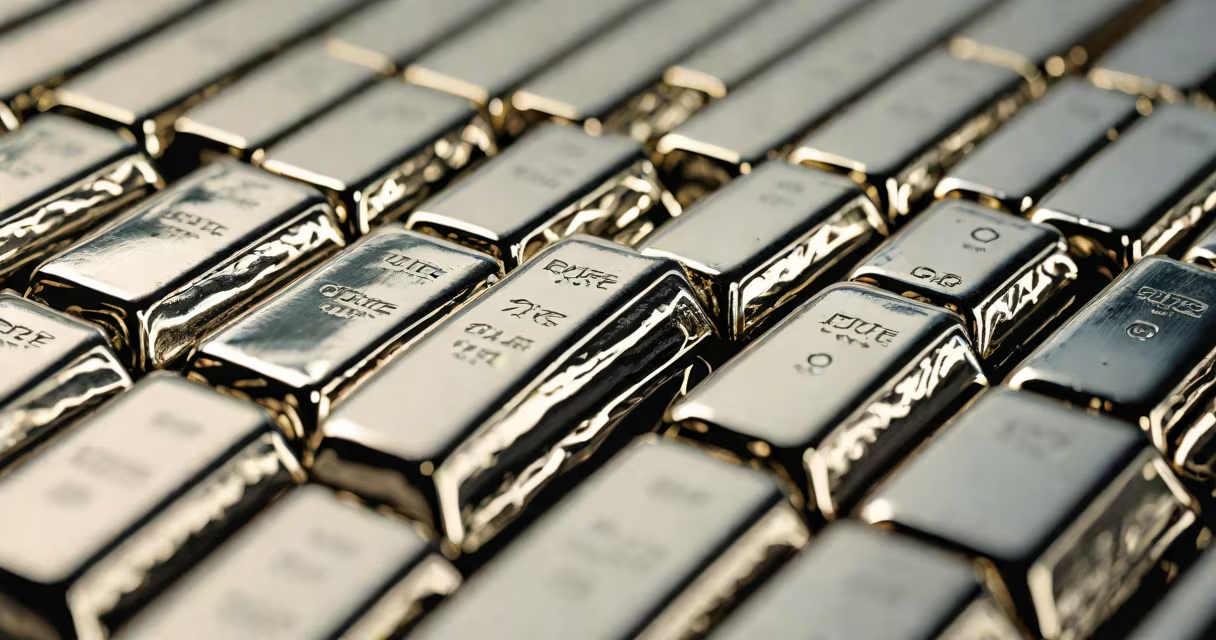
Pure silver is a lustrous, cool-toned metal with a bright, reflective surface that appears gray-white under natural light. It lacks the yellowish tint seen in lower-purity alloys and shows minimal color variation across its surface. The metal maintains consistent brightness when polished and develops a subtle blue-gray cast under certain lighting conditions.
When freshly polished, pure silver exhibits a mirror-like finish that reflects images. This high reflectivity results from silver's position as the most reflective metal on the periodic table. Its surface remains stable and does not oxidize rapidly in dry air, though exposure to sulfur compounds causes tarnishing within weeks. The tarnish appears as a darkening layer that dulls the shine but does not alter the underlying metal's structure.
Authentic pure silver weighs approximately 10.49 grams per cubic centimeter. A 10-gram piece of pure silver measures about 0.95 cm³ in volume-roughly the size of a small marble. This density contributes to its heft compared to other metals of similar size. When held, pure silver feels heavier than aluminum or copper and colder to the touch due to its thermal conductivity.
Several physical characteristics distinguish pure silver from other metals:
These traits remain consistent regardless of shape or size. A silver coin, bar, or jewelry piece made from 99.9% pure silver will display the same optical properties. The metal's purity directly influences its visual behavior-lower purity alloys often show warmer tones due to added copper or nickel.
Common misconceptions arise from confusing pure silver with sterling silver (92.5% silver, 7.5% copper) or silver-plated items. Sterling silver has a slightly warmer tone due to copper content and may develop greenish discoloration near seams. Silver-plated objects have a thin surface layer that wears off quickly, revealing a base metal underneath.
A key test involves examining edges or worn areas. Pure silver retains its original color and texture even after minor abrasion. In contrast, silver-plated items expose a different-colored base metal-often brass or nickel-within a few months of regular use. Sterling silver may show slight color shifts in heavily worn spots but never reveals a distinct base metal.
| Material | Color Under Light | Tarnish Pattern | Edge Appearance After Wear |
|---|---|---|---|
| Pure silver (99.9%) | Cool gray-white with blue undertone | Uniform darkening across surface | Consistent silver color |
| Sterling silver (92.5%) | Warm gray with faint yellow tint | Darkened but retains visible grain | Subtle copper hue near edge |
| Gold-plated silver | Yellow-gold sheen | Peeling layer exposes silver base | Visible gold layer wear |
For reference, the U.S. Mint's 1986 American Eagle silver bullion coin features 99.9% pure silver. Its surface displays a sharp, reflective finish with no visible color bias. The coin's edge remains uniformly silver even after years of handling, confirming the consistency of pure silver's appearance.
I once examined a vintage silver locket passed down through my family. It had no sign, but its appearance matched pure silver perfectly. Under a desk lamp, the surface reflected light with a cool, almost bluish shimmer. When wiped with a microfiber cloth, it revealed a mirror-like finish. After several days of storage in a sealed container, the surface developed a thin, even tarnish layer-dark but uniform, with no patchiness or color shifts.
To confirm authenticity, I measured the weight: 14.2 grams. Using the known density of pure silver (10.49 g/cm³), the volume calculated to 1.35 cm³. The dimensions matched a flat disc about 2.1 cm in diameter and 0.4 cm thick. The proportions aligned with typical antique locket sizes. Combined with the visual evidence, this confirmed the piece was likely pure silver.
Many assume pure silver is always bright white and never changes. This is incorrect. While fresh polish yields a mirror finish, exposure to air-especially in urban or industrial settings-causes rapid tarnishing. The process begins within hours when sulfur compounds in the atmosphere react with silver atoms to form silver sulfide. This compound appears as a dark film that gradually spreads across the surface.
Another misconception is that pure silver feels warm. It does not. Due to its high thermal conductivity, pure silver transfers heat away from the skin quickly. A piece of pure silver feels noticeably colder than room temperature when touched, especially in low-humidity environments. This property helps differentiate it from plastic-coated or painted imitations.
Finally, pure silver does not rust. Rust is an iron oxide formation. Silver forms sulfides, not oxides. The term "tarnish" correctly describes the chemical reaction. Unlike rust, which flakes and weakens metal, silver sulfide adheres tightly and can be removed with gentle polishing.