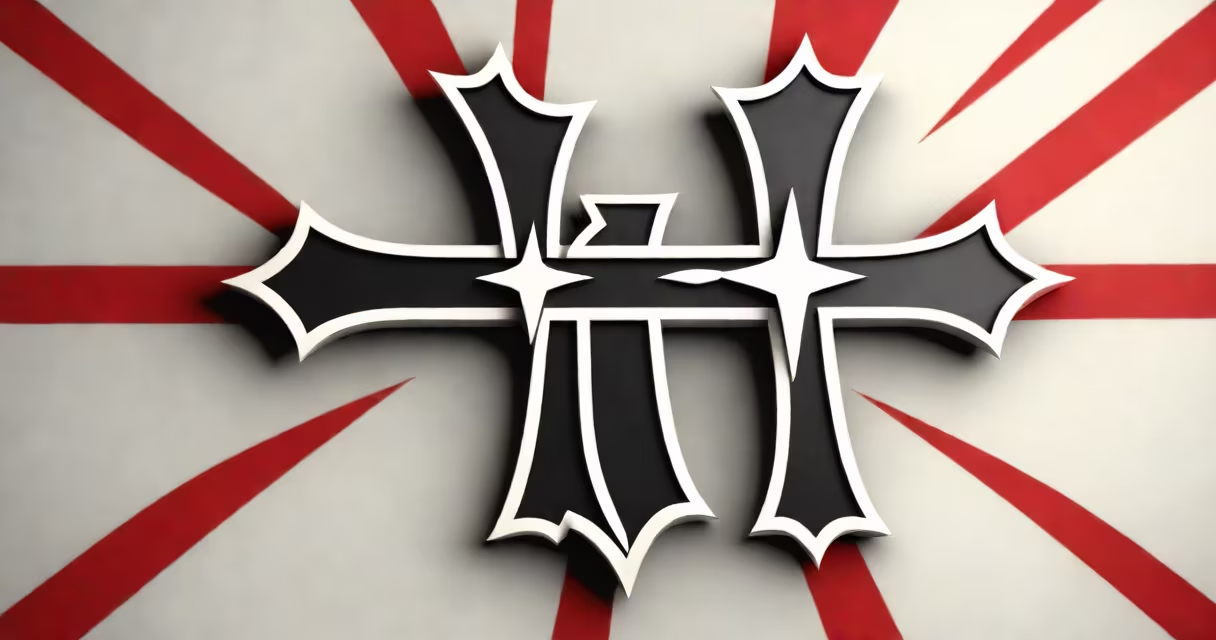
The crusader cross is a four-pointed cross with equal-length arms and a central dot, historically associated with the military campaigns of the medieval Crusades. It symbolized both Christian devotion and armed holy war, serving as a banner for armies traveling to reclaim the Holy Land.
Originally adopted in the 11th century, the cross was worn on the robes of knights and soldiers participating in the First Crusade (1096-1099). Its design evolved from earlier Christian crosses but gained distinct identity through its use in warfare. The central dot represented Christ's presence at the heart of the mission, while the equal arms signified balance between spiritual purpose and martial action.
Modern interpretations often simplify the symbol to a red cross on a white field, but historically, it was rendered in various colors depending on context. The cross appeared on banners, armor, seals, and ecclesiastical documents. It remains a recognized emblem of Christian military tradition, though its use today is debated due to its association with violence.
Crusaders wore the cross as a visible sign of their vow to fight for Christendom. It was sewn onto tunics, painted on shields, and carved into church walls. The cross was not merely decorative-it marked the wearer as part of a sacred mission sanctioned by the Church.
Popes authorized the use of the cross as a spiritual incentive. In 1095, Pope Urban II called for the First Crusade, urging Christians to reclaim Jerusalem. He promised spiritual rewards to those who joined, including remission of sins. The cross became a badge of penance and pilgrimage combined with combat.
Records from the time show that soldiers were required to wear the cross visibly. A 12th-century chronicle by Fulcher of Chartres describes crusaders "bearing the cross upon their shoulders like a burden of faith." This practice reinforced group identity and moral justification for war.
The standard crusader cross features four equal arms and a central dot. It differs from the Latin cross (long vertical, short horizontal) and the Greek cross (arms of equal length but no center point). The addition of the dot makes it distinct and historically specific.
Several regional variants existed:
| Type | Appearance | Use Context |
|---|---|---|
| Red crusader cross | Red arms, white background, central dot | Used by the Knights Templar and later adopted by the Order of St. John |
| White crusader cross | White arms, black background | Appeared on military banners during the Second Crusade |
| Gold crusader cross | Gold arms, blue background | Used in ecclesiastical art and royal insignia |
These variations were not standardized. Color choices reflected regional preferences, donor funding, and symbolic intent. Red often denoted sacrifice and bloodshed; white stood for purity and divine favor.
The crusader cross is frequently mistaken for the Maltese cross, which has a similar shape but different origins. The Maltese cross has four curved arms and is associated with the Knights Hospitaller, not the Crusades themselves. Confusing the two misrepresents historical context.
Another error is assuming the cross was always red. While red versions appear in later heraldry, early depictions from the 11th and 12th centuries used white, gold, or black. The red version became popular in the 19th century due to romanticized portrayals of the Crusades.
A lesser-known fact: the central dot was not added arbitrarily. It was derived from the Chi-Rho symbol (☧), a monogram of Christ used in early Christian art. The dot represented the letter "i" in the Greek word "Iēsous" (Jesus), reinforcing the theological foundation of the cross.
Today, the crusader cross appears in military insignias, religious iconography, and pop culture. It is used by some Christian groups to represent spiritual struggle and protection. However, its association with violence has led to controversy.
In 2017, a German court ruled that displaying the crusader cross in public spaces could be seen as promoting extremist views, especially when paired with nationalist messaging. The decision cited concerns about the symbol's misuse in far-right movements.
I once visited the Church of the Holy Sepulchre in Jerusalem and saw a 12th-century stone relief of a crusader bearing the cross. The carving showed a knight with a sword and shield, the cross prominently displayed on his chest. The detail was precise-four arms, a dot, and a faint halo. It wasn't just a symbol of war; it was a statement of faith under siege.
The crusader cross is often confused with other crosses used in religious and military contexts. Understanding the differences prevents misinterpretation.
Each symbol carries unique history and meaning. The crusader cross stands apart due to its direct link to organized military campaigns justified by religious doctrine.
The crusader cross means more than a religious emblem-it represents a complex intersection of faith, power, and violence. It was a tool of identity, motivation, and authority during the Crusades. Today, understanding its meaning requires acknowledging both its spiritual significance and its historical role in conflict.