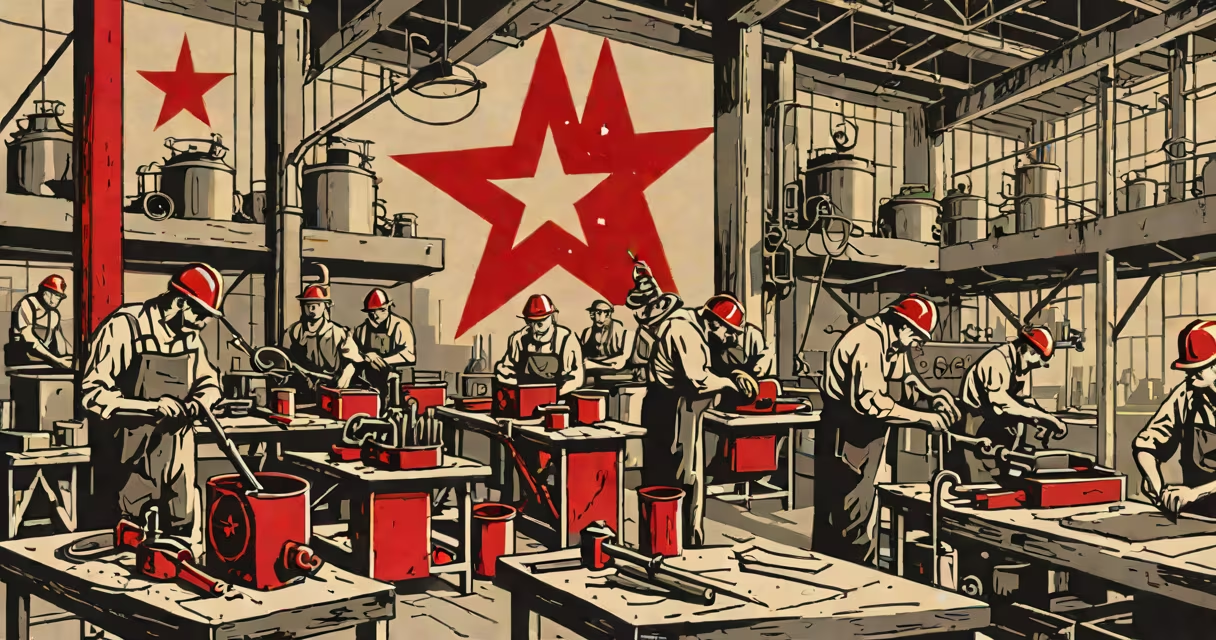
A communist economy is a system in which the state owns and manages all major means of production-factories, land, transportation, and key industries-and makes decisions about what to produce, how much, and who receives it, based on centralized planning rather than market forces.
This model emerged from Marxist theory, which argues that capitalism inherently creates inequality and worker exploitation. The goal of a communist economy is to abolish private ownership of the means of production and replace it with collective or state control to ensure equitable distribution of goods and services.
Unlike capitalist economies, where supply and demand determine prices and output, a communist economy relies on five-year plans, national budgets, and directives from government agencies to allocate resources. Prices are set administratively, not by consumer choice or competition.
In practice, a communist economy operates through a hierarchy of state planning bodies. At the top, a central authority-often a national government or party committee-sets broad goals for growth, employment, and production. These targets are then broken down into regional and sector-specific quotas.
Factories receive production orders based on these quotas. Workers do not choose their jobs or negotiate wages; instead, they are assigned roles by planners. Goods are distributed through state-run stores or ration systems, not markets. Consumers have little influence over what is available or priced.
The Soviet Union's Gosplan (State Planning Committee) was the central mechanism for managing the economy from the 1920s until the late 1980s. It issued detailed instructions to over 100,000 industrial enterprises annually, specifying output levels, resource inputs, and delivery schedules.
While all communist economies share core principles, implementation varies. The most consistent features include:
There are two main models:
| Type | Description | Example |
|---|---|---|
| Command Economy | Strict top-down control with no input from local producers or consumers. All decisions flow from a central authority. | Soviet Union (1928-1991) |
| Planned Economy with Limited Market Elements | Some decentralized decision-making or limited private enterprise allowed under state oversight. Often called "socialist market economy." | China (post-1978 reforms), Vietnam (since 1986) |
China's current system illustrates a hybrid model. While the state retains control over strategic sectors-energy, banking, telecommunications-private businesses operate freely in manufacturing, retail, and tech. The government sets long-term development goals (e.g., Made in China 2025), but firms respond to market signals within those boundaries.
Many people confuse a communist economy with socialism or even authoritarianism. These are distinct concepts.
Communism, as defined by Karl Marx, envisions a classless society where goods are distributed according to need. A communist economy is a transitional phase toward that ideal, not the final form. In contrast, socialism may allow limited private ownership and market mechanisms.
Another misunderstanding is that all communist economies were inefficient. While many suffered from chronic shortages and misallocation-such as the Soviet Union's persistent shoe shortages-the system did achieve rapid industrialization in countries like the USSR and North Korea.
For example, between 1950 and 1970, the Soviet Union increased steel production by 400%, outpacing Western Europe despite lower productivity per worker. This growth came at the cost of consumer goods and innovation, but it met the state's strategic goals.
The most extensive application of a communist economy occurred in the Soviet Union. From 1928 to 1991, the state directed nearly all economic activity. By 1970, the USSR had the world's second-largest economy, with high military spending and large-scale infrastructure projects.
However, inefficiencies mounted. Because factories were judged on output volume-not quality or customer satisfaction-many products were defective or obsolete. A 1985 study by the U.S. Central Intelligence Agency found that Soviet industrial planning failed to meet 30% of its annual targets due to poor coordination and inflated reporting.
China's shift from a pure command economy to a socialist market economy began in 1978 under Deng Xiaoping. The government retained control over land, energy, and finance but opened rural areas to private farming and urban zones to small businesses. By 2023, China's GDP had grown from $200 billion in 1978 to $18 trillion, making it the world's second-largest economy.
Even today, China maintains strict state oversight. Major tech companies like Alibaba and Tencent operate under close regulatory scrutiny. The government can intervene in pricing, data access, and mergers without public debate.
A communist economy is not synonymous with a welfare state or a mixed economy. Norway and Sweden have high taxes and extensive social programs, but they maintain private ownership, free markets, and democratic elections. Their systems are capitalist, not communist.
Similarly, the term "communist" does not describe any country that allows elections, independent media, or private business. North Korea's economy is often labeled communist, but it functions more like a militarized autocracy with severe restrictions on movement and information. Its economy is centrally planned, but the state uses forced labor and isolation to maintain power, not to distribute wealth equitably.
One non-obvious distinction: communism does not require a single political party. The original Marxist vision allowed for worker councils (soviets) to manage production. In practice, however, most communist states became one-party dictatorships, which distorts the theoretical model.
I visited a textile factory in Shenzhen in 2019 during a research trip. The facility was owned by a state-owned enterprise but operated under contract with a private export firm. Workers earned wages based on hours worked, not state quotas. The factory produced clothing for international brands, yet the government controlled land use, environmental standards, and labor regulations. This hybrid structure reflects how modern state-led economies function-not as rigid command systems, but as layered frameworks balancing control and market responsiveness.
A communist economy is a system of state-directed production and distribution based on central planning rather than market forces. It seeks to eliminate private profit and class divisions through collective ownership. While historically associated with the Soviet Union and Maoist China, modern variants exist in countries like China and Vietnam, blending state control with market mechanisms.
Understanding what is a communist economy requires separating theory from practice. The model aims for equity and stability, but in execution, it often leads to inefficiency, shortages, and reduced innovation. Recognizing these trade-offs helps clarify why few nations still rely solely on central planning.