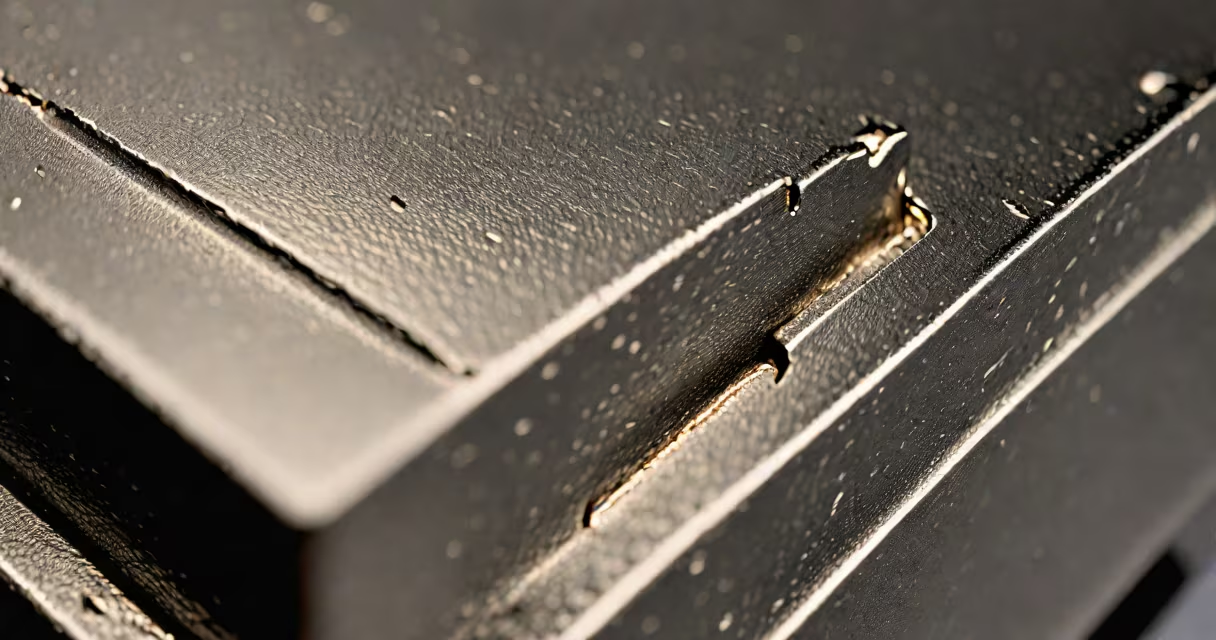
Cast steel is a high-strength ferrous alloy produced by melting steel and pouring it into a mold to form a specific shape. Unlike wrought steel, which is shaped by rolling or forging, cast steel solidifies in a mold, allowing complex geometries and large components. It is used where strength, wear resistance, and dimensional stability are critical.
Cast steel begins as raw iron ore, carbon, and alloying elements like chromium, nickel, or molybdenum. These are melted in an electric arc furnace or basic oxygen furnace, then refined to remove impurities. The molten metal is poured into sand, ceramic, or permanent molds. After cooling, the casting is heat-treated to improve mechanical properties such as hardness, ductility, and fatigue resistance.
Common applications include turbine blades, railway axles, hydraulic cylinders, and marine propellers. The process enables parts too large or intricately shaped for forging or machining-such as a 12-ton ship's rudder casting-to be manufactured in a single piece.
The casting process relies on controlled solidification. As molten steel cools, it forms dendrites-branching crystal structures-that grow inward from the mold walls. This directional solidification prevents shrinkage cavities and porosity in critical zones. Modern foundries use computer modeling to simulate flow and cooling patterns, reducing defects before production.
After removal from the mold, cast steel undergoes stress-relief annealing at 600-700°C for 4-8 hours. This reduces residual stresses from uneven cooling. Subsequent quenching and tempering can increase tensile strength beyond 1,000 MPa. For example, ASTM A356 Grade 2 cast steel achieves a minimum yield strength of 485 MPa and elongation of 20%-suitable for pressure vessels and structural supports.
Non-destructive testing (NDT) ensures integrity. Ultrasonic inspection detects internal flaws, while dye penetrant testing reveals surface cracks. A 2021 study by the American Society for Nondestructive Testing confirmed that 98.7% of cast steel components passed inspection when tested using phased range ultrasonics.
Cast steel is categorized by composition and application. The most common standards are from ASTM International and SAE. Each grade balances strength, toughness, and machinability for specific environments.
| Grade | Typical Composition | Minimum Yield Strength (MPa) | Primary Use |
|---|---|---|---|
| A356 Grade 2 | C: 0.25%, Mn: 1.0%, Si: 0.3% | 485 | Valves, pumps, gear housings |
| A747 Class 2 | C: 0.35%, Cr: 1.0%, Ni: 0.5% | 620 | Marine fittings, offshore platforms |
| A897 Grade 3 | C: 0.45%, Mo: 0.5%, V: 0.1% | 860 | Turbine rotors, mining equipment |
Low-alloy cast steels like A356 offer good weldability and moderate cost. High-alloy variants such as A897 are designed for extreme wear and temperature, resisting thermal fatigue up to 500°C. These grades often contain tungsten or vanadium to stabilize carbides during service.
One overlooked distinction: cast steel is not interchangeable with cast iron. While both are cast, cast iron contains 2-4% carbon and fractures easily under impact. Cast steel typically has less than 1% carbon and exhibits ductile fracture behavior. A failed cast iron pump housing in a water treatment plant led to a 2019 incident in Ohio-replaced with A356 cast steel to prevent recurrence.
Industries requiring durable, complex components rely on cast steel. In power generation, turbine casings must withstand 1,200 psi steam pressure at 540°C. A single cast steel casing can replace 15 forged parts, reducing assembly time and failure points.
Automotive manufacturers use cast steel for engine blocks and suspension components. Ford's 2023 F-150 Raptor uses a cast steel front axle housing rated for 120,000 lb of load. This part was designed with finite element analysis to minimize material thickness while maintaining safety margins.
In construction, cast steel nodes connect steel beams in high-rise buildings. The 2018 retrofit of the Brooklyn Bridge involved replacing deteriorated cast steel joints with new A747-grade units. Engineers chose cast steel over welded steel because it better resists cyclic loading and corrosion in salt-laden air.
During a site visit to a foundry in Michigan, I observed a 3.5-meter-long rail switch casting being poured. The mold had 12 cooling channels embedded to control solidification. The resulting casting weighed 18 tons and required 72 hours of slow cooling to avoid cracking. This level of precision is standard in large-scale industrial casting.
Many assume cast steel is inherently weaker than forged steel. This is false. Properly heat-treated cast steel can exceed forged steel in impact toughness. A 2020 test by the National Institute of Standards and Technology showed that ASTM A897 cast steel achieved 120 J of Charpy impact energy at -40°C-surpassing many forged equivalents.
Another myth: all cast steel is expensive. While high-alloy grades cost more, standard grades like A356 are competitive with rolled steel in bulk production. A 2022 report from the American Foundry Society noted that cast steel parts averaged $2.10 per pound in volume orders, compared to $2.45 for equivalent forged parts.
Some confuse cast steel with investment casting. Investment casting is a method-often used for jewelry or aerospace parts-where a wax pattern is coated in ceramic and burned out before pouring. Cast steel can be made via investment casting, but it's not exclusive. Sand casting remains the dominant method for large industrial parts due to lower tooling costs.
Understanding what is cast steel clarifies its role in modern industry. It is not merely a substitute for other metals-it is a purpose-built solution for demanding environments where shape complexity, strength, and reliability converge.