The Louvre in Paris holds over 380,000 objects and 35,000 works of art, including iconic pieces like the Mona Lisa, Venus de Milo, and the Winged Victory of Samothrace. It is the world's largest art museum by gallery space and one of the most visited cultural institutions globally.
Originally a royal palace built in the 12th century, the Louvre was converted into a public museum during the French Revolution in 1793. Its current layout spans eight wings and 360 rooms across 78,000 square meters of exhibition space. The museum's collections span from ancient civilizations to the 19th century, organized into six main departments: Egyptian Antiquities, Near Eastern Antiquities, Greek, Etruscan, and Roman Antiquities, Islamic Art, Sculpture, Decorative Arts, and Paintings.
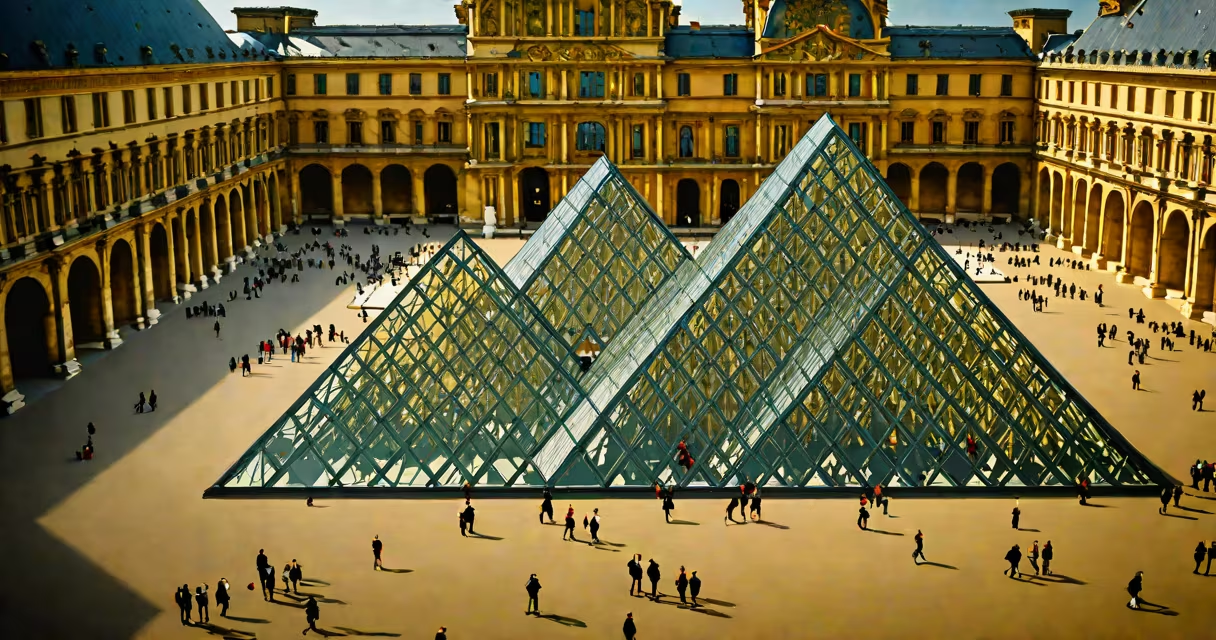
Visitors enter through the iconic glass pyramid designed by architect I.M. Pei, which serves as the main entrance. Beneath the pyramid lies a subterranean lobby that connects to the museum's central courtyard. From there, visitors move through a network of galleries filled with artifacts from Mesopotamia, Egypt, Greece, Rome, and the Islamic world, followed by European masterpieces from the Renaissance to Impressionism.
The Louvre's most visited artworks are displayed in the Denon Wing, which contains the majority of its Western European paintings and sculptures. The Mona Lisa, painted by Leonardo da Vinci around 1503-1506, occupies a climate-controlled, bulletproof enclosure behind thick glass. It draws approximately 10 million visitors annually, with crowds often forming hours before opening.
Another centerpiece is the Venus de Milo, a Hellenistic statue carved between 130 and 100 BCE. Standing 2.03 meters tall, it depicts Aphrodite, the goddess of love, and is renowned for its missing arms, which have sparked decades of speculation about their original position.
The Winged Victory of Samothrace, discovered in 1863 on the Greek island of Samothrace, is a Hellenistic marble sculpture of Nike, the goddess of victory. Carved around 190 BCE, it stands 2.44 meters high and appears to descend from the sky, her drapery flowing dramatically. The statue is displayed on a grand staircase leading to the upper levels of the Denon Wing.
| Artwork | Period | Location | Notable Feature |
|---|---|---|---|
| Mona Lisa | Renaissance | Denon Wing, Room 711 | Portrait of Lisa Gherardini; painted in oil on poplar wood |
| Venus de Milo | Hellenistic | Denon Wing, Room 345 | Marble statue of Aphrodite; missing arms |
| Winged Victory of Samothrace | Hellenistic | Denon Wing, Grand Staircase | Statue of Nike; changing pose with wind-blown drapery |
| Code of Hammurabi | Old Babylonian | Sully Wing, Room 300 | Basalt stele with 282 laws inscribed in cuneiform |
Outside the Denon Wing, the Sully Wing hosts the museum's extensive collection of ancient Near Eastern artifacts. Among them is the Code of Hammurabi, a 2.25-meter-tall basalt stele inscribed with 282 legal codes from 1754 BCE. The laws follow the principle of "an eye for an eye," reflecting early systems of justice.
The Islamic Art department, located in the Richelieu Wing, displays over 10,000 objects from the 7th to 19th centuries. Notable pieces include the 12th-century Alhambra-style ceiling panel from Spain and the 14th-century Persian manuscript of the Shahnameh, an epic poem of Persian mythology.
Many assume the Louvre is solely about European art. In reality, nearly half of its permanent collection comes from non-Western civilizations. The Egyptian Antiquities department alone holds over 50,000 artifacts, including the colossal statue of Ramesses II, which measures 3.1 meters in height and weighs 80 tons.
Another misconception is that the Louvre's glass pyramid is the oldest part of the building. It was completed in 1989 and replaced the original 18th-century courtyard. The pyramid is a modern addition, not a historical feature. The original palace structure dates back to 1190, when Philip II began construction on a fortress to defend Paris.
A lesser-known fact: the Louvre's underground galleries contain a hidden network of tunnels and storage areas. These were used during World War II to hide over 20,000 artworks from Nazi looting. The museum's director at the time, Jacques Jaujard, orchestrated the evacuation of key pieces to châteaux in the French countryside. This effort preserved much of Europe's cultural heritage.
I visited the Louvre in October 2022 during a weekend morning. I arrived at 9:00 AM, just after opening. The queue at the pyramid entrance was under 15 minutes long. I entered via the underground lobby and took the free audio guide, which offers 30-minute thematic tours in five languages.
I spent four hours exploring the Denon Wing. The Mona Lisa was visible from 10 meters away, but the crowd made close viewing impossible. I moved to the nearby Room 711, where a smaller version of the painting is displayed on a monitor. This allowed me to study the brushwork and composition without obstruction.
For efficient navigation, the Louvre provides a free map with color-coded zones. Red zones indicate major highlights. I followed the red path: entrance → pyramid → Denon Wing → Sully Wing → Richelieu Wing. I skipped the temporary exhibitions, which require separate tickets, and focused on permanent collections.
The Louvre does not house the entire French national art collection. Some items, such as Monet's Water Lilies series, are kept at the Musée de l'Orangerie. The Louvre also doesn't display contemporary art. That responsibility falls to the Centre Pompidou, located just 1.5 kilometers away.
The museum does not allow photography in the main galleries. Flash photography is banned near fragile works like the Mona Lisa. Visitors may take photos in designated areas only, such as the courtyard and the pyramid's interior.
Despite popular belief, the Louvre is not a single building. It consists of three main wings connected by underground passages: the Richelieu Wing (east), the Denon Wing (south), and the Sully Wing (west). The Louvre's footprint covers 18 acres, making it larger than the Vatican Museums and the British Museum combined.
Understanding what is inside the Louvre requires knowing it's not just a repository of famous paintings. It's a living archive of human creativity across millennia. The museum's mission, as stated on its official website, is to "make the world's artistic heritage accessible to all." This includes digitizing over 480,000 objects and offering free online access to 100,000 high-resolution images through the Louvre's online collection.
When you ask "what is inside the Louvre," the answer isn't just a list of artworks. It's a process through time-from ancient Mesopotamian tablets to Van Gogh's sunflowers. The museum's strength lies in its diversity, scale, and accessibility. browsing a digital exhibit on Assyrian reliefs, you're engaging with history in real time.