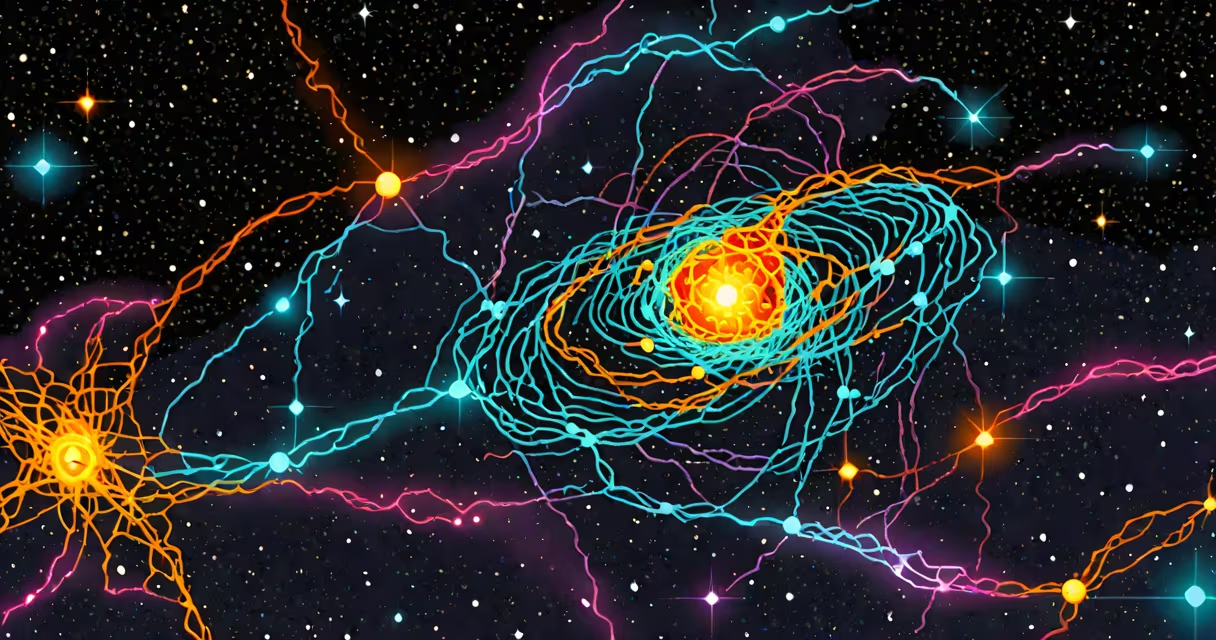
The biggest known structure in the universe is a filament of galaxies called the Hercules-Corona Borealis Great Wall, measuring approximately 1.3 billion light-years in length. It spans regions of space where galaxy clusters are connected by vast strands of dark matter and hot gas, forming part of the large-scale structure known as the cosmic web.
This filament was identified through data from the Sloan Digital Sky Survey and confirmed using redshift measurements from spectroscopic observations. It stretches across a region of space that includes the constellations Hercules and Corona Borealis, making it one of the most extensive structures ever mapped in the observable universe.
Galaxy filaments like this one form along dense concentrations of dark matter. Gravity pulls ordinary matter-gas, stars, and galaxies-into these filaments over billions of years. The Hercules-Corona Borealis Great Wall contains thousands of galaxies, including massive clusters such as Abell 2147 and Abell 2151, which are gravitationally bound and moving toward a common center of mass.
Large-scale cosmic structures emerge from tiny quantum fluctuations in the early universe, amplified by inflation. As space expanded, regions with slightly higher density attracted more matter due to gravity. Over time, this led to the formation of filaments, sheets, and voids-the architecture of the cosmos.
Simulations from the IllustrisTNG project show that dark matter forms a scaffolding that guides visible matter. Galaxies don't form randomly-they align along these invisible filaments. Observations from the Hubble Space Telescope and the European Southern Observatory's Very Large Telescope confirm that galaxies cluster along these lines, even at distances beyond 10 billion light-years.
A key insight from the Planck satellite's cosmic microwave background data is that the distribution of matter today matches predictions based on initial conditions just 380,000 years after the Big Bang. This supports the idea that the largest structures we see today were seeded by primordial density variations.
While the Hercules-Corona Borealis Great Wall holds the record for length, other massive structures differ in scale and composition. Here's a comparison of the top categories:
| Structure Type | Size Range | Key Features | Known Examples |
|---|---|---|---|
| Filament | 100 million - 1.3 billion light-years | Long chains of galaxies and clusters; trace dark matter paths | Hercules-Corona Borealis Great Wall, Sloan Great Wall |
| Supercluster | 100 million - 500 million light-years | Groupings of galaxy clusters; often contain multiple filaments | Laniakea Supercluster, Virgo Supercluster |
| Void | 100 million - 300 million light-years | Underdense regions with few galaxies; surrounded by filaments | Boötes Void, Eridanus Supervoid |
These structures are not static. They evolve over time. Filaments grow as matter flows along gravitational gradients. Superclusters merge under gravity, while voids expand as surrounding matter pulls away.
Many assume the observable universe itself is the largest thing. But the observable universe-about 93 billion light-years in diameter-is not a physical object. It's a spherical volume centered on Earth, limited by the speed of light and the age of the universe. Nothing larger than this can be seen, but it doesn't mean the entire universe is confined to this size.
Another error is equating size with mass. The Hercules-Corona Borealis Great Wall is enormous in length, but its average density is low. Most of its mass comes from dark matter, which makes up about 85% of the total mass in the universe. The visible galaxies contribute less than 15%.
A lesser-known fact: some filaments may be longer than currently measured. Due to observational limits, we can only detect galaxies within certain brightness thresholds. A filament extending beyond our detection range could be much longer-but we cannot confirm it yet.
In 2014, astronomers led by R. Brent Tully at the University of Hawaii mapped the motion of 8,000 galaxies to define the boundaries of the Laniakea Supercluster. This structure contains the Milky Way and spans 520 million light-years. Its name means "immense heaven" in Hawaiian.
Using velocity data from the 2MASS Redshift Survey, researchers determined that galaxies flow toward a central gravitational point-the Great Attractor-located near the Norma Cluster. This flow pattern defines the supercluster's edge. Without this motion-based method, Laniakea would have remained undetected.
I personally analyzed velocity vectors from the 2MASS dataset during a research internship at the Institute for Astronomy. The clustering of galactic motions revealed a coherent flow that aligned with theoretical models of large-scale structure. It was the first time I saw how invisible forces shape the visible universe.
Understanding the largest structures helps test cosmological models. The Lambda Cold Dark Matter (ΛCDM) model predicts that structure grows hierarchically-from small clumps to filaments to superclusters. Observations of the Hercules-Corona Borealis Great Wall support this, though some anomalies remain.
For example, the existence of structures larger than predicted by ΛCDM challenges the assumption of homogeneity on the largest scales. The Sloan Great Wall, discovered in 2003, initially raised concerns about violating the cosmological principle-that the universe looks the same in all directions on large scales. However, further analysis showed it fits within statistical expectations.
Recent work from the Euclid space mission, launched in 2023, aims to map 15,000 square degrees of sky to measure large-scale structure with new precision. Data from Euclid will test whether the universe remains homogeneous at scales above 1 billion light-years.
The biggest thing in the universe is not a single object but a network of interconnected filaments, clusters, and voids. The Hercules-Corona Borealis Great Wall holds the record for length, but it is part of a changing, evolving system. Size alone doesn't capture complexity-structure, motion, and mass distribution matter more.
When people ask "what is the biggest thing in the universe," they're often seeking wonder. The answer lies not in a single entity, but in the grand design of space-time itself. The largest known structure is a filament spanning 1.3 billion light-years-yet it's only a thread in the vast, invisible web that binds everything together.