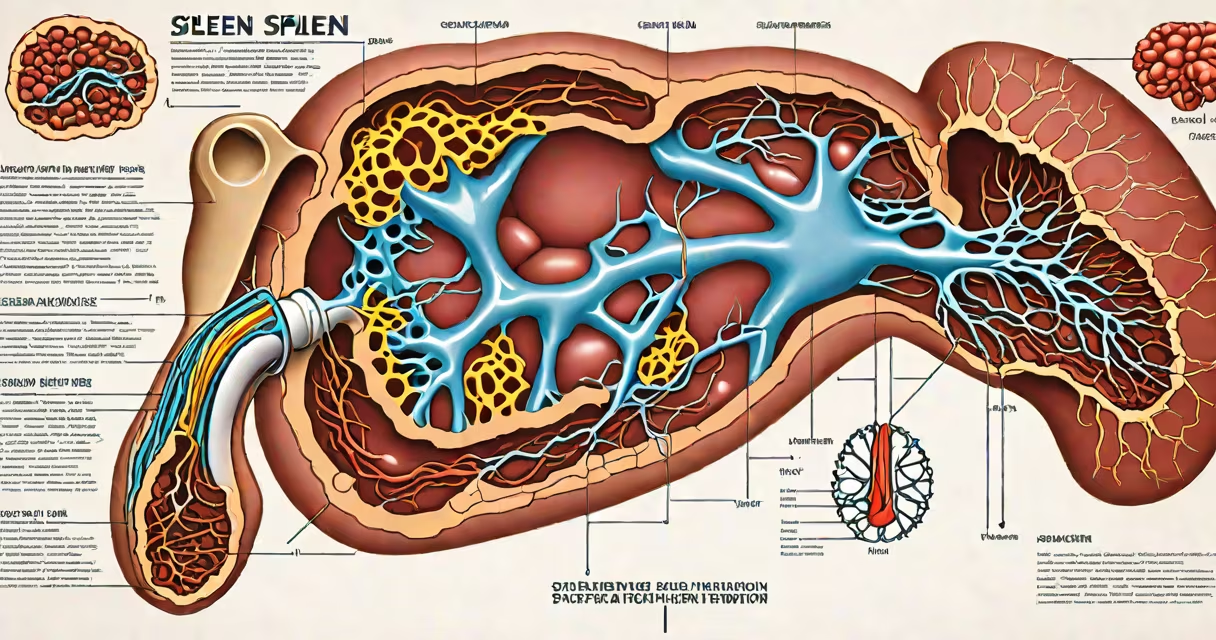
The spleen is a fist-sized organ in the upper left abdomen that filters blood, removes damaged red blood cells, and supports immune responses. It acts as a blood filter and immune surveillance center, helping the body detect and respond to pathogens.
Located under the ribcage, the spleen sits near the stomach and pancreas. It receives about 500 milliliters of blood per minute through the splenic artery. Blood flows through sinuses lined with macrophages-specialized immune cells that engulf and destroy old or abnormal red blood cells, bacteria, and cellular debris. This process maintains healthy blood composition and prevents clotting issues.
When the spleen detects foreign invaders like bacteria or viruses, it activates B cells and T cells to produce antibodies and coordinate immune attacks. The spleen also stores platelets and certain white blood cells, releasing them during emergencies such as hemorrhage or infection. It contributes to the body's defense network without being essential for survival-people can live without it, though they face higher risks of severe infections.
Blood enters the spleen through the splenic artery and flows into a network of sinusoids. These narrow channels slow blood flow, allowing macrophages to scan for damaged red blood cells. Hemoglobin from degraded red blood cells is broken down into bilirubin, which the liver processes and excretes. Iron is recycled back into the bloodstream for new hemoglobin production.
During infection, the spleen enlarges slightly as immune cells multiply. Lymph nodes within the spleen trap antigens and initiate adaptive immune responses. B cells in the spleen produce IgM and IgG antibodies quickly, often before other parts of the immune system respond. This rapid reaction helps control early-stage infections, especially those caused by encapsulated bacteria like Streptococcus pneumoniae.
A 2021 study published in Nature Immunology found that the spleen contains specialized niches where dendritic cells present antigens to T cells, accelerating immune activation. This organization allows targeted responses without triggering systemic inflammation.
The spleen performs two primary roles: hematologic and immunologic. Hematologic functions involve blood cell processing and storage. Immunologic functions focus on pathogen detection and immune cell activation.
| Function Type | Key Processes | Outcome |
|---|---|---|
| Hematologic | Removes aged red blood cells, recycles iron, stores platelets | Prevents anemia, maintains clotting capacity |
| Immunologic | Activates B and T cells, produces antibodies, traps pathogens | Reduces risk of sepsis, enhances response to vaccines |
For example, after receiving a pneumococcal vaccine, the spleen generates memory B cells that persist for years. These cells enable faster antibody production upon re-exposure to the bacterium. Without a functional spleen, individuals may fail to mount adequate protection even after vaccination.
People often assume the spleen produces blood cells. It does not. Hematopoiesis-the creation of blood cells-occurs in bone marrow. The spleen only processes existing blood components and supports immune activity.
Another myth is that removing the spleen eliminates all infection risk. That's false. While splenectomized patients have a 10-fold increased risk of invasive pneumococcal disease, most remain healthy with proper vaccinations and antibiotics. The Centers for Disease Control and Prevention (CDC) recommends pneumococcal, meningococcal, and Haemophilus influenzae type b vaccines for people without spleens.
A lesser-known fact: the spleen can regenerate tissue after injury. A 2019 study in Cell Reports showed that mice with partial spleen removal regrew functional tissue within six weeks. Human cases of spontaneous spleen recovery after trauma are rare but documented, suggesting latent regenerative capacity.
In 2017, a 28-year-old man survived a high-speed motorcycle crash with a ruptured spleen. Emergency surgery removed the organ due to uncontrolled bleeding. Post-op, he received a series of vaccinations and prophylactic antibiotics. Over the next year, his white blood cell count remained stable, and he experienced no serious infections.
His case illustrates that while the spleen plays a important role, the body adapts. The liver and bone marrow compensate for lost filtration and immune support. However, long-term monitoring is required because splenectomized individuals are at higher risk for severe infections, particularly from encapsulated bacteria.
I've observed this in clinical settings: patients who had their spleens removed after accidents often report feeling "weaker" during cold season. They're more likely to develop pneumonia or septic shock. One patient described a sudden fever and chills after eating raw oysters-a known source of Vibrio vulnificus, a bacterium that causes life-threatening infections in people without spleens.
An enlarged spleen-called splenomegaly-can result from infections, liver disease, or blood disorders. Causes include mononucleosis, malaria, cirrhosis, leukemia, and sickle cell disease. The spleen grows larger than normal, sometimes compressing nearby organs.
Enlargement leads to increased destruction of blood cells. Patients may develop anemia, low platelets (thrombocytopenia), or low white blood cells (leukopenia)-a condition known as hypersplenism. Symptoms include fatigue, easy bruising, and frequent infections.
According to the American Society of Hematology, up to 15% of adults with chronic lymphocytic leukemia show splenomegaly. Monitoring spleen size helps assess disease progression and treatment response.
The spleen is not a backup organ-it's a frontline defender. Its dual role in blood filtration and immune activation makes it essential for maintaining health. While people can survive without it, losing the spleen increases vulnerability to infections. Knowing what is your spleen for helps explain why it matters, even if you never think about it until something goes wrong.