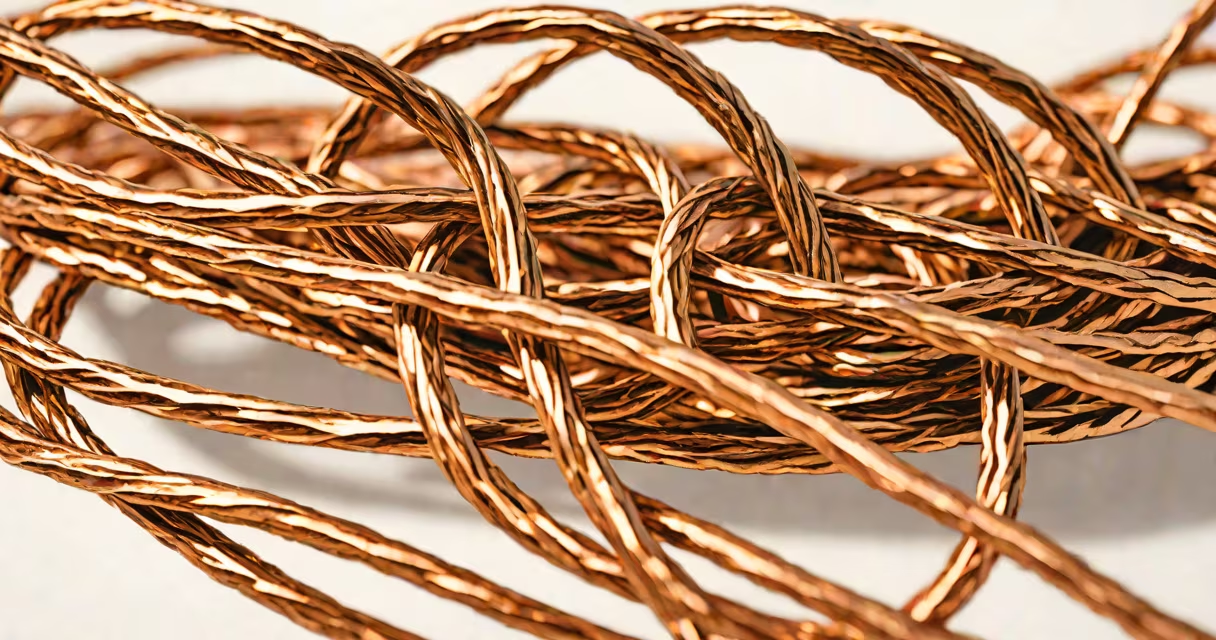
0 gauge wire has a diameter of 8.25 millimeters. This size is standardized under the American Wire Gauge (AWG) system, which defines wire thickness using a numerical scale where lower numbers indicate thicker wires.
The AWG system uses a logarithmic progression: each decrease of 3 AWG steps doubles the cross-sectional area. From 1 AWG to 0 AWG, the wire increases by 25% in area. The jump from 0 AWG to -1 AWG (not standard) would continue this pattern, but 0 AWG remains the thickest common gauge in the system.
For context, 0 AWG wire is roughly the width of a large pencil or a thick marker. It's used in heavy-duty electrical applications such as battery cables, grounding systems, and industrial power distribution where high current capacity is essential.
The AWG system was developed in the United States in the late 19th century to standardize wire sizes. It's based on a mathematical relationship between gauge number and wire diameter. As the gauge number decreases, the wire gets thicker.
Each step down in AWG reduces the diameter by approximately 10.5%. For example, 1 AWG is about 7.35 mm in diameter, while 0 AWG is 8.25 mm-a 12.3% increase. This consistent ratio ensures predictable performance across different gauges.
Wire thickness affects resistance and current-carrying capacity. Thicker wires have lower resistance and can handle higher currents without overheating. A 0 AWG wire can safely carry up to 150 amps in continuous service, depending on insulation and ambient temperature.
0 AWG is frequently used in automotive battery cables. These cables connect the battery to the starter motor and other high-draw components. Their low resistance minimizes voltage drop during engine cranking, ensuring reliable ignition.
Industrial settings also rely on 0 AWG for power distribution. Large motors, welding equipment, and backup generators often use this gauge for main feed lines. In solar installations, 0 AWG may serve as the main DC conductor from arrays to inverters.
Electric vehicle (EV) charging stations sometimes use 0 AWG for AC input lines. The National Electrical Code (NEC) requires specific ampacity ratings for conductors, and 0 AWG meets Class 1 and Class 2 requirements for circuits up to 150A.
While 0 AWG is a single defined size, variations exist based on material and insulation. Copper is most common due to its high conductivity. Aluminum 0 AWG is used in overhead power lines but requires larger diameters for equivalent current capacity.
Insulation materials affect performance. Thermoplastic (PVC) insulation allows use up to 60°C, while cross-linked polyethylene (XLPE) supports temperatures up to 90°C. High-temperature environments demand insulated 0 AWG rated for 105°C or higher.
| Gauge | Diameter (mm) | Cross-Sectional Area (mm²) | Typical Use |
|---|---|---|---|
| 0 AWG | 8.25 | 53.5 | Battery cables, industrial power |
| 1 AWG | 7.35 | 42.4 | Home service panels, subpanels |
| 2 AWG | 6.54 | 33.6 | Large branch circuits, solar arrays |
Some manufacturers produce 0 AWG in stranded configurations. Stranded wire improves flexibility and vibration resistance, making it ideal for mobile equipment like construction machinery and marine vessels.
0 AWG is not the same as 00 AWG (double-zero). 00 AWG is thinner than 0 AWG-diameter 9.27 mm-and is used in very high-current applications like utility transmission lines. Confusing the two can lead to undersized wiring, risking overheating and fire.
Also, 0 AWG is not interchangeable with metric wire sizing. A 10 mm diameter wire is thicker than 0 AWG (8.25 mm) and would require a custom specification. Always verify dimensions against the correct standard.
One common mistake is assuming that gauge number correlates linearly with thickness. In reality, the relationship is exponential. A 0 AWG wire is nearly twice the cross-sectional area of 10 AWG, despite being only 10 steps apart on the scale.
I once measured a 0 AWG battery cable during a vehicle repair. Using digital calipers, I confirmed the diameter was 8.25 mm. The cable had a rubber jacket and braided copper strands. When I bent it, the strands flexed smoothly-indicating good flexibility for repeated handling.
During installation, I noticed the terminal clamps were oversized. They had to be pressed onto the wire with a hydraulic crimper. Standard hand tools wouldn't work. This reinforced how physically demanding 0 AWG installation can be.
For precision measurements below 1 mm, engineers use the micron gauge. A micron is one-thousandth of a millimeter. While 0 AWG is measured in whole millimeters, micron gauges track tolerances in thin films, coatings, and microelectronics.
For example, a semiconductor wafer might be specified as 100 microns thick-equivalent to 0.1 mm. This level of precision isn't needed for power cables but is critical in manufacturing integrated circuits.
0 gauge wire is 8.25 millimeters in diameter. It's part of the American Wire Gauge system, designed for high-current applications. Its thickness enables safe, efficient power delivery in vehicles, industry, and renewable energy systems. Always confirm gauge specifications to avoid safety risks.