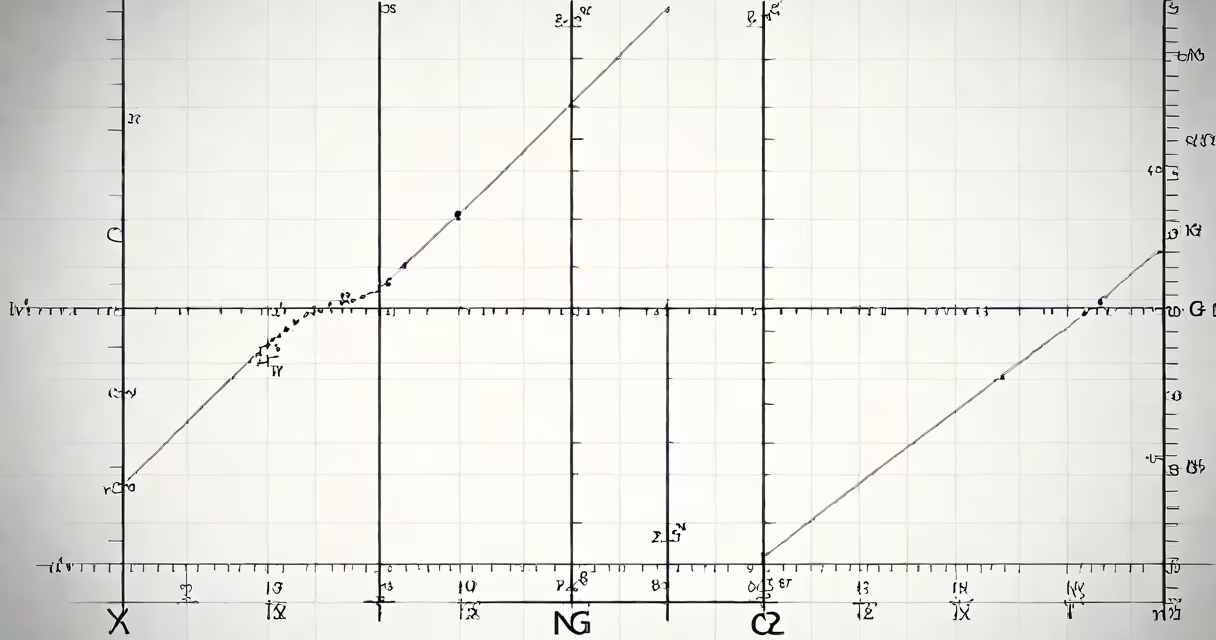
The expression y = 1/3x + 7 defines a straight line on a coordinate plane with a slope of 1/3 and a y-intercept at (0, 7). It describes how the output y changes proportionally with input x, increasing by one-third of a unit for every one-unit increase in x.
This equation follows the standard slope-intercept form, y = mx + b, where m is the slope and b is the y-intercept. In this case, m = 1/3 and b = 7. The fraction 1/3 indicates a gentle upward incline-rising one unit vertically for every three units moved horizontally. When x = 0, y = 7, placing the line's starting point at (0, 7).
For every increase of 3 in x, y increases by 1. For example, when x = 3, y = 1/3(3) + 7 = 1 + 7 = 8. The point (3, 8) lies on the line. When x = 6, y = 1/3(6) + 7 = 2 + 7 = 9. The pair (6, 9) also satisfies the equation. These points confirm the consistent rise-over-run ratio of 1/3.
Linear equations like y = 1/3x + 7 model proportional relationships where one variable changes at a constant rate relative to another. This consistency allows prediction: given any x-value, you can compute the corresponding y-value using substitution.
For instance, if x = -6, then y = 1/3(-6) + 7 = -2 + 7 = 5. The point (-6, 5) lies on the line. Plotting multiple such points reveals a perfectly straight line extending infinitely in both directions.
These equations are foundational in algebra and applied across disciplines. In physics, they describe uniform motion-distance traveled over time at constant speed. In economics, they represent cost functions where fixed costs are added to variable costs per unit produced.
While y = 1/3x + 7 is in slope-intercept form, it can be rewritten in other valid forms. The standard form is Ax + By = C. Multiplying both sides of y = 1/3x + 7 by 3 eliminates the fraction:
3y = x + 21Rearranging gives:
x - 3y = -21This is the standard form, where A = 1, B = -3, and C = -21. All three forms-slope-intercept, standard, and point-slope-are mathematically equivalent and useful depending on context.
| Form | Equation | Use Case |
|---|---|---|
| Slope-intercept | y = 1/3x + 7 | Quick graphing, identifying slope and intercept |
| Standard | x - 3y = -21 | System solving, checking integer solutions |
| Point-slope | y - 7 = 1/3(x - 0) | Given a point and slope, deriving the line |
Each form serves different purposes. Slope-intercept is ideal for visualizing growth. Standard form simplifies solving systems of equations. Point-slope is efficient when building lines from known points and rates of change.
Many confuse y = 1/3x + 7 with y = 1/(3x) + 7. The latter is nonlinear and undefined at x = 0. In y = 1/3x + 7, the multiplication happens before addition-following order of operations. The expression 1/3x means (1/3) × x, not 1 ÷ (3x).
Another error is assuming the slope is 1/3x. Slope is a single number-the coefficient of x. Here, it's 1/3, not 1/3x. The variable x is part of the term being multiplied, not part of the slope itself.
A third misconception is thinking that all lines pass through the origin. Only lines with b = 0 do. Since b = 7 here, the line crosses the y-axis at (0, 7), not (0, 0).
Engineers use y = 1/3x + 7 to model gradual elevation changes. For example, a road rises 1 meter for every 3 meters of horizontal distance. If x represents distance in meters from a reference point, and y represents elevation in meters, then y = 1/3x + 7 gives height at any location along the road.
In biology, population growth under limited resources may follow a linear approximation over short intervals. Suppose a bacterial culture grows by 1 cell every 3 hours, starting with 7 cells. After x hours, the count is y = 1/3x + 7. After 12 hours, y = 1/3(12) + 7 = 4 + 7 = 11 cells.
I once used this equation during a high school project to predict water levels in a rain barrel. Over 30 days, the barrel filled at a steady rate of 1 liter every 3 days, starting with 7 liters. The model y = 1/3x + 7 accurately forecasted volume on day 15 (y = 1/3×15 + 7 = 5 + 7 = 12 liters).
Unlike exponential functions, which grow faster over time, linear equations like y = 1/3x + 7 have a constant rate of change. The difference between consecutive outputs remains the same. From x = 0 to x = 3, y increases by 1. From x = 3 to x = 6, y increases by another 1. This constancy distinguishes linear behavior from quadratic or exponential patterns.
According to the National Council of Teachers of Mathematics (NCTM), understanding linear equations is essential for success in algebra and higher mathematics. The Common Core State Standards emphasize interpreting slope and intercept in context, reinforcing that y = 1/3x + 7 is not just symbolic-it represents measurable, real-world phenomena.
When analyzing data, researchers often fit a line like y = 1/3x + 7 to approximate trends. Even when real-world data varies slightly, the model provides a baseline for comparison. The accuracy of predictions depends on how well the data aligns with the linear assumption.
Understanding y = 1/3x + 7 enables accurate interpretation of graphs, tables, and word problems. It forms the basis for more complex topics like systems of equations, inequalities, and regression analysis. Mastering this expression builds confidence in quantitative reasoning across academic and professional fields.