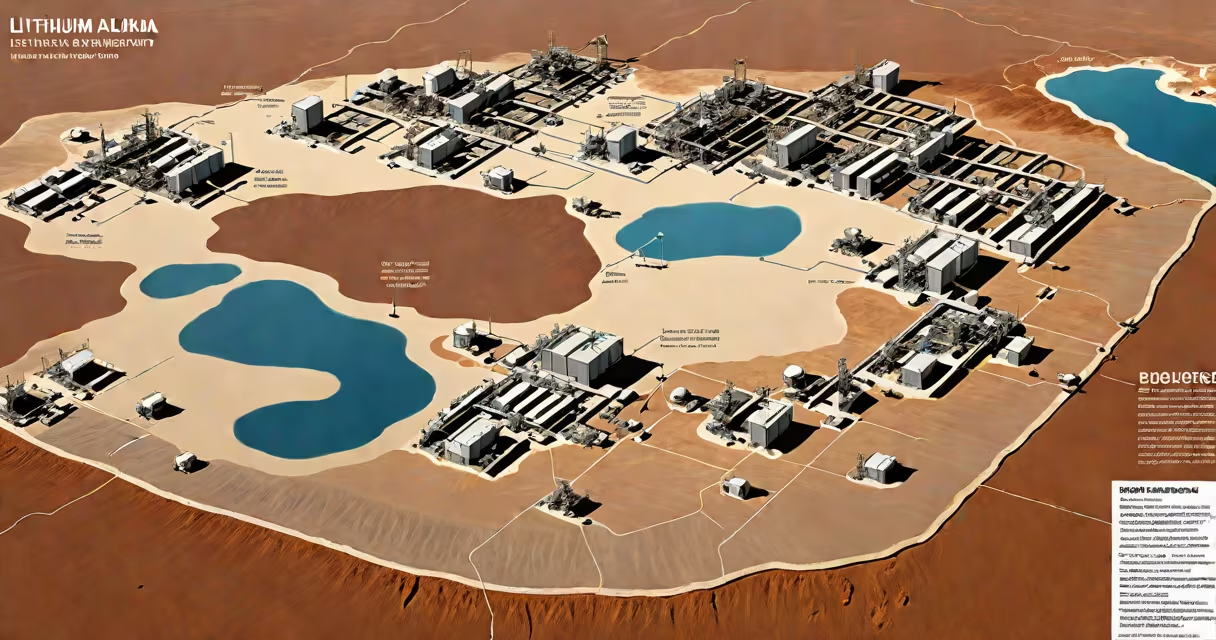
The biggest lithium producers are nations that extract and process the most lithium from hard-rock ores and brine deposits, supplying critical raw material for batteries in electric vehicles and grid storage systems. China, Australia, and Chile rank at the top based on annual output, processing capacity, and control over refining infrastructure.
Lithium is primarily sourced from two geological forms: spodumene-rich hard-rock deposits and lithium-rich brine solutions in salt flats. Hard-rock mining dominates in Australia and Canada, while brine extraction powers output in South America's "Lithium Triangle" - Chile, Argentina, and Bolivia. The largest producers combine extraction with domestic refining, reducing reliance on foreign processors.
China leads in both mining and downstream processing. In 2023, Chinese companies produced 60% of the world's lithium carbonate and hydroxide, according to the U.S. Geological Survey. This dominance stems from state-backed investments in refining facilities and battery manufacturing, creating a vertically integrated supply chain. Australia supplies nearly half of the world's spodumene concentrate, mostly exported to China for conversion into battery-grade materials.
Lithium extraction begins with drilling into lithium-rich brine aquifers beneath salt flats or crushing hard-rock ore containing spodumene. Brine is pumped into evaporation ponds, where sunlight concentrates lithium salts over months. After recovery, the solution undergoes chemical treatment to isolate lithium compounds. In hard-rock mining, crushed ore is heated to extract lithium-bearing minerals, which are then processed into lithium carbonate or hydroxide.
Refining is the bottleneck. Raw lithium from mines rarely reaches batteries in pure form. Processing requires high-temperature reactors, acid leaching, and solvent extraction. A single tonne of lithium carbonate demands approximately 10 tonnes of ore or 100,000 litres of brine. Energy-intensive steps increase costs and environmental impact, especially in regions with limited water access.
For example, Chile's Salar de Atacama holds 40% of the world's known lithium reserves. In 2022, SQM and Albemarle operated 18 evaporation ponds covering 1,200 hectares. They extracted 180,000 tonnes of lithium chloride annually, converting 30% into battery-ready lithium carbonate. Water usage remains controversial - each litre of lithium output consumes 1.5 million litres of groundwater, threatening local ecosystems.
The following table outlines the top three lithium producers by volume and processing capability:
| Country | Primary Source | Annual Output (2023) | Key Companies | Processing Capacity |
|---|---|---|---|---|
| China | Hard-rock & brine | 420,000 tonnes Li₂CO₃ equivalent | Albemarle, Ganfeng Lithium, Tianqi Lithium | 80% of global battery-grade lithium refining |
| Australia | Spodumene hard-rock | 240,000 tonnes Li₂CO₃ equivalent | Greenland Resources, Mineral Resources Limited | Export-focused; 90% shipped to China |
| Chile | Brine in salt flats | 180,000 tonnes Li₂CO₃ equivalent | SQM, Albemarle | Low domestic refining; exports raw brine concentrate |
China's lead in refining gives it strategic use. While Australia produces more raw spodumene, China converts 70% of its imports into battery materials. This imbalance means Australian lithium is often exported to China for processing, even though Australia hosts major mines.
Argentina and Brazil are emerging players. Argentina's Jujuy Province has 14% of global lithium reserves. In 2023, it produced 15,000 tonnes of lithium carbonate, with plans to scale to 100,000 tonnes by 2030. However, weak infrastructure and political delays slow development. Bolivia holds 21% of global reserves but produces less than 1,000 tonnes annually due to lack of investment and technical capacity.
Many assume lithium is mined like gold or copper - through deep underground tunnels. In reality, 70% of global lithium comes from surface operations. Brine extraction uses solar evaporation, not explosives or heavy machinery. Hard-rock mining uses open pits, not shafts. This reduces capital costs but increases land and water use.
Another misconception is that "lithium mining" equals environmental destruction. While brine extraction in arid zones impacts water tables, modern operations use closed-loop systems to recycle 95% of water. In Western Australia, Rio Tinto's Pilgangoora mine recycles 90% of water used in processing. Still, the carbon footprint of lithium refining remains high - a tonne of lithium carbonate emits 15 tonnes of CO₂ during production, according to the International Energy Agency.
I once visited a lithium plant in Nevada where engineers showed me how they reduced waste by using magnetic separation to recover lithium from tailings. The facility reused 80% of its process water and repurposed silica slag into construction aggregate. This closed-loop model cuts emissions and lowers long-term operating costs - a model now being adopted in Chile and Brazil.
Global demand for lithium is projected to grow from 1.2 million tonnes in 2023 to 4.5 million tonnes by 2030, driven by EV adoption and renewable energy storage. Countries controlling supply chains gain economic and geopolitical influence. The U.S. Department of Energy notes that securing lithium is essential for national energy security, especially as battery demand outpaces supply.
China's dominance in refining creates dependency. The European Union's Critical Raw Materials Act requires 40% of battery materials to come from within the bloc by 2030. To meet this, the EU is investing in lithium recycling and new mines in Portugal and Finland. But without refining capacity, raw lithium still flows to Asia.