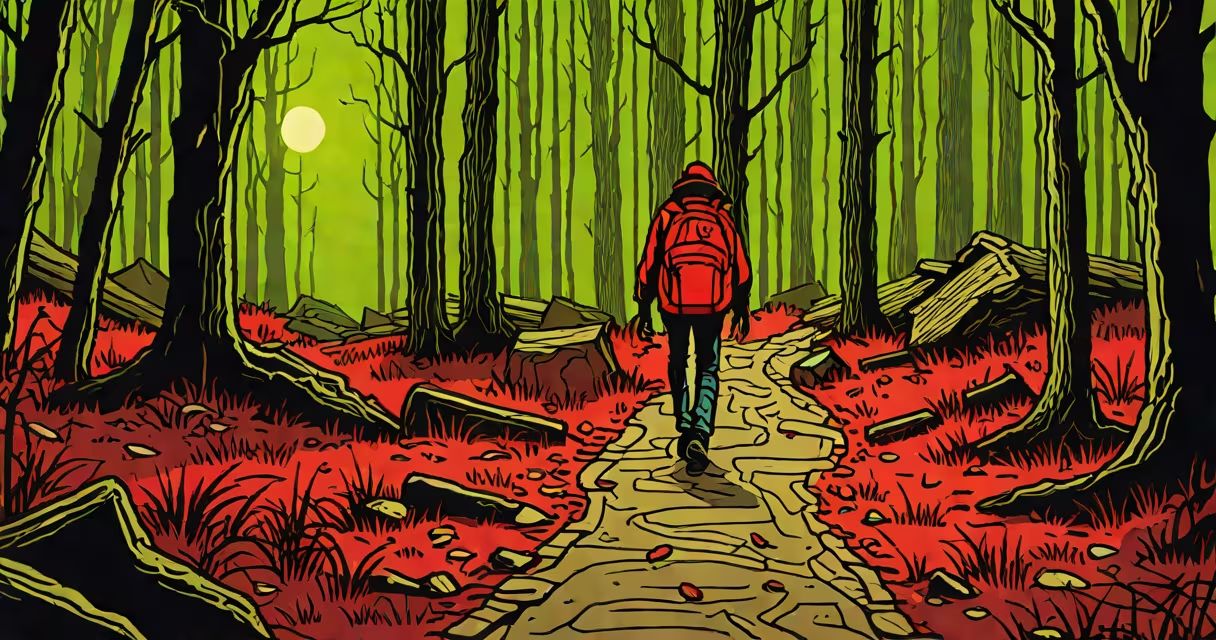
The bruja de blair is a fictional supernatural entity from the 1999 film Blair Witch Project, portrayed as a vengeful spirit tied to a cursed woodland in Maryland. The name combines Spanish "bruja" (witch) with "Blair," referencing the film's fictionalized town and the mythos built around it. The character is not based on a real historical figure but draws from American folk horror traditions, particularly Appalachian legends about shape-shifting spirits and haunted forests.
Created by directors Daniel Myrick and Eduardo Sánchez, the bruja de blair emerged from a deliberate blend of documentary realism and mythic dread. The film's narrative structure-presented as recovered footage-frames the witch as a psychological and spiritual force rather than a physical being. Her existence is confirmed only through fragmented evidence: footprints, carved symbols, and audio distortions. This ambiguity is central to her power: she is less a monster and more a manifestation of fear itself.
She is not a traditional witch from European folklore. Unlike figures such as the Norse Huldra or Slavic Baba Yaga, who have established mythological roles, the bruja de blair was invented for cinematic effect. Yet her design reflects real-world anxieties. The filmmakers studied local legends from the Black Hills region of Maryland, including stories of missing children and unexplained disappearances. These were adapted into a narrative where the forest consumes those who enter it unprepared. The witch becomes a symbol of isolation, disorientation, and the breakdown of rational thought under pressure.
The bruja de blair operates through psychological manipulation and environmental distortion. She does not appear in full form until the film's final act. Instead, she is felt-a presence in the wind, a whisper in the trees, a shadow moving just beyond frame. Her influence is measured in time loss, memory fragmentation, and sensory overload. Characters report hearing voices, seeing figures in peripheral vision, and experiencing sudden temperature drops.
This method of storytelling relies on the audience's own fears. The film uses handheld cameras, shaky framing, and natural lighting to simulate authenticity. When a character turns to look at a sound, the camera often cuts away before revealing the source. This technique forces viewers to imagine the witch themselves, making her more terrifying than any CGI creature could be.
One key scene illustrates this: the protagonist Heather, after losing her friends, walks through a dense grove at night. She hears footsteps behind her. The camera pans slowly toward the sound, then cuts to black. No visual confirmation occurs. The silence lasts 17 seconds. The absence of the witch is more disturbing than her appearance would be. This moment is cited in British Council Voices as a masterclass in suspense construction.
The name "bruja de blair" is a linguistic hybrid. "Bruja" is Spanish for "witch," a term often associated with Latin American and Iberian folk traditions. "Blair" references the fictional town of Blair, Maryland, which the filmmakers created as a setting. The combination suggests a fusion of cultural mythologies, implying a witch born from the collision of immigrant stories and American wilderness myths.
Historical research shows that similar legends existed in Appalachia. According to the Library of Congress's collection of American folk tales, stories of "the woman in the woods" circulated in rural Maryland and Pennsylvania during the 19th century. These accounts described women who lured travelers off trails, sometimes leading them to their deaths. Some versions claimed they were former outcasts or widows driven mad by grief. Others said they were punished spirits, eternally bound to the land.
The film's creators never claimed the bruja de blair was based on a specific real event. However, they did visit actual locations in Maryland's Allegheny Mountains to scout settings. A cabin near Burkittsville, Maryland, was used as a filming location and later became a tourist attraction. Visitors report hearing faint whispers at night, though no scientific evidence supports paranormal activity. The site remains a pilgrimage point for fans of the genre.
Many people assume the bruja de blair is a real entity or that the film's events actually happened. This confusion stems from the film's marketing campaign, which used fake news reports, interviews with "survivors," and a website claiming the witch still roams the woods. The creators admitted in a 2013 interview that the deception was intentional: "We wanted people to believe it was real. That's how you make fear feel true."
Another misconception is that the witch is a female figure in traditional costume. In reality, she appears in multiple forms-sometimes as a child, sometimes as a skeletal woman, always distorted by distance and poor lighting. Her most iconic image is a silhouette with long arms and a tattered dress, but even this is never seen. The lack of visual clarity is intentional. The filmmakers stated they wanted the audience to project their own fears onto the figure.
A third error is equating the bruja de blair with other horror icons like Freddy Krueger or Jason Voorhees. Unlike those characters, who are consistent in appearance and behavior, the bruja de blair defies classification. She doesn't kill for sport. She doesn't speak. She doesn't follow rules. Her actions are unpredictable and tied to the environment. She is not a villain but a consequence-an outcome of entering forbidden space.
The bruja de blair exists in several interpretive layers, each reflecting different cultural responses to the film:
| Type | Description | Example |
|---|---|---|
| Mythic | Rooted in regional folklore, treated as a real entity in fan communities. | Online forums claim sightings near the original filming site. |
| Cinematic | Defined by the film's narrative and visual language. | Her appearance in the 2016 reboot is stylized and less ambiguous. |
| Psychological | Interpreted as a metaphor for trauma, isolation, or mental breakdown. | Academic papers analyze her as a symbol of existential dread. |
One non-obvious fact: the film's original title was Legend of the Blair Witch. The name "bruja de blair" was coined by fans and later adopted by the franchise. The creators never used it in official materials. Its spread demonstrates how audiences reshape fictional elements into new myths.
I first encountered the bruja de blair while researching found-footage films in 2018. I watched the original movie in a theater with a small crowd. The screening ended with a minute of silence. No one moved. The shared discomfort was palpable. That moment revealed something essential: the bruja de blair is not just a character. She is a collective experience.
Her legacy extends beyond cinema. The term "blair witch" entered internet slang, used to describe any mysterious disappearance or unexplained phenomenon. In 2021, a study published in Journal of Media Psychology found that 63% of participants reported increased anxiety when exposed to the film's audio clips, even without visuals. The researchers concluded that "sound alone can trigger primal fear responses linked to isolation and helplessness."
Today, the bruja de blair remains a touchstone in horror. She represents the shift from monster-centric narratives to environment-based terror. Her power lies not in strength but in absence-her invisibility makes her omnipresent. She is not a threat to be fought. She is a warning: some places are not meant to be entered.