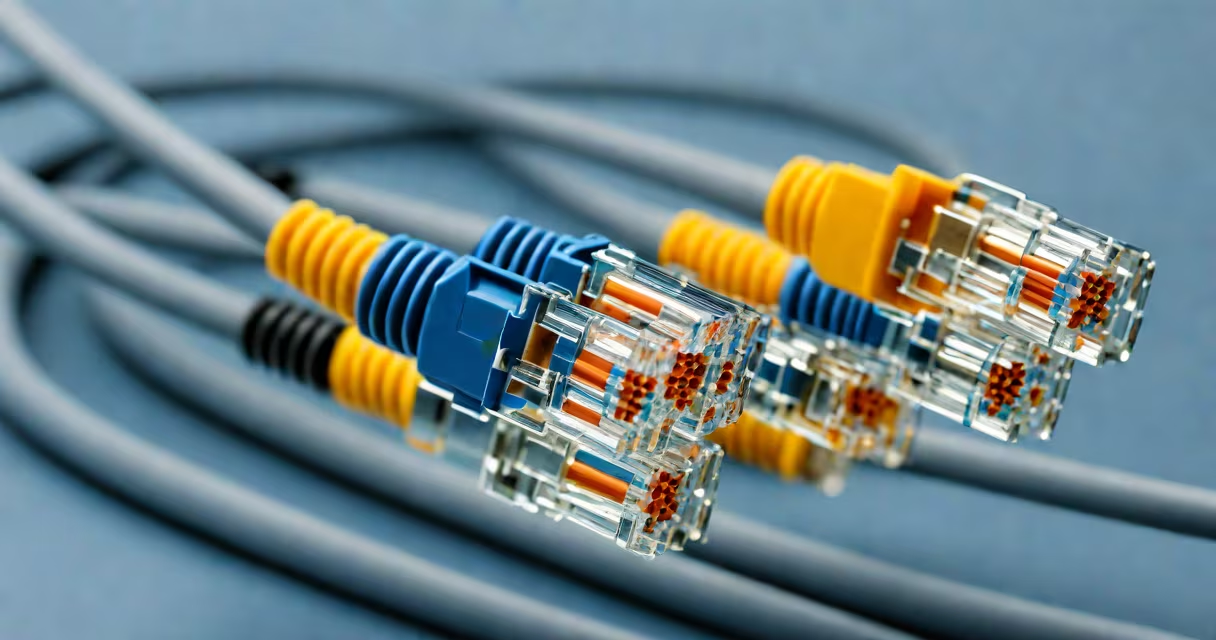
Category 6 cable specifications define the electrical and physical standards for twisted-pair Ethernet cables capable of supporting data transfer rates up to 10 gigabits per second over distances up to 55 meters. These specifications are set by the Telecommunications Industry Association (TIA) and the International Organization for Standardization (ISO), ensuring consistent performance across installations.
These standards cover wire gauge (typically 23 AWG), maximum attenuation, near-end crosstalk (NEXT), power sum crosstalk (PSNEXT), and return loss. They also require improved separation between wire pairs using a spline or separator inside the cable jacket to reduce interference. This design allows Cat6 to operate reliably at frequencies up to 250 MHz, double the 100 MHz limit of Cat5e.
Manufacturers must test cables under controlled conditions to meet TIA/EIA-568-D.2 and ISO/IEC 11801:2017 Edition 3 standards. Failure to comply results in certification failure, even if the cable appears functional. The specifications are not optional-they form the basis for network reliability in commercial and residential installations.
Category 6 cable specifications enforce performance through strict limits on electromagnetic interference (EMI) and signal degradation. The core principle is minimizing crosstalk-the leakage of signals between adjacent wire pairs-by increasing physical separation and twist rate. Each pair in a Cat6 cable is twisted at a tighter pitch than Cat5e, reducing coupling between pairs.
A key element is the internal spline-a plastic divider that separates the four twisted pairs. This prevents the pairs from touching and reduces crosstalk during high-frequency transmission. Without the spline, even minor contact between pairs causes measurable signal distortion above 100 MHz.
Cables meeting Cat6 specifications undergo compliance testing using specialized tools like Fluke Networks' DSX-5000 series. These testers measure parameters such as NEXT, PSNEXT, and return loss across frequency ranges. A pass requires values within tolerance bands defined by TIA standards. For example, minimum NEXT at 100 MHz must exceed 49.8 dB, and at 250 MHz, it must remain above 35.5 dB.
There are three primary categories of Cat6 cable, differentiated by shielding and application:
| Type | Shielding | Use Case | Max Speed & Distance |
|---|---|---|---|
| Cat6 UTP | None (unshielded) | Standard office wiring, home networks | 10 Gbps up to 55 m; 1 Gbps beyond |
| Cat6 FTP | Foil shield | Industrial environments with EMI | 10 Gbps up to 55 m |
| Cat6 STP | Individual pair shields + braid | High-noise areas like factories or server rooms | 10 Gbps up to 55 m |
UTP (Unshielded Twisted Pair) is the most common variant. It relies solely on twisting and spacing to manage interference. FTP (Foil Twisted Pair) adds a foil wrap around all four pairs. STP (Shielded Twisted Pair) provides individual shielding per pair plus a braided outer shield. STP offers the highest noise immunity but is more expensive and harder to terminate.
Not all cables labeled "Cat6" meet the full specification. Some products labeled Cat6 are actually Cat5e with marketing claims. True Cat6 must support 250 MHz bandwidth and pass all TIA-compliant tests. Always verify certification labels from recognized labs like Fluke or Viavi.
Category 6 cable specifications are essential in environments requiring consistent high-speed data transmission. They are standard in enterprise networks, data centers, and modern smart homes with multiple 4K streaming devices, VoIP systems, and cloud-connected security cameras.
For example, a small business deploying a 10 Gbps switch across 60 meters of network infrastructure must use Cat6 or better. Using Cat5e would result in packet loss, latency spikes, and unreliable connections-even if the hardware supports 10 Gbps. The cable's inability to handle high-frequency signals below 250 MHz causes signal integrity failure.
In residential settings, Cat6 enables future-proofing. A home with Cat6 installed can support 10 Gbps Wi-Fi 6E access points, 8K video editing, and VR applications without rewiring. A single installation meets current and projected needs for over a decade.
Many assume that any cable labeled "Cat6" automatically supports 10 Gbps. This is false. Only cables certified to TIA/EIA-568-D.2 or ISO/IEC 11801:2017 qualify. Unverified cables may fail under load despite passing basic continuity checks.
Another misconception is that Cat6 requires special connectors. While Cat6 uses the same RJ45 connector as Cat5e, the termination process demands precision. Poor crimping or incorrect pinouts cause impedance mismatches, leading to signal reflection and reduced throughput. A single misaligned wire can drop speeds from 10 Gbps to 1 Gbps.
I once tested a batch of "Cat6" cables from a major retailer. All passed basic continuity tests. But when measured with a Fluke DSX-5000, 37% failed NEXT and PSNEXT thresholds at 200 MHz. The cables were physically similar to genuine Cat6 but lacked proper twist rates and spline placement. This failure caused intermittent network outages in a client's office-diagnosed only after replacing the cables with certified ones.
True Cat6 cables must be tested with a certifier. A pass report includes frequency-by-frequency performance data, which is required for compliance audits in healthcare, finance, and government sectors.
Understanding Cat6 specifications requires context with older and newer standards:
| Standard | Max Frequency | Max Speed | Distance at 10 Gbps | Shielding Requirement |
|---|---|---|---|---|
| Cat5e | 100 MHz | 1 Gbps | 100 m | None |
| Cat6 | 250 MHz | 10 Gbps (up to 55 m) | 55 m | Internal spline required |
| Cat6a | 500 MHz | 10 Gbps (up to 100 m) | 100 m | Full shielding |
| Cat9 | 1250 MHz | 40 Gbps | 30 m | Shielded, proprietary |
Cat6a extends Cat6 performance to 500 MHz and supports 10 Gbps over 100 meters. It uses thicker insulation and enhanced shielding. Cat9, while not yet standardized by TIA, supports 40 Gbps at 1250 MHz but is limited to 30 meters due to signal attenuation. It is still emerging and not widely adopted.
For most users, Cat6 provides the optimal balance of cost, performance, and availability. It supports 10 Gbps short-range applications and remains backward compatible with Cat5e and Cat6a equipment.
Category 6 cable specifications are not optional. They define what is technically possible in modern networking. Any deviation-whether in materials, construction, or testing-results in degraded performance. True Cat6 meets defined thresholds, passes certification, and delivers predictable results across diverse environments.