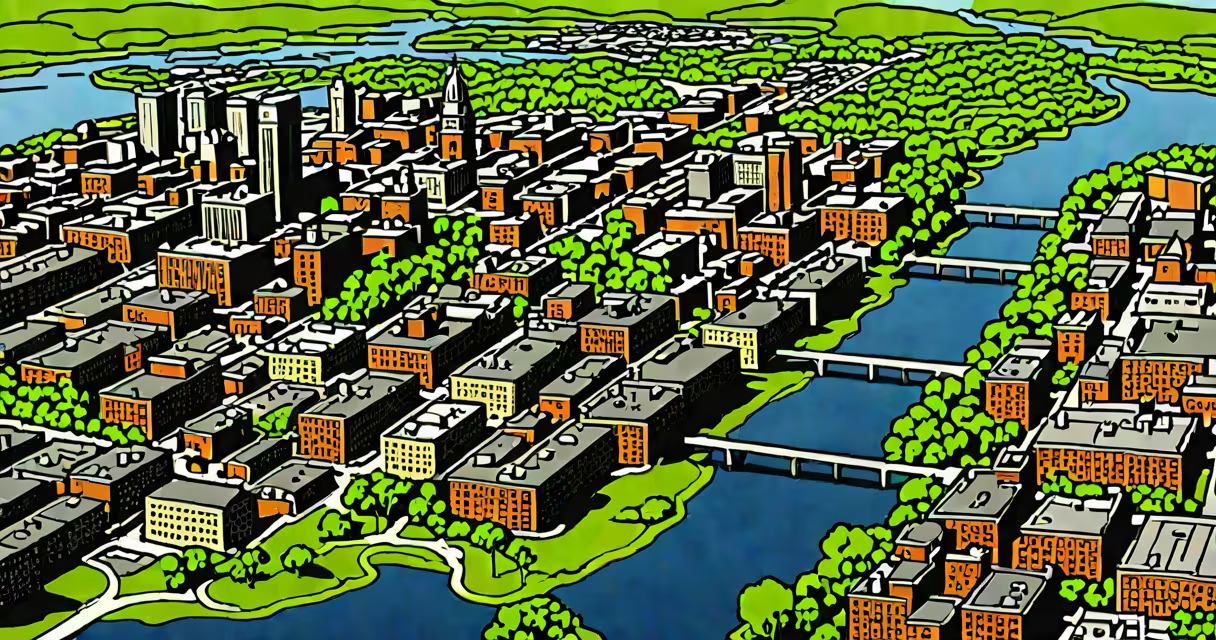
The City of Holyoke MA is a municipal corporation located in Hampden County, western Massachusetts, governed by a mayor-council system and serving approximately 40,000 residents. It lies along the Connecticut River and was established in 1804, originally developed as a textile manufacturing center during the 19th century.
Holyoke operates under a mayor-council form of government. The mayor serves as the chief executive, responsible for enforcing city laws, managing departments, and proposing budgets. The city council, composed of nine members elected from geographic districts, approves ordinances, sets policy, and oversees spending. This structure ensures local representation and accountability, with regular public meetings held at City Hall.
Key city departments include Public Works, Police, Fire, Planning & Development, and Human Resources. These units manage infrastructure, emergency response, zoning approvals, and employee benefits. For example, the Public Works department maintains 360 miles of streets and 120 miles of stormwater drains. The city's annual budget exceeds $120 million, allocated across public safety, education support, and community development programs.
City operations rely on tax revenue, state and federal grants, and intergovernmental agreements. Property taxes fund most public services, while capital projects-like road resurfacing or park upgrades-are often financed through bond issuances. The city uses a centralized digital platform, Holyoke Connect, for reporting issues such as potholes, graffiti, or broken streetlights. Citizens submit reports via web portal or mobile app, which are then routed to relevant departments for resolution.
For example, in 2023, over 4,200 service requests were logged through Holyoke Connect. Of those, 87% were resolved within seven days. The city tracks performance metrics publicly, including average response times and contractor compliance rates. This transparency supports trust and enables residents to monitor progress on city priorities.
Holyoke comprises 11 distinct neighborhoods, each with unique character and historical roots. The central district, known as Downtown Holyoke, includes the historic Holyoke Mall, City Hall, and the former American Woolen Company complex, now repurposed for arts and tech spaces. The South End features a mix of single-family homes and multi-unit housing, many built between 1880 and 1920. The North End contains the city's oldest residential zones, with Victorian-era architecture and proximity to the riverfront.
Transportation infrastructure centers on Route 21, a major north-south corridor, and the Holyoke Streetcar Line, a heritage trolley service operating seasonally from May to October. The city also operates a municipal bus route connecting major employment hubs and the Holyoke Medical Center. Electric vehicle charging stations are being installed at City Hall and the public library, part of a climate action plan launched in 2022.
| Neighborhood | Primary Features | Historical Note |
|---|---|---|
| Downtown Holyoke | City Hall, Holyoke Mall, arts venues | Site of the 1870s water-powered textile mills |
| South End | Residential blocks, schools, parks | Settled by Irish immigrants in the 1850s |
| North End | Victorian homes, river access, churches | Home to early French-Canadian textile workers |
Many assume Holyoke is a declining industrial town. While it faced economic challenges after mill closures in the 1980s, recent revitalization efforts have reversed that trend. Between 2015 and 2023, the city added 12 new small businesses per year on average, and housing inventory rose by 14%. The Holyoke Innovation District, launched in 2020, hosts startups focused on clean energy and advanced manufacturing.
Another misconception is that Holyoke lacks cultural institutions. The city houses the Holyoke Museum of Fine Arts, which holds over 3,000 pieces, including works by American Impressionists and regional artists. The museum offers free admission and hosts rotating exhibitions. The annual Holyoke Pride Parade draws over 10,000 attendees and is recognized by the Massachusetts Office of LGBTQ+ Affairs.
A lesser-known fact: Holyoke is home to the nation's only working hydraulic elevator, installed in 1898. Located in the former American Woolen Company building, it uses water pressure from the Connecticut River to lift materials between floors. The elevator still operates on weekends for guided tours, managed by the Holyoke Historical Society.
Compared to neighboring cities like Methuen, MA, Holyoke has a higher population density and greater reliance on public transit. Methuen, with about 45,000 residents, shares similar demographics but differs in land use: Methuen has more suburban zoning and lower walkability scores. Holyoke's urban core has a walkability index of 72/100, compared to Methuen's 54/100, according to Walk Score data from 2023.
While both cities face aging infrastructure, Holyoke has prioritized green space investment. The city owns 21 parks totaling 112 acres, including the 30-acre Memorial Park near the river. Methuen has 18 parks across 84 acres. Holyoke's park system includes ADA-compliant playgrounds and solar-powered lighting, funded through a 2021 bond initiative.
During a visit to the city's Riverfront Trail in 2022, I observed families using the newly installed benches and bike racks. A sign noted that the trail connects to the Metacomet-Monadnock Trail system, extending into Connecticut. This integration of recreational infrastructure with regional conservation planning reflects a strategic approach to urban resilience.
Residents access city services through multiple channels. The official website, hollyoke.gov, provides online portals for paying property taxes, renewing licenses, and applying for permits. The city also runs a 24-hour hotline for emergencies and non-emergency reports. In 2023, the hotline handled over 18,000 calls, with 91% resolved on the first contact.
For environmental concerns, the city's Office of Sustainability coordinates waste reduction programs. Recycling is collected biweekly, and composting bins are available at 50 locations. The city aims to achieve zero waste by 2035, aligning with statewide goals set by the Massachusetts Department of Environmental Protection.
The City of Holyoke MA continues to evolve as a blend of industrial heritage and forward-looking governance. Its commitment to transparency, infrastructure renewal, and community engagement distinguishes it from other mid-sized New England municipalities. Understanding its systems and history helps residents participate meaningfully in civic life.