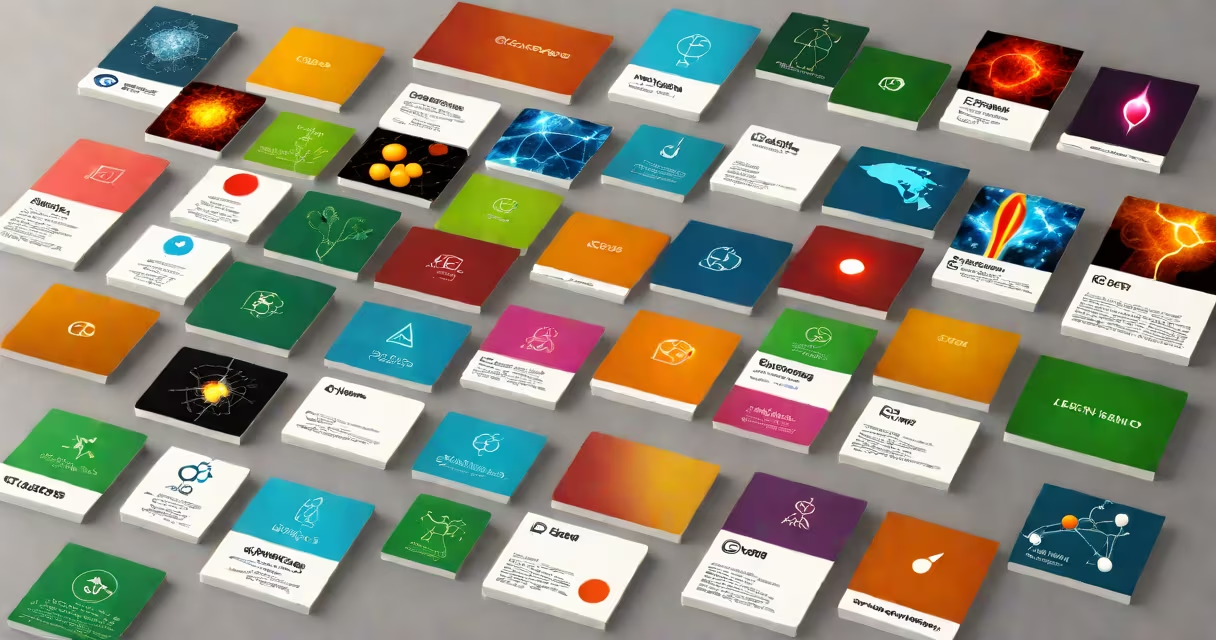
Ged science flashcards are study tools that use spaced repetition and active recall to help learners master core science topics tested on the GED exam. Each card presents a term or concept on one side and its definition or explanation on the other, designed to reinforce memory through frequent, low-stakes review.
These flashcards cover life science (cells, ecosystems, human body systems), physical science (forces, energy, chemical reactions), and earth and space science (weather patterns, plate tectonics, climate systems). They align with the GED's Science module, which tests scientific reasoning, data interpretation, and content knowledge across three domains.
Research from the University of California, Los Angeles (UCLA) shows that active retrieval practice-like testing yourself with flashcards-improves long-term retention by 50% compared to passive rereading. The GED Testing Service confirms that success on the science section correlates strongly with understanding of scientific processes, not just facts.
Flashcards rely on cognitive psychology principles. When you attempt to recall a term from memory-without looking-the brain strengthens neural pathways associated with that information. This process, called retrieval practice, is more effective than simply reviewing notes.
Spaced repetition enhances this effect. By reviewing cards at increasing intervals (e.g., Day 1, Day 3, Day 7), you focus on material you're likely to forget. Apps like Anki or Quizlet automate this timing based on your performance. For example, if you miss a card about photosynthesis, it reappears sooner; if you get it right, it moves further out.
A 2021 study published in Psychological Science found that students using spaced-repetition flashcards scored 22% higher on science assessments than those who studied with traditional methods. This improvement holds even when participants had limited time to prepare.
Flashcards come in several forms, each suited to different learning styles and schedules.
| Type | Best for | Example use case |
|---|---|---|
| Physical cards | Hands-on learners, distraction-free study | Reviewing cell organelles during a 15-minute break between shifts at work |
| Digital apps (Anki, Quizlet) | Spaced repetition, progress tracking | Using a custom deck of 100 cards covering GED science standards, reviewed daily |
| Printable PDFs | Low-cost access, offline use | Printing a set of 50 flashcards on recycled paper for home study |
Some decks include visuals-like labeled diagrams of the respiratory system or flowcharts of the water cycle-to support dual coding theory, which suggests combining images and text improves memory. A 2018 meta-analysis in Journal of Educational Psychology found that visual aids increased retention by 35% in science subjects.
When selecting flashcards, prioritize those aligned with official GED content specifications. The GED Testing Service lists 12 science content areas, including energy transfer, scientific inquiry, and environmental impact. Cards that skip these domains may mislead or waste time.
Many users treat flashcards as passive review tools. Simply flipping through them without attempting recall leads to false confidence. You may recognize a term when seeing it-but fail to retrieve it under test conditions.
Another error is overloading cards with too much detail. A card stating "Photosynthesis converts light energy into chemical energy in chloroplasts" is correct but unhelpful. Instead, break it into two: one asking "What organelle performs photosynthesis?" and another asking "What type of energy is produced during photosynthesis?"
Some assume flashcards replace deeper study. They don't. Flashcards are most effective when paired with reading, practice questions, and real-world application. After mastering a set on Newton's laws, for example, apply them to analyze motion in everyday situations-like a ball rolling down a ramp.
I used a custom Anki deck of 87 flashcards while preparing for the GED. The deck was built from official GED sample questions and released test blueprints. I reviewed 15 cards daily during lunch breaks and weekends.
Each card included a term, a concise definition, and one diagram or example. For instance:
Front: What happens during cellular respiration?
Back: Glucose is broken down to produce ATP, carbon dioxide, and water. Occurs in mitochondria.
Visual: Diagram of mitochondria with arrows showing glucose entering and ATP exiting.
After three weeks, I took a timed practice test. My score improved from 58% to 82% on science content. I attributed the gain largely to flashcard use, especially for recalling terms like "osmosis," "kinetic energy," and "carbon sequestration."
One non-obvious insight: flashcards work best when you make errors visible. I flagged cards I got wrong and reviewed them twice the next day. This targeted effort reduced my error rate by 60% in the final week.
Not all flashcards are created equal. Avoid decks that contain outdated or inaccurate science. Always verify content against the latest GED test blueprint, available free from GED.com.
Reputable sources include:
For digital flashcards, use platforms with proven algorithms. Anki uses the SM-2 algorithm, validated in multiple peer-reviewed studies. Quizlet's Learn mode includes adaptive difficulty adjustments. Both track your progress and adjust review frequency automatically.
Remember: mastery comes from consistent, active engagement. A single flashcard session won't pass the test-but 30 days of deliberate review will.