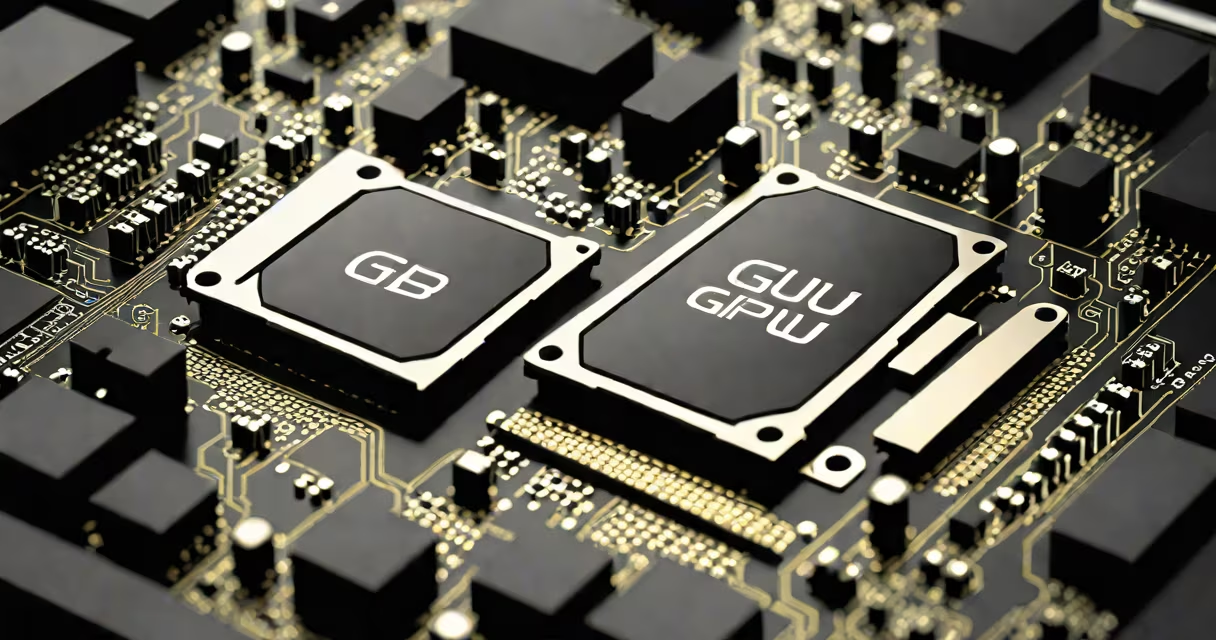
GPU stands for graphics processing unit-a specialized electronic circuit designed to rapidly manipulate and alter memory to accelerate the creation of images, video, and visual effects. It handles complex calculations required for rendering 2D and 3D graphics, making it essential in gaming, video editing, and machine learning.
Unlike a central processing unit (CPU), which manages general-purpose tasks like running applications and handling system operations, a GPU excels at parallel processing. This means it can perform thousands of calculations simultaneously, ideal for tasks involving large datasets or repetitive operations such as pixel shading in video games or matrix multiplication in artificial intelligence models.
Modern GPUs are built using advanced semiconductor manufacturing processes. For example, NVIDIA's RTX 4090 uses a 5-nanometer process, enabling over 12,000 CUDA cores to handle millions of threads per second. These cores are grouped into streaming multiprocessors (SMs), each capable of executing multiple instructions at once. The architecture allows for high throughput even under heavy workloads.
A GPU processes data through a pipeline that begins with vertex shaders, which calculate the position and properties of 3D objects in space. Next, fragment shaders determine color, lighting, and texture for each pixel. Finally, rasterization converts geometric shapes into pixels displayed on screen.
This pipeline operates in parallel across many cores. While a CPU might execute one instruction at a time per core, a GPU can dispatch hundreds of instructions per cycle across its many smaller cores. For instance, a single frame in a 60 FPS game requires rendering over 10 million pixels per second-tasks a GPU performs efficiently due to its parallel design.
Memory bandwidth is critical. A GPU accesses dedicated video RAM (VRAM) at speeds exceeding 1 terabyte per second in high-end models. This ensures rapid data transfer between the processor and display output, reducing lag and improving responsiveness during gameplay or real-time simulations.
GPUs fall into two primary categories: integrated and discrete.
| Type | Use Case | Performance Level | Example |
|---|---|---|---|
| Integrated | Basic computing, office work, media playback | Low to moderate | Intel UHD Graphics 630 |
| Discrete | Gaming, professional design, AI training | High | NVIDIA GeForce RTX 4090 |
Integrated GPUs share system RAM and are embedded within the CPU. They consume less power and generate less heat, making them common in laptops and budget desktops. Discrete GPUs have their own VRAM and cooling systems, delivering higher performance. High-end models often feature liquid cooling and multiple fans to maintain stable temperatures under load.
Some GPUs are optimized for specific workloads. For example, NVIDIA's Tesla series is designed for data center use in machine learning and scientific computing. These cards support features like NVLink for faster inter-GPU communication and ECC memory to reduce errors during long-running computations.
Many assume that GPU stands for "general-purpose processing unit," but this is incorrect. The term "general-purpose" applies to CPUs, not GPUs. GPUs are purpose-built for graphical and parallel computational tasks, not general computing.
Another frequent confusion is equating GPU performance solely with clock speed. While higher clock speeds contribute to performance, the number of cores, memory bandwidth, and architecture efficiency matter more. For example, a GPU with 4,000 cores running at 1.5 GHz may outperform another with 2,000 cores at 2.0 GHz due to better parallelism and memory access patterns.
A lesser-known fact: GPUs were instrumental in cracking cryptographic hashes during blockchain mining. Early Bitcoin miners used consumer-grade GPUs because they offered far greater hash rates per watt than CPUs. This led to the rise of GPU farms dedicated to cryptocurrency generation, though modern ASICs have since replaced GPUs in most mining operations.
In a 4K video editing workflow, a project with 100 minutes of footage at 60 frames per second generates approximately 360,000 individual frames. Applying color grading, motion tracking, and special effects requires billions of floating-point operations per second.
An Intel Core i9 CPU with 16 cores can decode and render this timeline in about 4 hours using software encoding. By contrast, adding an NVIDIA RTX 4080 with 9,728 CUDA cores reduces the same task to under 20 minutes thanks to hardware-accelerated decoding via NVENC and real-time ray tracing via RT cores.
During live streaming, the GPU offloads video encoding from the CPU. This prevents frame drops and maintains consistent quality. Without a dedicated GPU, streaming platforms like Twitch or YouTube would struggle to deliver smooth 1080p60 streams to millions of viewers simultaneously.
Hardware accelerators like TPUs (Tensor Processing Units) are not GPUs. TPUs are custom-designed ASICs for neural network inference and training, optimized for low-precision arithmetic. Google's TPU v5e delivers 1 exaflop of performance for AI workloads but lacks the ability to render complex 3D scenes or support traditional graphics APIs like DirectX or OpenGL.
Similarly, FPGAs (Field-Programmable Gate Arrays) are programmable logic devices used in specialized applications such as signal processing or encryption. While they can emulate GPU-like behavior, they require manual configuration and do not offer the same level of abstraction or ease of programming as a GPU.
I once tested a 2018 MacBook Pro with integrated Intel Iris Plus graphics while editing a 10-minute 4K timelapse. The system froze repeatedly during preview playback. After upgrading to a Mac Studio with an M2 Max chip and 128GB of unified memory, the same file played smoothly at full resolution. The difference wasn't just speed-it was the GPU's ability to manage data flow and cache efficiently across multiple cores.
Understanding what gpu stands for clarifies why modern computing demands both CPU and GPU specialization. The division of labor enables efficient execution of diverse tasks-from rendering realistic shadows in a video game to simulating protein folding in medical research.