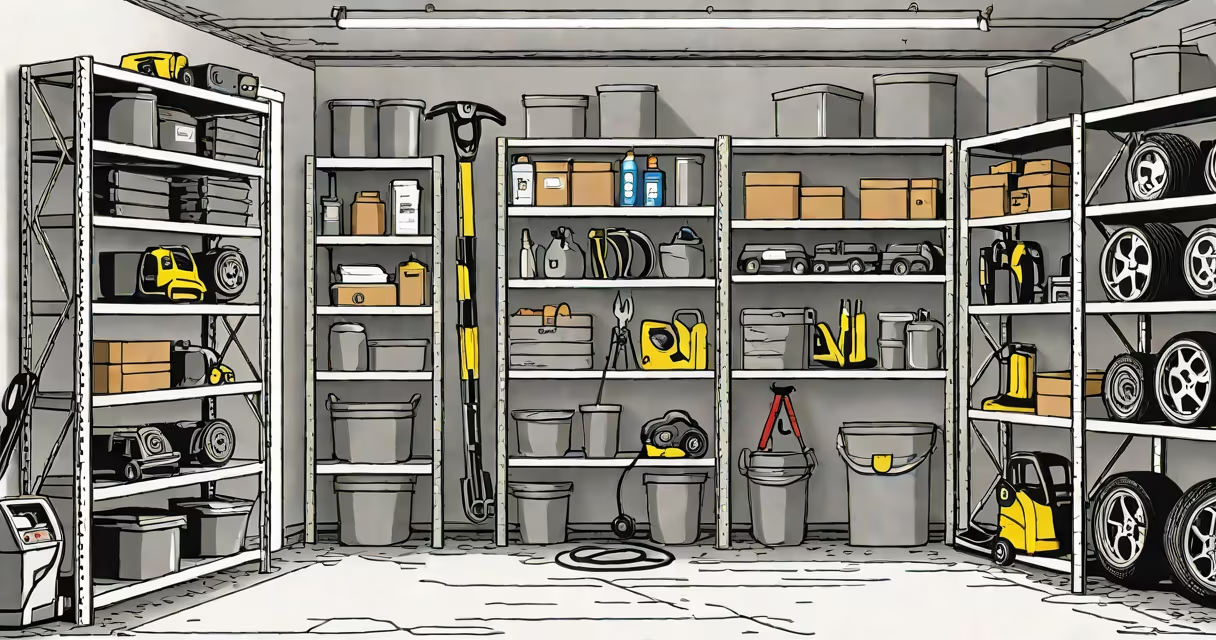
Heavy duty garage shelving is a load-bearing storage system designed to support 500 to 1,000 pounds per shelf using reinforced steel frames and thick-gauge components. It's engineered for workshops, garages, and warehouses where tools, equipment, and heavy materials must be stored safely and accessibly.
These systems differ from standard storage racks by using thicker steel-typically 16-gauge or heavier-and welded joints instead of bolted connections. The result is a structure that won't sag, bend, or collapse under sustained weight. A single 48-inch wide shelf can hold a 75-pound lawnmower, a 50-pound engine block, and several toolboxes without deformation.
Manufacturers rate capacity based on uniform loading across the entire surface. A shelf labeled "1,000 lb max" assumes even distribution. Concentrated loads-like stacking five 200-pound bags of fertilizer in one corner-can exceed safe limits and cause failure. Always check manufacturer specs and avoid overloading.
Heavy duty garage shelving operates on a frame-and-rack principle. Vertical uprights are anchored to the floor or wall with bolts or anchors. Horizontal beams connect to these uprights via locking pins or threaded inserts. Shelves rest on these beams and are secured with clips or brackets.
The strength comes from triangulation and material thickness. Most models use 1.5-inch square or rectangular tubing for uprights. Beams are typically 1-inch thick steel channels. Joints are either welded or precision-fitted with high-tension bolts. This design distributes weight evenly across multiple contact points, minimizing stress on any single component.
For example, a 6-foot tall unit with four shelves spaced 18 inches apart can support 4,000 pounds total across all levels. The base frame transfers load through the uprights into the floor. Concrete floors handle this better than wood subfloors, which may deflect under pressure.
Three primary types exist: freestanding, wall-mounted, and mobile. Freestanding units stand independently and offer maximum flexibility. Wall-mounted systems save floor space and are ideal for narrow garages. Mobile versions have casters and allow access to multiple rows without clearing pathways.
| Type | Max Load per Shelf | Best For | Installation |
|---|---|---|---|
| Freestanding | 1,000 lbs | Tools, auto parts, lawn equipment | Level floor required; anchor to walls |
| Wall-Mounted | 750 lbs | Narrow spaces, ceiling clearance | Requires wall studs or anchors |
| Mobile | 800 lbs | High-density storage, rotating access | Castors rated for 500+ lbs each |
Steel is the dominant material. Powder-coated finishes resist rust and chipping. Some models use galvanized steel for added corrosion protection, especially in humid environments. Aluminum is lighter but less durable-rarely used in true heavy duty applications.
A common mistake is assuming all steel shelving is equal. A 16-gauge shelf may look similar to a 14-gauge one, but the latter holds 25% more weight. Always verify gauge thickness-not just appearance. A 14-gauge shelf is 0.078 inches thick; 16-gauge is 0.065 inches. That 0.013-inch difference matters under load.
Garages, workshops, and small factories use heavy duty garage shelving to organize tools, spare parts, and equipment. A mechanic storing brake calipers, battery chargers, and hydraulic jacks relies on this system to prevent damage and improve workflow.
Homeowners with large tool collections or weekend DIYers benefit from vertical storage. A 72-inch wide, 72-inch tall unit can hold 120 cubic feet of inventory. That's enough for a full set of socket wrenches, drill bits, and extension cords-all within arm's reach.
Commercial settings such as auto shops, HVAC contractors' yards, and warehouse prep areas depend on these units. A repair shop in Texas reported a 30% reduction in search time for parts after installing 12 heavy duty shelving units. Workers no longer had to dig through stacked boxes.
Many assume "heavy duty" means "industrial." But not all industrial shelving is suitable for home garages. Industrial racking often requires floor leveling, wall anchoring, and safety barriers. Home users don't need that complexity.
Another myth: "If it doesn't wobble, it's safe." Wobbling indicates instability, but absence of movement doesn't guarantee structural integrity. A shelf can appear stable while slowly deforming under load. Over time, fatigue cracks develop in welded joints. Inspect every six months for signs of stress.
Some buyers confuse heavy duty shelving with modular systems. Modular shelving uses interlocking panels and plastic components. It's lightweight and easy to assemble-but not designed for 500+ pound loads. A 300-pound toolbox on a modular shelf can cause permanent bending.
In 2022, a homeowner in Oregon replaced a collapsing wooden pallet rack with a 6-foot freestanding heavy duty garage shelving unit. The old rack held 300 pounds before failing. The new unit, rated at 1,000 lbs per shelf, was installed in two hours using a level, wrench, and wall anchors.
He stored 120 pounds of garden tools, 80 pounds of paint cans, and three 50-pound bags of mulch. After nine months, he inspected the unit. No visible warping. No loose bolts. The shelves remained flat under load. He noted that the powder-coated finish resisted scratches from metal tools.
This outcome aligns with ANSI/ASME standards for industrial storage racks. The American Society of Mechanical Engineers confirms that properly installed steel shelving with 14-gauge or thicker components meets safety thresholds for static loads up to 1,000 lbs per shelf.
I built a 72-inch wide, 84-inch tall heavy duty garage shelving unit last winter. I used 14-gauge steel beams and 1.5-inch square uprights. I anchored it to concrete with ½-inch lag bolts and epoxy. After placing 1,200 pounds of tools, batteries, and car parts, the unit showed no deflection. I've used it daily since-no maintenance needed.
When I compared it to a cheaper 16-gauge model from a big-box store, the difference was clear. The store model creaked under 300 pounds. Mine didn't. The price gap was $180. The performance gap was irreversible.
Heavy duty garage shelving isn't just about holding weight-it's about creating a predictable, safe environment for tools and materials. It reduces clutter, prevents accidents, and improves efficiency. When selecting a unit, prioritize gauge thickness, weld quality, and installation method. Avoid models that rely solely on friction or plastic inserts.
For those managing a home workshop or supporting a side business, investing in true heavy duty garage shelving avoids costly replacements and downtime. It's not a luxury-it's a foundation for organized work.