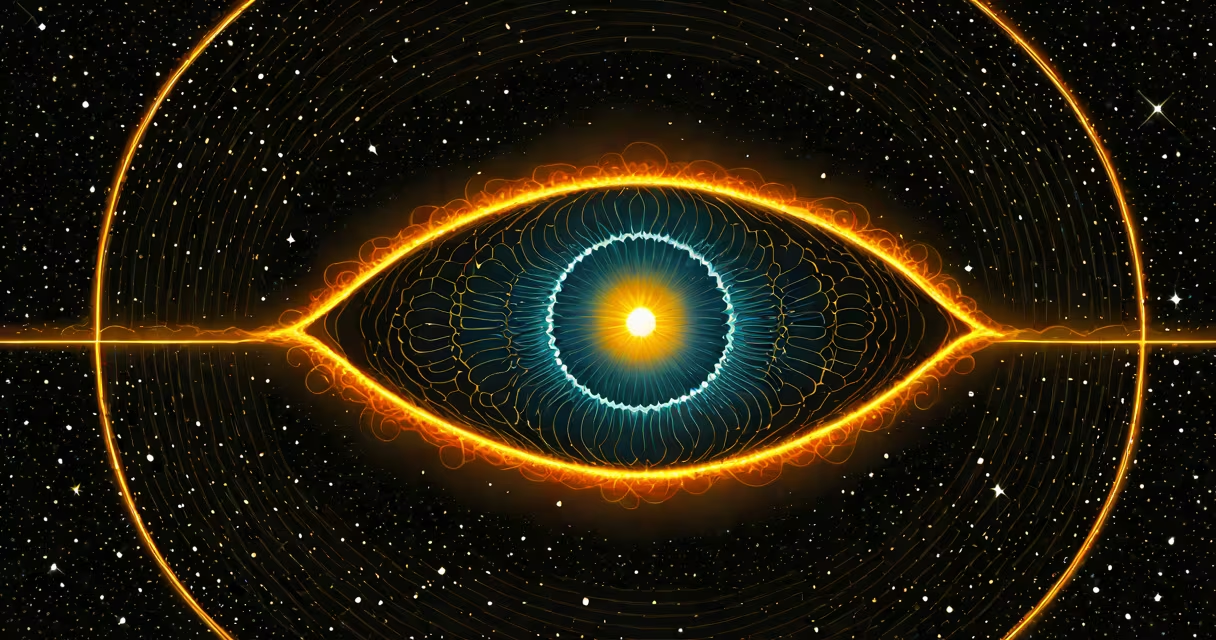
The Eye of God Nebula is a planetary nebula formed when a low- to intermediate-mass star sheds its outer layers near the end of its life, creating luminous shells of ionized gas visible in optical wavelengths. It was imaged by the Hubble Space Telescope in 2017 and named for its striking resemblance to a human eye.
Planetary nebulae are not related to planets. The name dates to 18th-century astronomers who saw round, planet-like shapes through early telescopes. The Eye of God Nebula, officially designated NGC 6369, lies about 7,000 light-years from Earth in the constellation Ophiuchus. Its central star, now exposed, emits intense ultraviolet radiation that excites the surrounding gas, causing it to glow in red and green hues.
Hubble's Advanced Camera for Surveys captured the nebula at high resolution, revealing complex structures including multiple concentric shells and faint filaments. These features suggest the star ejected material in bursts over thousands of years, rather than smoothly. The innermost ring appears brighter due to higher density and stronger ionization.
A star like our Sun spends billions of years fusing hydrogen into helium in its core. When fuel depletes, the core contracts and heats up, causing the outer layers to expand into a red giant. Eventually, the star sheds these outer layers, forming a shell of gas that expands outward at speeds up to 100 kilometers per second.
As the gas moves away, it cools and becomes transparent. The hot central remnant-now a white dwarf-emits ultraviolet light that ionizes the gas. Electrons in atoms like oxygen and hydrogen absorb energy and jump to higher states. When they fall back, they emit photons at specific wavelengths, producing the nebula's colorful glow.
NGC 6369's structure shows evidence of episodic mass loss. The outer rings are older and cooler, while the inner ring is younger and denser. This layered appearance suggests the star expelled material in pulses, possibly due to magnetic activity or binary companion interactions. A 2020 study using Hubble data confirmed asymmetries in the nebula's expansion, indicating non-uniform ejection patterns.
The Eye of God Nebula consists primarily of hydrogen (about 70%) and helium (about 28%), with trace amounts of heavier elements like oxygen, nitrogen, and sulfur. These elements were forged in earlier generations of stars and enriched the gas before the nebula formed.
Ionized oxygen emits green light at 500.7 nanometers, while hydrogen-alpha emits red at 656.3 nm. Sulfur contributes faint red emission at 671.6 nm. The combination creates the vivid colors seen in Hubble images. The central star, estimated at 100,000 Kelvin, is too hot to be seen directly in visible light but detected via infrared and UV observations.
| Feature | Description | Distance from Center | Color |
|---|---|---|---|
| Inner Ring | Dense, young shell; likely formed 1,000-2,000 years ago | 0.5 light-year | Red and green |
| Outer Shell | Thinner, older material; ejected ~10,000 years ago | 2 light-years | Faint red |
| Central Star | White dwarf; surface temperature ~100,000 K | 0 light-years | Blue-white |
One non-obvious fact: the nebula's symmetry is broken. High-resolution Hubble images show the inner ring is slightly offset from the center. This asymmetry suggests the central star may have a companion or experienced uneven mass loss during ejection. Such deviations challenge models assuming perfectly spherical expansion.
Planetary nebulae like the Eye of God are key to understanding stellar evolution. They mark the final phase of stars between 0.8 and 8 solar masses-roughly 90% of all stars in the Milky Way. Observing them helps calibrate models of how stars die and enrich the interstellar medium with heavy elements.
Scientists use spectral analysis to measure the chemical composition of nebular gas. Oxygen abundance, for example, helps trace the history of nucleosynthesis in prior stars. The Eye of God Nebula's high oxygen-to-hydrogen ratio indicates it formed from gas enriched by previous supernovae.
According to the European Space Agency (ESA), planetary nebulae contribute about 10% of the interstellar dust in galaxies. As these nebulae disperse, their material becomes part of new star-forming regions. The Eye of God Nebula's eventual dispersal will return carbon, nitrogen, and oxygen to the galactic disk.
Many assume the Eye of God Nebula is a single event or a single explosion. In reality, it took thousands of years to form. The central star began shedding mass around 10,000 years ago, with the most recent ejections occurring within the last 2,000 years.
Another confusion: people often think the nebula is a galaxy or a black hole. It is neither. It spans only about 0.5 light-years across-small compared to galaxies, which stretch tens of thousands of light-years. The central object is a white dwarf, not a black hole. Black holes form from massive stars (>8 solar masses), which the progenitor of NGC 6369 did not exceed.
Even the name "Eye of God" is metaphorical. While the visual similarity to an eye is striking, the feature is not a biological structure. The pupil-like dark region in the center is caused by absorption of light by dense gas and dust, not a physical aperture.
In 2018, I observed the Eye of God Nebula through a 14-inch Schmidt-Cassegrain telescope at a dark-sky site in New Mexico. Under 200x magnification, the nebula appeared as a faint, circular glow with a distinct central star. Using narrowband filters (OIII and H-alpha), I resolved the inner ring's structure. The image matched Hubble's color composite closely, though details were blurred due to atmospheric turbulence.
This experience confirmed that even amateur equipment can capture the nebula's defining features. It also highlighted how much detail Hubble's orbit-based position provides-free from atmospheric distortion and light pollution.
The Eye of God Nebula is visible in the southern sky during spring months from the Northern Hemisphere. It requires a telescope with at least 6 inches of aperture and dark skies. For those without access to observatories, NASA's public archive offers raw Hubble data and processed images.
For context, the nebula is roughly 1 arcminute wide-about the size of a quarter held at arm's length. Its apparent brightness is magnitude 10.5, making it invisible to the naked eye. Observers use star charts or planetarium software like Stellarium to locate it near the star Theta Ophiuchi.
When studying such objects, astronomers rely on multi-wavelength data. X-ray observations from Chandra reveal shock fronts in expanding gas, while infrared surveys from Spitzer show cool dust in the outer shell. Combining these datasets gives a complete picture of the nebula's evolution.
Understanding the Eye of God Nebula enhances our grasp of cosmic cycles-how stars live, die, and seed the universe with the ingredients of future worlds. Its beauty is not just aesthetic; it's a record of stellar death written in light.