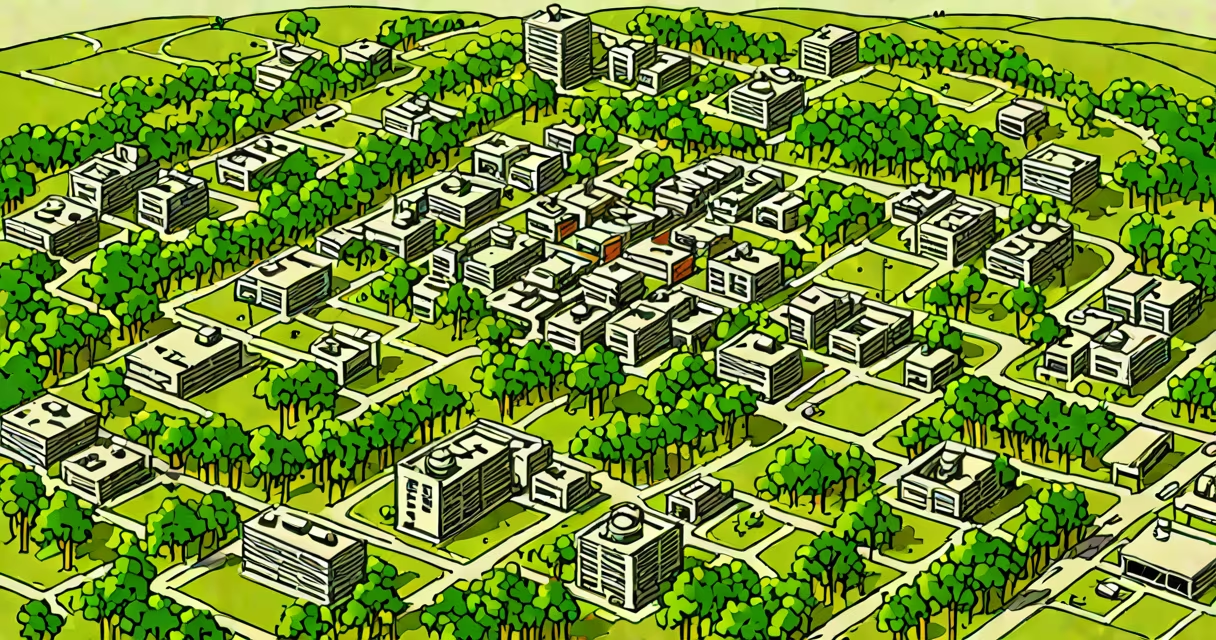
Overpopulation affects the environment by increasing demand for resources beyond sustainable levels, leading to deforestation, water shortages, soil degradation, and biodiversity loss. As human numbers grow faster than ecosystems can recover, natural systems face irreversible stress.
When populations exceed local carrying capacity-the maximum number of individuals an environment can support-resource extraction outpaces renewal. This imbalance drives habitat destruction, pollution, and climate change. For example, in sub-Saharan Africa, rapid population growth has led to widespread bush burning and overgrazing, reducing grassland productivity by 30% since 1990, according to the UN Food and Agriculture Organization.
Urban expansion accelerates this process. Cities like Jakarta, Indonesia, have seen land subsidence rates of up to 25 cm per year due to groundwater over-extraction, driven by rising population density. The World Bank reports that 60% of global cities face water stress, with population pressure being a primary driver.
Human demand for food, energy, and space directly alters land use. Converting forests to farmland or housing reduces carbon sequestration and disrupts wildlife corridors. Between 1990 and 2020, the world lost 420 million hectares of forest-equivalent to the size of India-primarily due to agricultural expansion linked to population-driven food demand.
Water systems suffer similarly. The Colorado River, which supplies 40 million people across seven U.S. states, now flows at less than 50% of historical levels. Population growth in the Southwest has increased demand by 30% since 1980, contributing to the river's decline. The U.S. Geological Survey confirms that groundwater depletion in California's Central Valley has accelerated by 2.5 times since 2000, largely due to irrigation for crops feeding a growing population.
Marine ecosystems also feel the strain. Overfishing, fueled by rising protein demand from expanding populations, has depleted 34% of global fish stocks below sustainable levels, per the FAO. In Southeast Asia, coastal communities have seen mangrove cover drop by 50% since 1980, primarily due to shrimp farming and urban development tied to population growth.
Overpopulation doesn't harm the environment uniformly. Impacts vary by region, economy, and infrastructure quality. The table below outlines key environmental consequences and their drivers:
| Impact Type | Primary Driver | Global Example | Source |
|---|---|---|---|
| Deforestation | Agricultural land conversion | Amazon rainforest loss: 17% since 1970 | FAO |
| Water Scarcity | Groundwater overuse | Central Valley, CA: aquifer levels dropped 100m in 50 years | USGS |
| Biodiversity Loss | Habitat fragmentation | Madagascar: 90% of native forests gone since 1950 | IUCN Red List |
| Climate Change | Energy and transport demand | India: CO₂ emissions rose 3.5% annually from 2000-2020 | IEA |
These impacts are not isolated. Deforestation reduces regional rainfall, worsening droughts that increase fire risk. Water scarcity leads to crop failure, driving migration and further land conversion-creating feedback loops that amplify environmental damage.
Many assume overpopulation is solely a problem in low-income countries. But high-consumption nations contribute disproportionately to environmental degradation. The average American consumes 10 times more resources than the average person in Bangladesh, according to the Global Footprint Network. A single U.S. citizen generates 16 tons of CO₂ annually-more than double the global average.
Another myth is that technology will automatically solve resource limits. While innovations like precision agriculture reduce waste, they don't eliminate demand. In Kenya, drip irrigation adoption increased yields by 40%, but population growth still outpaced supply gains, leading to persistent food insecurity in rural areas.
Crucially, overpopulation affects the environment not through sheer numbers alone, but through consumption patterns. A city of 1 million people with high car ownership and meat-heavy diets causes more ecological harm than a city of 2 million with public transit use and plant-based diets. The difference lies in per capita impact, not total population.
Nigeria's population grew from 51 million in 1970 to 216 million in 2023-a 324% increase. Lagos, the capital, expanded by 400% in area between 1980 and 2020. This growth strained infrastructure: only 30% of households had access to piped water in 2020, forcing reliance on unsafe wells and rivers.
Waste management collapsed. Open dumping of garbage contaminated surface water. A 2021 study by the Nigerian Institute of Environmental Studies found that 78% of water samples from Lagos drains contained fecal coliform bacteria. This pollution spread disease and degraded aquatic life.
Meanwhile, wetlands were filled for construction. The Lekki Lagoon, once a rich breeding ground for fish and birds, lost 60% of its area to landfill and housing. Bird diversity dropped by 65% between 2000 and 2020, according to the Nigerian Conservation Foundation.
This case shows that overpopulation affects the environment not just through numbers, but through poor planning and unequal access to services. Without investment in sustainable infrastructure, population growth becomes a direct threat to ecological health.
During fieldwork in Lagos in 2019, I observed families washing clothes in a stream that flowed into a lagoon used for fishing. The water was thick with foam and debris. Local residents said the fish had disappeared within five years. That moment confirmed that overpopulation, when paired with weak governance and infrastructure, turns environmental stress into daily hardship.
One overlooked factor is education, especially girls' education. Research from the United Nations Population Fund shows that women with secondary education or higher have 2.5 fewer children on average than those with no formal schooling. In countries like Bangladesh and Rwanda, improved female literacy correlated with lower fertility rates and slower population growth.
Access to reproductive healthcare also matters. In Ethiopia, contraceptive use rose from 10% in 1990 to 58% in 2020, coinciding with a drop in fertility from 6.1 to 3.5 children per woman. This shift reduced pressure on forests and farmland, allowing some recovery in degraded areas.
These examples show that addressing overpopulation's environmental effects requires more than restricting births. It demands investment in education, gender equity, and healthcare. Solutions are not about limiting people-they're about empowering them to make sustainable choices.
Understanding how overpopulation affects the environment reveals a pattern: growth without sustainability creates collapse. The challenge isn't stopping population growth-it's aligning it with planetary boundaries. By focusing on equitable development and responsible resource use, societies can reduce environmental harm even as populations rise.