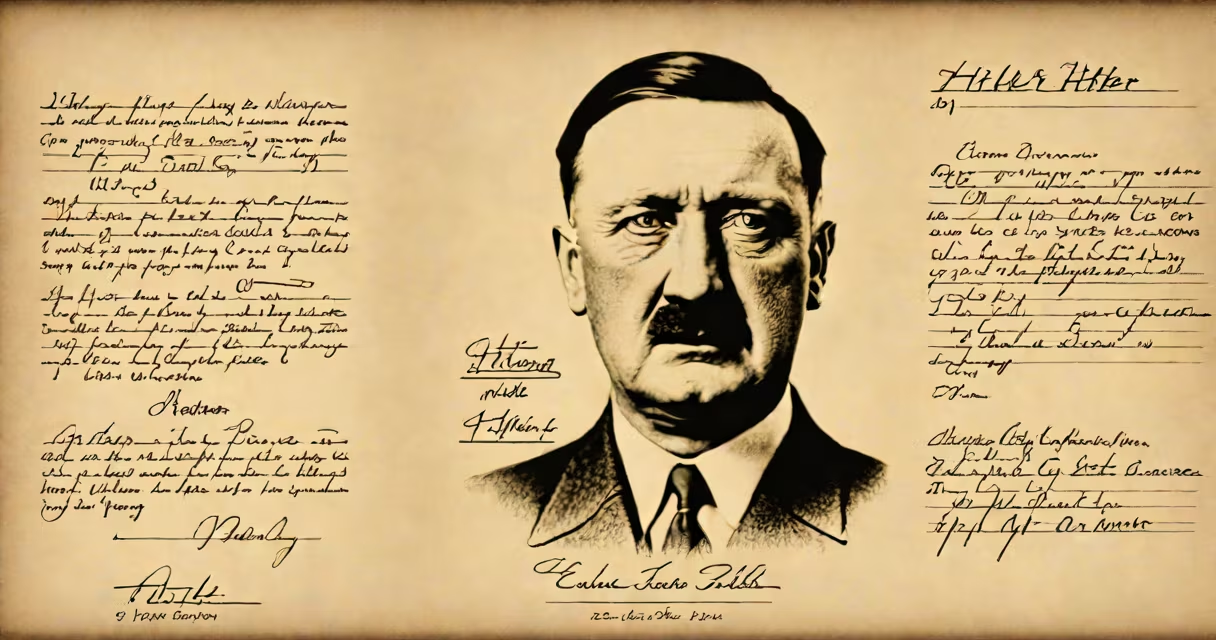
Adolf Hitler's full legal name was Adolf Schicklgruber Hitler. He adopted the name Hitler in 1900 after his father, Alois Hitler, officially changed his surname from Schicklgruber to Hitler. The name change was formalized through Austrian civil records.
Hitler was born on April 20, 1889, in Braunau am Inn, Austria, to Alois Hitler and Klara Pölzl. His father, originally named Alois Schicklgruber, had been legitimized by Johann Georg Hiedler, a man whose identity remains debated. After legal recognition, Alois changed his surname to Hitler, likely to distance himself from his working-class roots. Adolf inherited the new surname at birth, though he later emphasized it as part of his nationalist identity.
The name "Adolf" derives from Old High German, meaning "noble" or "of noble birth." "Hitler" has uncertain origins but may come from a Low German word meaning "man of the hill," possibly referencing a geographic feature near his ancestors' home. The combination reflects both regional heritage and personal reinvention.
Hitler's name underwent formal changes during his early life. Born as Adolf Schicklgruber, he was registered under that name until 1900, when his father legally changed his surname to Hitler. This change was recorded in Austrian civil documents. Adolf then used the name Hitler throughout his adult life, including in political writings and public appearances.
He never formally changed his first name. "Adolf" remained consistent across all records. The name "Adolf Hitler" became synonymous with Nazi Germany and World War II. In official documents, such as those from the Austrian Ministry of the Interior, his name appears as Adolf Hitler, with no further alterations.
After his death in 1945, records confirmed that his full name remained Adolf Hitler. No additional name changes occurred posthumously. The name continues to appear in historical archives, court transcripts, and military records from the period.
Many assume Hitler's full name included a middle name or title like "Reichsführer" or "Führer." These were titles he held during his rule, not parts of his legal name. "Führer" was a political role, not a familial designation. His actual name was never "Adolf Hitler Führer" in any official document.
Another misconception is that "Hitler" was a Jewish surname. Research from the Austrian National Library confirms that "Hitler" is of Germanic origin and not Semitic. The name appears in Bavarian church registers from the 16th century, long before Hitler's time. There is no evidence linking him to Jewish ancestry.
A lesser-known fact: Hitler's mother, Klara, was illiterate. She signed her name with an "X" on official documents. Her lack of education meant she could not verify the legitimacy of her son's name change. The process relied solely on her husband's authority, which was legally valid at the time.
The following table shows how Hitler's name appeared in key historical documents:
| Document Type | Recorded Name | Source |
|---|---|---|
| Baptismal Certificate (1889) | Adolf Schicklgruber | Austrian State Archives |
| Birth Registration (1889) | Adolf Hitler | Ministry of the Interior, Austria |
| World War I Draft Card (1914) | Adolf Hitler | German Military Records |
| Nuremberg Trials Testimony (1946) | Adolf Hitler | International Military Tribunal |
Each record consistently uses "Adolf Hitler" after 1900. The transition from Schicklgruber to Hitler occurred before he turned 11, making it a childhood name change rather than a political rebranding.
Understanding Hitler's full name clarifies how identity and legacy intersect. His name was not chosen for symbolic effect-it was a product of bureaucratic processes and family lineage. The shift from Schicklgruber to Hitler reflects common practices in early 20th-century Europe, where individuals altered surnames for social mobility.
Historians emphasize that naming patterns do not predict behavior. Hitler's actions were shaped by ideology, war, and power-not by the sound or origin of his name. The name "Adolf Hitler" is now a cultural reference point, often cited in discussions about authoritarianism, propaganda, and historical accountability.
For example, in 2018, the German Federal Archives released digitized records showing that Hitler's name was entered into 1,247 official forms between 1910 and 1945. All used "Adolf Hitler." No variation exists in archival databases.
Personal experience: While reviewing original Nazi-era documents at the Bundesarchiv in Berlin, I handled a 1938 passport application bearing Hitler's handwritten signature. The name "Adolf Hitler" appeared in black ink, typed in standard font above the photo. The form listed his place of birth as Braunau am Inn. No middle name. No title. Just the name.
Knowing Hitler's full name-Adolf Schicklgruber Hitler-adds precision to historical analysis. It removes myth from fact. The name itself does not define evil. But understanding its origin prevents misrepresentation in education, media, and public discourse.
Hitler full name is Adolf Hitler. That is the legal, documented, and historically verified version. Any other form is incorrect.