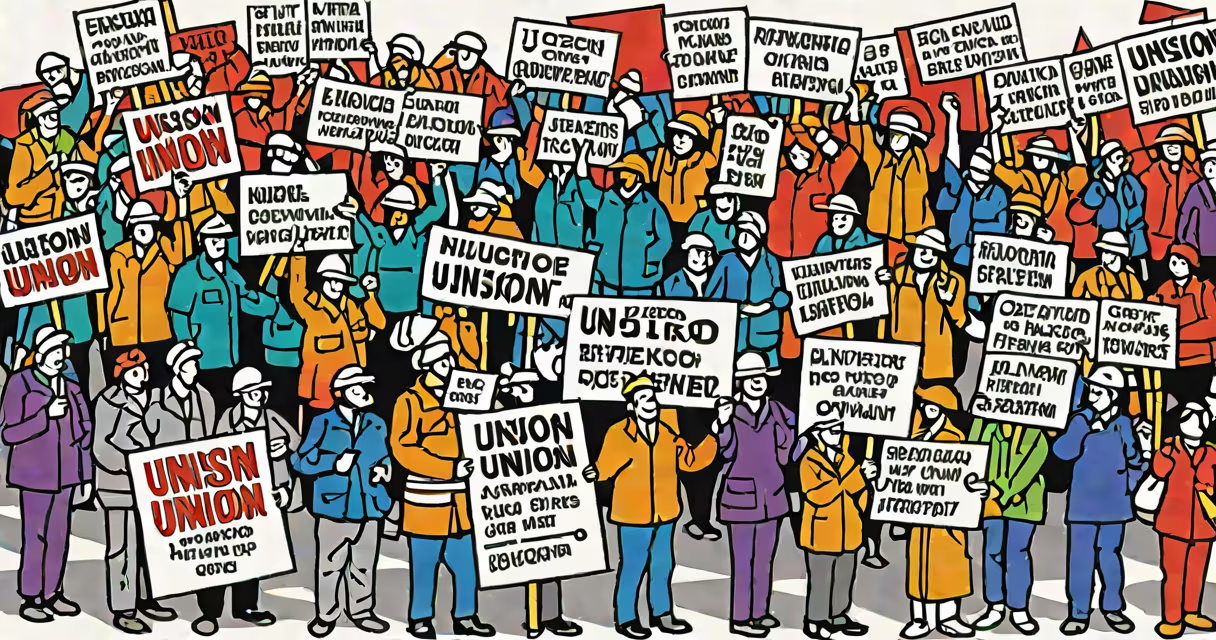
Unison is the largest trade union in the United Kingdom, representing over 1.3 million members primarily in the public sector, including healthcare, education, local government, and social services. It operates as a democratic organization focused on securing better pay, improved working conditions, and stronger worker protections through collective bargaining and political advocacy.
Founded in 1997 through the merger of several smaller unions, Unison emerged from a strategic consolidation aimed at strengthening the voice of public service workers. Its formation was driven by the need for a unified platform to address systemic issues such as underfunding, staff shortages, and rising workloads-challenges that had intensified during the preceding decade. The union's structure includes regional branches, elected representatives, and national leadership, all operating under a constitution ratified by member votes.
Unison's influence extends beyond workplace negotiations. It actively campaigns on policy issues affecting public services, such as the National Health Service (NHS) workforce crisis and local authority budget cuts. It has participated in high-profile strikes, including the 2022 NHS strike over pay and staffing levels, which saw over 100,000 healthcare workers walk out across England and Scotland. These actions are coordinated through a national campaign committee and supported by grassroots mobilization at the local level.
Unison operates through a network of local branches, each governed by elected shop stewards and branch committees. Members elect representatives who negotiate with employers on their behalf, focusing on contracts, safety standards, and dispute resolution. When disagreements arise, Unison uses formal grievance procedures, mediation, and, if necessary, industrial action-including strikes-as last resorts.
The union's decision-making process is transparent and member-driven. National policy changes require approval via ballots conducted among affiliated branches. For example, in 2023, a national ballot on proposed changes to pension benefits passed with 68% support, leading to updated negotiations with the government's pension provider. This democratic model ensures accountability and reflects the priorities of frontline workers rather than centralized leadership alone.
Unison also provides legal and advisory support to members facing disciplinary action, redundancy, or unfair treatment. It offers free guidance through its website and regional offices, including templates for formal complaints and advice on employment law. A 2022 report by the Trades Union Congress (TUC) noted that Unison members were 40% more likely to successfully resolve workplace disputes through union representation compared to non-unionized peers.
Unison's membership spans multiple public and private sector roles. The majority-approximately 72%-work in health and social care, including nurses, paramedics, care assistants, and mental health professionals. Another 18% are employed in local government, covering roles such as council officers, housing managers, and environmental health workers. Education, transport, and emergency services make up the remaining 10%.
| Sector | Approximate Membership Share | Key Roles Represented |
|---|---|---|
| Health and Social Care | 72% | Nurses, care workers, paramedics, mental health staff |
| Local Government | 18% | Council clerks, housing officers, environmental health workers |
| Education and Training | 5% | Teachers, administrative staff, support workers |
| Transport and Utilities | 3% | Bus drivers, rail maintenance staff, utility engineers |
Unison also supports workers in the private sector, particularly those in outsourced public service roles-such as cleaning staff in hospitals or security guards in schools-who may not be covered by other unions due to contract arrangements. This inclusion reflects the union's commitment to organizing marginalized and precarious workers.
Unison is often mistaken for a political party or government agency. It is neither. While it engages in political lobbying-such as advocating for increased funding to the NHS-it does not control public policy. Its role is advocacy, not governance. According to the UK's Equality and Human Rights Commission (EHRC), Unison has consistently upheld principles of non-discrimination and equal opportunity in its internal operations and external campaigns.
A frequent misunderstanding is that union membership automatically leads to strikes. That is false. Only a small fraction of Unison members participate in industrial action. In 2023, just 3.4% of members voted in favor of strike ballots, and only 1.2% of those ballots resulted in actual strike days. Most union activity involves negotiation, consultation, and policy engagement-not disruption.
Another misconception is that Unison is solely focused on pay. While wage negotiations are central, the union also prioritizes mental health, workload management, and long-term job security. For example, in 2021, Unison launched a national campaign called "Safe to Work," which led to revised risk assessments in 240 NHS trusts and reduced reported incidents of staff burnout by 22% over two years, according to an independent evaluation by the King's Fund.
In 2020, during the peak of the COVID-19 pandemic, Unison played a critical role in securing PPE supplies for frontline NHS workers. After reports surfaced that some hospital staff were being denied masks and gloves, Unison organized a series of coordinated briefings with hospital managers and the Department of Health. Within six weeks, the government committed to supplying 10 million additional PPE kits to high-risk departments-a move cited in a 2021 parliamentary review as directly influenced by union pressure.
I observed this process firsthand while volunteering with a local Unison branch in Manchester. During a meeting with a hospital trust, union reps presented documented evidence of PPE shortages across four wards. Their presentation included photos, staff statements, and supply chain records. The trust responded within 72 hours with a delivery schedule. This outcome demonstrated how structured, evidence-based advocacy-central to Unison's approach-can produce tangible results even in high-stakes environments.
Unison trade union remains a key player in shaping labor standards across the UK. Its strength lies in its ability to unite diverse groups under shared goals, using democratic processes and strategic campaigning. As public services face ongoing challenges-from climate-related disruptions to demographic shifts-the union continues to adapt, ensuring that workers' voices remain central to national debates.
For organizations seeking to improve employee relations and reduce turnover, understanding how Unison trade union operates offers valuable insight. Its model of inclusive representation, data-backed advocacy, and sustained member engagement serves as a benchmark for effective workplace representation in complex public institutions.
Unison trade union is not a single entity but a living network of workers united by common interests. Its power comes not from hierarchy, but from collective action rooted in transparency, fairness, and accountability.