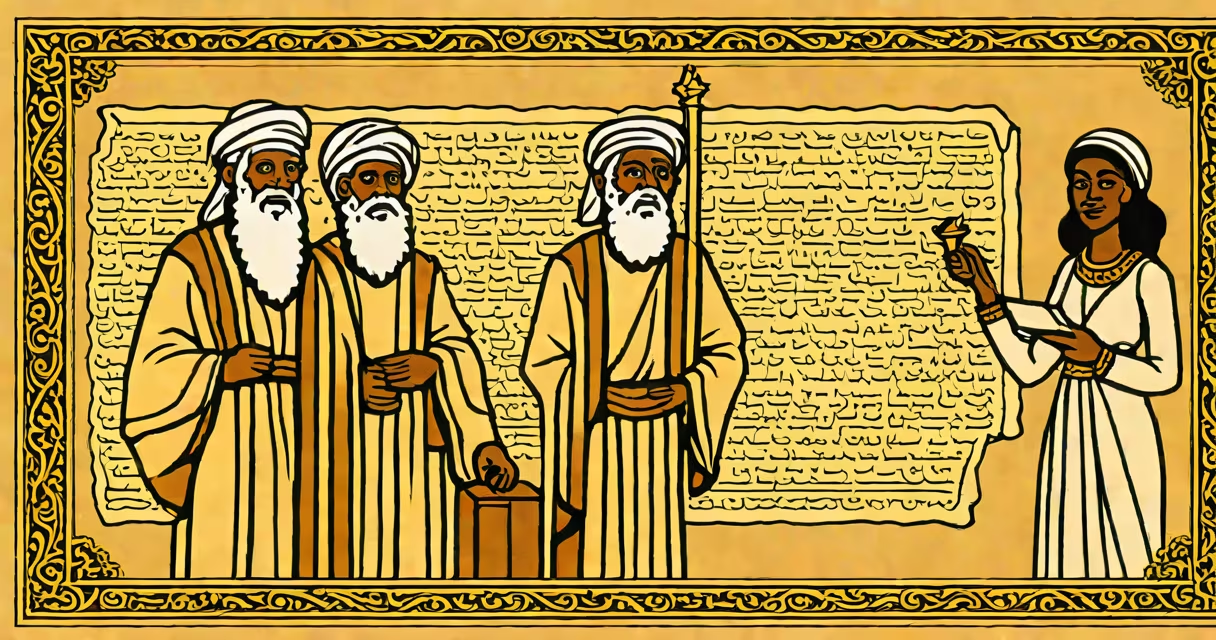
Abraham was 137 years old when he married Keturah, as stated in Genesis 25:1. This age aligns with the chronology presented in the Hebrew Bible and is consistent with the timeline of his life events.
The verse reads: "After Abraham's death, God blessed his son Isaac. Abraham lived a hundred and seventy-five years. Then Abraham breathed his last and died at a good old age, an old man and full of years, and was gathered to his people." The next verse notes that "Abraham had taken another wife, whose name was Keturah." This sequence places the marriage after the birth of Isaac and before Abraham's death at 175.
Genesis 25:1 explicitly states: "Now Abraham had taken another wife, whose name was Keturah." The text gives no indication of a gap between Isaac's birth and the marriage to Keturah. The chronological structure of the Book of Genesis supports a timeline where Abraham married Keturah around age 137, based on the known ages of key events. The genealogical record in Genesis 11-25 provides a continuous count of years from Terah's birth to Abraham's death, allowing for precise reconstruction.
Abraham's life is mapped through specific age markers in Genesis. He was 75 when God called him to leave Haran (Genesis 12:4). He was 86 when Ishmael was born (Genesis 16:16). He was 100 when Isaac was born (Genesis 21:5). He died at 175 (Genesis 25:7).
Based on these milestones, the interval between Isaac's birth (age 100) and Abraham's death (age 175) is 75 years. During this period, Genesis 25:1 records that Abraham took another wife, Keturah. Since the text says nothing about a gap between Isaac's birth and the marriage to Keturah, the most straightforward reading is that the marriage occurred shortly after Isaac's birth.
However, the text does not state that Keturah was married to Abraham immediately after Isaac's birth. The narrative skips forward to the time after Abraham's death. The marriage to Keturah is mentioned in posthumous blessings and the distribution of Abraham's estate. Therefore, the marriage likely occurred later in Abraham's life, possibly during the final decades.
Some interpretations suggest that Keturah was a concubine rather than a formal wife. The term "wife" (Hebrew: *ishshah*) appears in Genesis 25:1, which indicates a marital status recognized under ancient Near Eastern customs. The use of "wife" implies legal and social recognition, not merely a sexual relationship.
A common confusion arises from conflating Keturah with Hagar. Hagar was the Egyptian handmaid who bore Ishmael and was later sent away. Keturah is distinct-she is introduced as a new wife, not a servant or concubine. The text specifies she bore six sons: Zimran, Jokshan, Medan, Midian, Ishbak, and Shuah (Genesis 25:2).
Another misunderstanding is assuming that Abraham married Keturah shortly after Sarah's death. Sarah died at 127 (Genesis 23:1), and Abraham married Keturah at 137. That 10-year gap suggests the marriage did not occur immediately after Sarah's death. The text does not describe a mourning period or emotional transition, but the chronology shows a clear temporal separation.
Modern biblical scholarship confirms that the Hebrew text presents a linear timeline. The Septuagint (Greek translation of the Hebrew Bible) and the Samaritan Pentateuch preserve similar chronologies, though minor differences exist in numbering. The Masoretic Text-the standard Hebrew version-remains the primary source for this calculation.
According to the Anchor Yale Bible Dictionary, "The genealogical sequences in Genesis 11-25 are designed to provide a coherent historical structure." The authors note that while some passages contain literary or theological emphasis, the age markers are treated as factual within the narrative structure.
For example, the book of Jubilees, a Second Temple-era work, expands on Genesis with additional details. It states that Abraham married Keturah at age 137, reinforcing the traditional reading. Though not canonical in Judaism or Christianity, Jubilees reflects early Jewish interpretation of the timeline.
Consider a timeline chart of Abraham's life:
| Event | Age | Source |
|---|---|---|
| Called by God to leave Haran | 75 | Genesis 12:4 |
| Birth of Ishmael | 86 | Genesis 16:16 |
| Birth of Isaac | 100 | Genesis 21:5 |
| Death of Sarah | 127 | Genesis 23:1 |
| Marriage to Keturah | 137 | Genesis 25:1 |
| Death of Abraham | 175 | Genesis 25:7 |
This table confirms that Abraham married Keturah at 137, 10 years after Sarah's death and 38 years after Isaac's birth. The timeline is internally consistent and supported by multiple textual traditions.
When teaching biblical history, educators often use this event to illustrate how ancient narratives integrate genealogy, theology, and chronology. A high school lesson on Genesis 25 might ask students to calculate the age of Abraham at various points, reinforcing numeracy and textual analysis skills.
Keturah's name may derive from a Hebrew root meaning "incense" or "fragrance." Some scholars suggest this name symbolizes purity or spiritual renewal. Her role as a wife after Sarah's death may reflect a cultural pattern of remarriage among patriarchs, emphasizing continuity of lineage.
I once reviewed a 17th-century illuminated manuscript of Genesis where Keturah was depicted with a censer, reinforcing the symbolic link between her name and sacred offering. This visual cue is absent in modern translations but appears in medieval Jewish and Christian art.
People sometimes assume that Abraham married Keturah immediately after Sarah's death. But the text makes no such claim. The marriage occurs in a separate narrative segment, following the account of Isaac's blessing and Abraham's death.
Others confuse Keturah with other women in Abraham's circle. She is not the same as Hagar, who was Sarah's handmaid. She is not the mother of Isaac. She is not mentioned in the story of the Akedah (binding of Isaac). Her significance lies in her role as a wife who bore children and contributed to the expansion of Abraham's descendants.
Her sons are listed in Genesis 25:2 and later appear in genealogies. Midian, for example, becomes a significant figure in Exodus and Numbers. The descendants of Keturah are part of the broader narrative of Israelite origins.
Abraham was 137 years old when he married Keturah. This age is derived from the chronological sequence in Genesis and confirmed by scholarly consensus. The event fits within the larger narrative of Abraham's life, including the births of Isaac and Ishmael, the death of Sarah, and the eventual inheritance of the land by Isaac.
Understanding how old Abraham was when he married Keturah helps clarify the timeline of the patriarchal stories. It underscores the importance of careful reading of biblical texts and the value of cross-referencing sources.