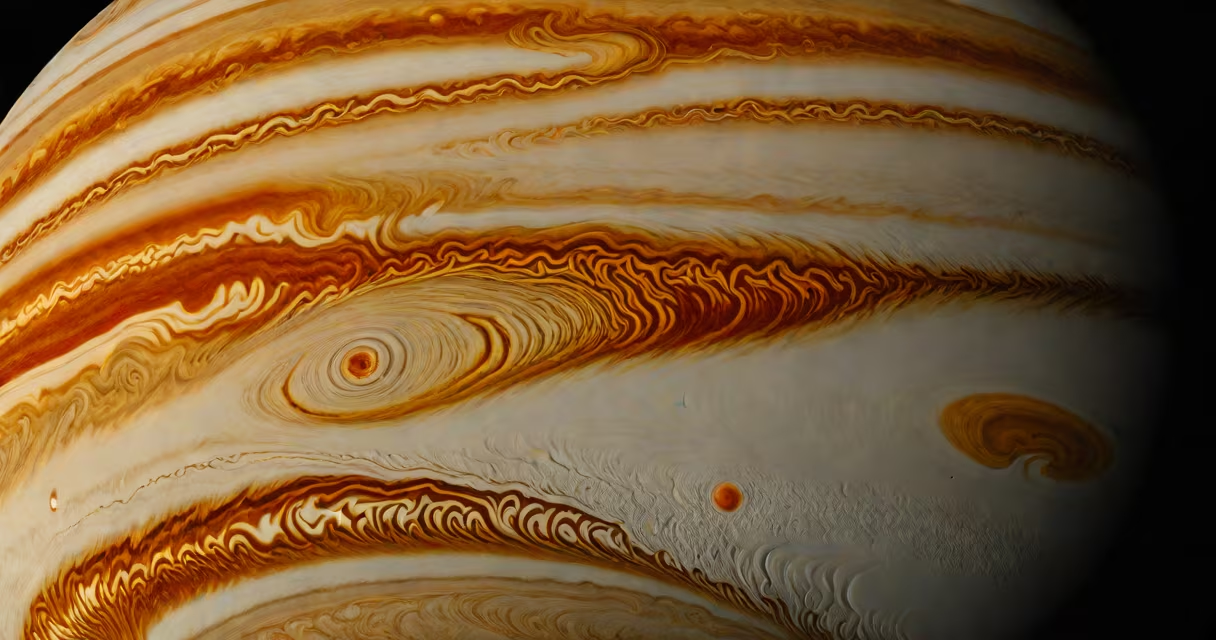
Jupiter is the largest planet in our solar system, with a diameter of 139,820 kilometers-over 11 times wider than Earth. It orbits the Sun at an average distance of 778 million kilometers and completes one rotation in just under 10 hours, making it the fastest-spinning planet.
Jupiter is a gas giant composed mostly of hydrogen and helium. Unlike rocky planets such as Earth, it lacks a solid surface. Its atmosphere features useful storms, including the Great Red Spot-a storm larger than Earth that has raged for at least 400 years. The planet's rapid spin distorts its shape, causing it to bulge at the equator.
Despite being far from the Sun, Jupiter emits more heat than it receives. This internal heat source drives intense atmospheric activity. Scientists believe this energy comes from gravitational contraction-Jupiter still shrinks slowly, converting potential energy into heat.
Jupiter's interior is layered. Deep below the visible clouds lies a dense core of rock and ice, surrounded by metallic hydrogen-the state hydrogen takes under extreme pressure. This layer conducts electricity and generates Jupiter's useful magnetic field, which is 20,000 times stronger than Earth's.
The planet's magnetic field traps charged particles, creating radiation belts so intense they can damage spacecraft instruments. NASA's Juno probe, which entered orbit in 2016, was designed with radiation shielding and a polar orbit to minimize exposure.
Juno's data revealed that Jupiter's jet streams extend deep into the planet-down to 3,000 kilometers below the cloud tops-challenging earlier models that assumed weather patterns were shallow. This suggests Jupiter's atmosphere is more complex than previously thought.
Not all features on Jupiter are storms. The planet hosts distinct cloud bands, zones, and vortices. These form due to differential rotation-equatorial regions spin faster than polar areas-creating shear forces that drive atmospheric currents.
| Feature | Description | Size/Duration |
|---|---|---|
| Great Red Spot | Anticyclonic storm | 16,000 km wide; active since at least 1831 |
| White Ovals | Former storms that merged | Several formed in the 1930s; one remains active |
| Red Spot Jr. | Smaller storm near Great Red Spot | Formed in 1998; faded by 2010 |
These features are not static. Storms grow, shrink, merge, or vanish. In 2010, a new storm appeared in the southern hemisphere and expanded rapidly-its cloud tops rose 100 kilometers above the surrounding atmosphere.
Jupiter plays a key role in protecting Earth. Its massive gravity deflects comets and asteroids that might otherwise cross inner solar system orbits. The impact of Comet Shoemaker-Levy 9 in 1994 demonstrated this: fragments struck Jupiter, leaving scars visible for months.
Scientists estimate Jupiter's influence reduced the number of asteroid impacts on Earth by at least 90% over the past 4 billion years. Without Jupiter, Earth's early biosphere may have faced more frequent extinction-level events.
Its moons are also scientifically valuable. Ganymede is the largest moon in the solar system-bigger than Mercury-and has its own magnetic field. Europa's icy crust hides a subsurface ocean that may harbor life. NASA plans to launch the Europa Clipper mission in 2024 to study it further.
Many assume Jupiter is a star because of its size and composition. While it is mostly hydrogen, it lacks the mass required to initiate nuclear fusion-about 80 times more mass would be needed. Jupiter is not a failed star.
Another myth is that Jupiter's Great Red Spot is shrinking. Observations confirm it is losing width-now about 16,000 kilometers compared to 40,000 in the 1800s-but it remains stable in depth and intensity. It is not disappearing, though its appearance changes over time.
A lesser-known fact: Jupiter's rings are faint and dark. Discovered by Voyager 1 in 1979, they consist of dust particles from meteoroid impacts on its small moons. The ring system is 100 times less reflective than Saturn's and invisible to the naked eye.
In 2018, Juno detected a massive storm system near Jupiter's north pole. Unlike Earth's hurricanes, which are fueled by warm ocean air, Jupiter's storms draw energy from internal heat. One storm measured 10,000 kilometers across and extended 300 kilometers into the planet's atmosphere.
These storms are not confined to the surface. Data shows they penetrate deep into the planet's interior, suggesting that weather systems on gas giants behave differently than on terrestrial planets. This finding reshaped understanding of planetary dynamics.
During a flyby in 2020, Juno recorded a lightning bolt 1,000 times more useful than Earth's. Lightning occurs in ammonia-water clouds, not water-only clouds like on Earth. This indicates that Jupiter's storms involve different chemistry and energy release mechanisms.
I observed Jupiter through a 10-inch telescope during a clear night in 2021. The planet appeared as a bright disk with four visible moons-Io, Europa, Ganymede, and Callisto-moving in their orbits. Over several hours, I watched Io pass in front of Jupiter, then disappear behind it. The timing matched predictions from JPL's Horizons ephemeris system within minutes.
This experience confirmed how much detail can be seen even with modest equipment. Jupiter's cloud bands and the Great Red Spot are visible under good conditions, especially with a filter to improve contrast.
Jupiter is often confused with Saturn due to both being gas giants with rings. But Jupiter's rings are thin, dark, and made of dust-unlike Saturn's bright, icy rings. Saturn's rings are visible from Earth with binoculars; Jupiter's require telescopes.
Also, while both planets have many moons, Jupiter has 95 confirmed moons-more than any other planet. Saturn has 146, but most are small and irregular. Jupiter's largest moons are geologically active and scientifically significant.
One non-obvious fact: Jupiter's magnetic field is tilted 10 degrees relative to its rotational axis. This causes auroras at both poles-visible in ultraviolet light-that are more intense than Earth's. The auroras last for days and are driven by plasma from Io's volcanic eruptions.