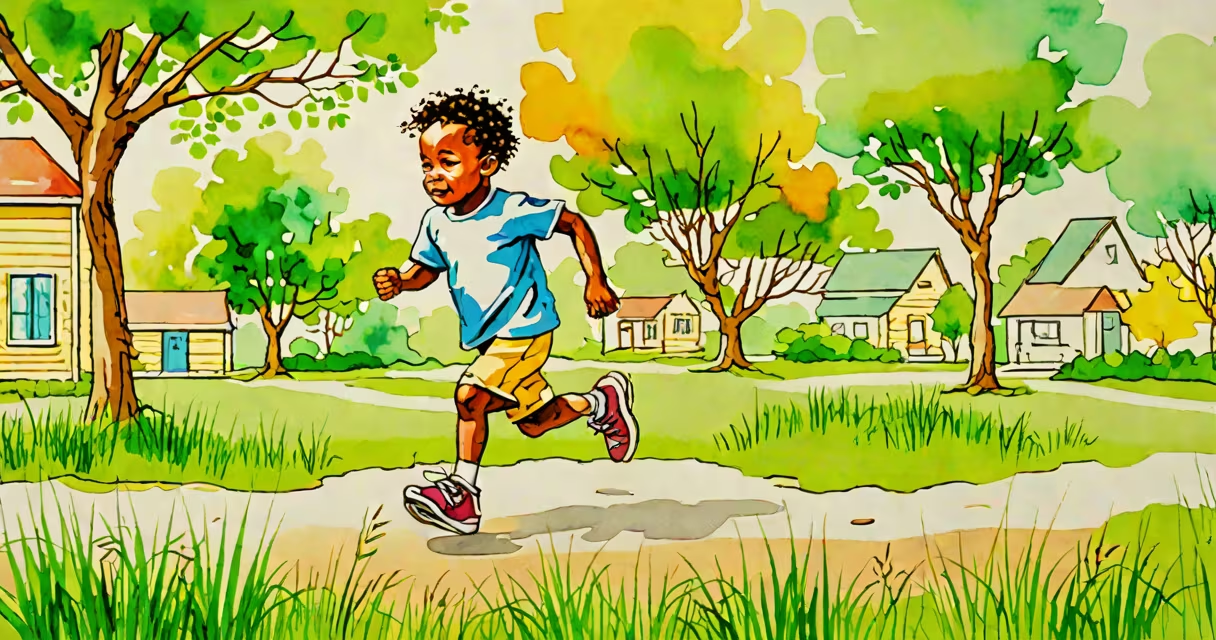
Large motor skills for 4 year olds refer to the ability to control and coordinate major muscle groups to perform actions like running, jumping, climbing, and balancing. These skills form the foundation for physical independence, social participation, and academic readiness.
By age four, children typically demonstrate increasing strength, balance, and coordination. They can hop on one foot, ride a tricycle, climb playground equipment, and catch or throw a ball with accuracy. These movements aren't random-they reflect neurological maturation and consistent practice during early childhood.
The American Academy of Pediatrics (AAP) notes that large motor skill development supports cognitive and emotional growth. Children who engage in regular movement activities show improved attention spans, better problem-solving abilities, and stronger self-regulation.
At age four, children refine movements they began mastering earlier. They transition from wobbly runs to smooth, purposeful strides. Their balance improves dramatically-they can stand on one foot for five seconds or more and walk along a narrow line without falling.
Neurological development underpins this progress. The cerebellum, responsible for coordination and balance, matures between ages 3 and 5. As neural pathways strengthen, children gain better control over their limbs and spatial awareness.
Physical activity reinforces these changes. A study published in *Pediatrics* found that preschoolers who engaged in 60 minutes of structured play daily showed 23% greater improvement in motor coordination compared to peers with less activity.
Children aged four typically achieve the following benchmarks:
| Motor Skill | Typical Achievement | Example Activity |
|---|---|---|
| Running | Smooth, controlled motion with arms swinging | Chasing a friend around a yard |
| Hopping | Can hop forward on one foot 3-5 times | Jumping over chalk lines on pavement |
| Jumping down | Leaps from low surfaces safely | Jumping off a step onto grass |
| Ball handling | Throws and catches a large ball with aim | Playing catch with a parent |
| Balance | Stands on one foot for 5 seconds | Walking along a taped line on the floor |
These skills emerge through repetition and play. A child who jumps repeatedly from a small platform builds confidence and refines timing and muscle control.
Parents often worry if their child isn't keeping up with peers. But variation in development is normal. Some children master hopping early; others take longer. What matters is progress over time, not perfection on a timeline.
A common error is confusing delayed large motor skills with developmental delay. According to the Centers for Disease Control and Prevention (CDC), if a child cannot walk independently by 18 months, jump with both feet by age 3, or run with coordination by age 4, further evaluation may be needed.
One overlooked sign is difficulty with bilateral coordination-using both sides of the body together. A child who consistently uses only one hand to grab toys or struggles to cross midline while drawing may have underlying motor challenges. Early intervention can prevent later academic difficulties.
Play-based environments are the most effective settings for developing large motor skills. Structured activities should feel like games, not drills.
Simple routines make a difference. At home, parents can set up obstacle courses using cushions, tunnels, and cones. A 4-year-old might crawl through a tunnel, balance on a taped line, then jump over a rope-all in under ten minutes.
In preschools, teachers use movement circles, animal walks (bear crawl, frog jump), and rhythmic games. One classroom I observed had children march in place while mimicking a marching band, then freeze when the music stopped. The activity combined listening, timing, and motor control-core elements of large motor development.
Outdoor play is especially valuable. A 2021 study in *Journal of Physical Activity and Health* found that children who played outdoors for at least 30 minutes daily were 40% more likely to meet gross motor milestones than those with limited outdoor access.
If a child consistently avoids running, frequently falls, or shows frustration during physical tasks, consult a pediatrician or occupational therapist. Persistent toe-walking, lack of coordination in crossing arms, or difficulty climbing stairs may indicate a need for assessment.
Early identification leads to better outcomes. The CDC recommends screening for developmental delays at 9, 18, and 24 months-but ongoing observation remains key. A child who struggles with large motor skills at age four may benefit from targeted exercises, such as balance beam walking or ball tossing games.
Large motor skills for 4 year olds are not isolated physical achievements. They're linked to language, memory, and social interaction. When a child runs to join a game, they're not just moving-they're making decisions, reading cues, and adapting in real time.
Research from the University of Illinois shows that children with higher levels of physical activity score 15% higher on standardized tests measuring executive function. This connection underscores why schools now integrate movement breaks into the daily schedule.
Understanding large motor skills for 4 year olds means seeing them as part of a larger system of growth-not just how high a child can jump, but how confidently they move through the world.