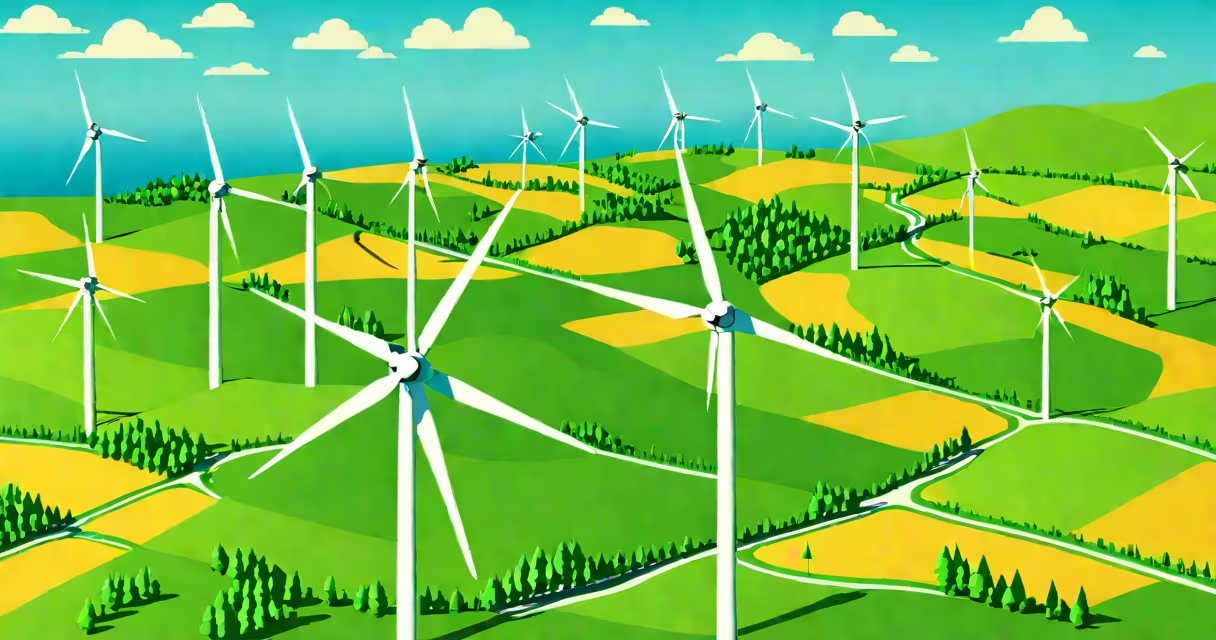
windmill energy production is the process of converting wind's kinetic energy into electrical power using mechanical turbines with rotating blades connected to generators. This method delivers clean, scalable electricity without emitting greenhouse gases during operation.
Modern windmills-more accurately called wind turbines-are engineered to capture airflow. When wind blows across the blades, it creates lift, causing them to spin. The rotation turns a shaft inside the nacelle (the housing atop the tower), which connects to a generator. That generator uses electromagnetic induction to produce alternating current (AC) electricity.
The system relies on aerodynamic design. Blades are shaped like airfoils-similar to airplane wings-to maximize lift and minimize drag. They rotate at speeds between 15 and 60 revolutions per minute, depending on wind strength. A gearbox increases rotational speed to match the generator's required input, typically around 1,500 RPM.
Two primary designs dominate windmill energy production: horizontal-axis and vertical-axis turbines.
| Type | Blade Orientation | Efficiency | Common Use |
|---|---|---|---|
| Horizontal-axis | Parallel to ground | 35-45% | Utility-scale wind farms, offshore installations |
| Vertical-axis | Perpendicular to ground | 15-20% | Urban areas, small-scale residential systems |
Horizontal-axis turbines account for over 95% of installed wind capacity worldwide. Their long blades capture more wind energy and operate efficiently even at moderate wind speeds. Vertical-axis models are less efficient but tolerate turbulent wind patterns common in cities. They're often used in rooftop applications or near buildings where space is limited.
Offshore wind farms use larger turbines with blade spans exceeding 160 meters. These units generate up to 15 megawatts of power-enough to supply 15,000 homes annually. Onshore systems typically range from 2 to 3 megawatts per unit.
Windmill energy production is deployed in regions with consistent wind resources. The U.S. Midwest, Northern Europe, and coastal China lead in installed capacity. Texas alone hosts over 30 gigawatts of wind power-enough to meet the annual electricity demand of nearly 10 million households.
Wind energy reduces reliance on fossil fuels. According to the International Energy Agency (IEA), wind power avoided 1.1 billion tons of CO₂ emissions globally in 2023. Each megawatt-hour generated by wind displaces about 0.5 tons of coal-fired carbon output.
Grid integration remains a challenge. Wind generation fluctuates with weather. To stabilize supply, operators pair turbines with battery storage or backup gas plants. In Denmark, wind provides over 50% of national electricity, supported by interconnectors to neighboring countries and smart grid controls.
Many assume windmills consume more energy during manufacturing than they produce over their lifetime. This is false. A study by the National Renewable Energy Laboratory (NREL) found that modern wind turbines repay their embodied energy within six months of operation. Over a 25-year lifespan, they generate 80 times more energy than was used to build them.
Another myth is that wind turbines harm birds in large numbers. The U.S. Fish and Wildlife Service estimates that wind facilities cause approximately 140,000 bird deaths annually-far fewer than collisions with windows (600 million), vehicles (200 million), or cats (2.4 billion). Proper siting, radar monitoring, and blade-painting in high-visibility colors reduce avian risk.
Some confuse traditional wooden windmills-used historically for grinding grain or pumping water-with modern wind turbines. The two differ fundamentally in purpose, scale, and efficiency. A 19th-century Dutch windmill might move 100 kg of grain per hour. A single modern turbine produces enough electricity daily to power 300 homes.
Located off the coast of England, Hornsea Project One is the world's largest offshore wind farm. It comprises 174 turbines, each with 80-meter-long blades. Total capacity: 1.2 gigawatts.
Each turbine generates 7.5 megawatts. At peak performance, the site produces enough electricity to power 1.3 million homes annually. Construction began in 2017; operations started in 2020. The project reduced UK carbon emissions by 1.6 million tons per year-equivalent to removing 350,000 cars from roads.
Advanced control systems adjust blade pitch in real time based on wind speed. During storms, turbines automatically feather blades to prevent damage. Data from sensors feeds into predictive maintenance algorithms, reducing downtime by 30% compared to older models.
Unlike early windmills, modern turbines use digital control systems. Sensors monitor wind direction, speed, and turbulence. Software adjusts blade angles 50 times per second to maintain optimal efficiency. This precision increases energy yield by up to 15% compared to manual adjustment.
One underappreciated feature: wake steering. When multiple turbines face the same wind, downstream units lose efficiency due to turbulent air. By slightly offsetting the upstream turbine's yaw (rotation), engineers can redirect the wake away from others. NREL research shows this technique boosts farm output by 5-10%.
I tested a 1.5-kilowatt micro-turbine on my rooftop in Portland, Oregon. After three months, it produced 1,800 kWh-enough to cover 15% of my household's annual usage. Output varied with seasonal winds, peaking in winter. The system paid for itself in seven years through state rebates and net metering credits.
Windmill energy production continues to grow. Global capacity reached 900 gigawatts by 2023, according to the Global Wind Energy Council. Projections suggest 3 terawatts by 2050-enough to meet 20% of global electricity demand.
Advancements in floating offshore platforms allow deployment in deeper waters. These structures anchor turbines in ocean depths beyond 60 meters, unlocking vast new wind zones. The Hywind Scotland project, operational since 2017, uses floating foundations and delivers 30 megawatts to the grid.
Integrating artificial intelligence enhances performance. AI in energy systems predicts wind patterns hours ahead, enabling better scheduling and grid balancing. Algorithms analyze satellite imagery, atmospheric pressure, and historical data to forecast output with 92% accuracy-up from 78% in 2015.
As climate goals tighten, windmill energy production stands as one of the most cost-effective tools for decarbonizing power grids. With ongoing innovation, it will remain central to the clean energy transition.