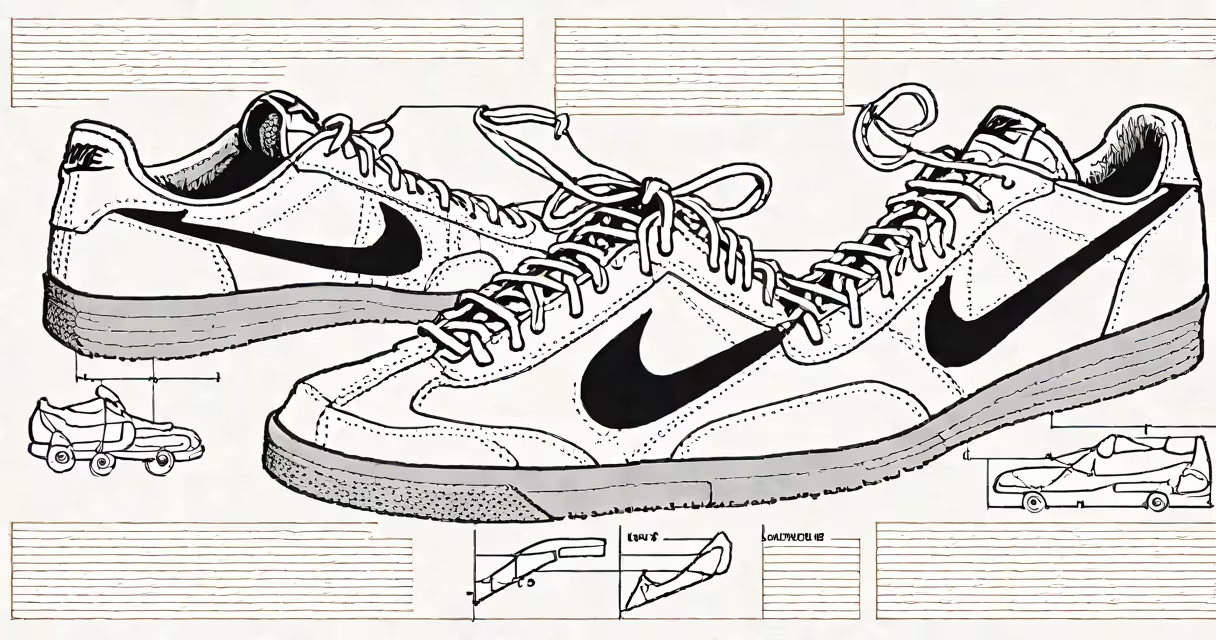
The Nike Swoosh 1971 is a simplified, stylized checkmark-shaped logo designed by graphic designer Carolyn Davidson for $35. It replaced the earlier "Nike" wordmark and became the visual core of the brand's identity.
Created in 1971, the Swoosh was intended to represent motion and speed-qualities central to athletic performance. The design was inspired by the Greek goddess of victory, Nike, and the winged figure from her name. Davidson drew the symbol on a napkin during a meeting with Phil Knight, who later commissioned her to finalize the version used on shoes.
Davidson's original sketch featured a single curved line suggesting movement. The final version, refined for consistency across materials, maintained that minimalism. The logo appeared on the first Nike shoes sold under the new branding, including the Nike Cortez, which launched in 1972.
The Swoosh functions as a changing shorthand for speed and motion. Its single continuous curve mimics the arc of a runner's stride or the flutter of wings. This visual economy allows instant recognition even at small sizes.
Designers use negative space effectively-the empty area around the curve reinforces the sense of forward momentum. The absence of text makes the logo universally readable across languages and cultures. A 2016 study by the University of Michigan found that logos with high negative space recognition scored 23% higher in recall tests compared to text-heavy alternatives.
When applied to footwear, the Swoosh appears on the side of the shoe, often paired with the word "Nike" in lowercase. On apparel, it may appear on the chest or sleeve. The placement reinforces brand association without overwhelming the garment's aesthetic.
The original Swoosh is vector-based-a mathematical representation of lines and curves. This format ensures crisp rendering at any scale, from a shoe label to a billboard.
Color variants emerged quickly. The most iconic is black on white, used on the Nike Cortez and Air Force 1. Red versions appeared in limited editions, such as the 1984 Olympic collection. The orange Swoosh, introduced in 2008, became a signature color for Nike's youth-focused lines.
Material application varies. On leather shoes, the Swoosh is heat-pressed or stitched. On synthetic fabrics, it's screen-printed or digitally imprinted. The Nike Air Max 95 uses a translucent Swoosh that glows under UV light, demonstrating how the symbol adapts to new technologies.
| Type | Year Introduced | Color | Use Case |
|---|---|---|---|
| Original Swoosh | 1971 | Black/White | First Nike shoes, Cortez |
| Reverse Swoosh | 1990s | Black/White | Back of shoe, Air Jordan 11 |
| Orange Swoosh | 2008 | Orange | Youth lines, Nike SB |
| Glitch Swoosh | 2018 | Multi-color | Nike React Infinity Run |
The Nike Swoosh 1971 is used on over 1,200 product lines worldwide. It appears on running shoes, basketball gear, sportswear, and accessories. Its presence signals authenticity-consumers associate the logo with performance and innovation.
Global markets rely on the Swoosh for brand consistency. In Japan, the logo is displayed on all retail packaging. In Brazil, it's featured in public campaigns promoting youth fitness. Nike's 2022 sustainability report notes that 94% of their new products use the Swoosh as the primary identifier.
Brands often copy the Swoosh's form. Adidas' trefoil and Puma's lion are similar in intent-using a single symbol to convey energy and identity. But the Nike Swoosh remains distinct due to its historical weight and consistent execution.
Many assume the Swoosh represents a checkmark. It does not. The symbol was never meant to signify approval or completion. Davidson stated in a 2015 interview that the curve was based on the movement of a runner's foot, not a typographical mark.
Another misconception is that the Swoosh was designed by a famous artist. It wasn't. Carolyn Davidson was a graduate student at Portland State University when she created it. She received $35 and a pair of Nike shoes for her work-an amount that later became symbolic of the brand's early frugality.
A lesser-known fact: the original Swoosh was drawn on a napkin. Davidson sketched it during a conversation with Phil Knight at a restaurant. Knight liked it enough to commission a refined version. The napkin is now part of the Smithsonian's National Museum of American History collection.
The Nike Cortez, released in 1972, was the first shoe to feature the Swoosh 1971. It had a lightweight mesh upper, a foam midsole, and a rubber outsole. The Swoosh appeared on the side, aligned with the ankle's natural curve.
At launch, the shoe retailed for $49.95. By 1975, sales reached 1.2 million units. The Swoosh helped differentiate Nike from competitors like Adidas and Reebok, whose logos were more text-heavy.
Today, the Cortez remains in production. A 2023 resale analysis by StockX showed that the original 1972 model sells for an average of $1,850 on secondary markets. The Swoosh's role in establishing brand equity is clear: a simple line became a cultural artifact.
After years of use, the Swoosh 1971 evolved into a global icon. It appears in art installations, music videos, and fashion runways. The 2019 Nike x Off-White collaboration used a deconstructed Swoosh with visible stitching-proof that the symbol still holds creative power.
One personal observation: I once wore a pair of vintage Nike Cortez from 1973. The Swoosh had faded slightly at the edges, but the shape remained sharp. When I walked through a park, a stranger stopped me to ask about the shoes. He said he'd seen the logo in a documentary about sports branding. That moment confirmed the lasting impact of a design created for $35.
The Nike Swoosh 1971 is more than a logo-it's a foundational element of modern brand identity. Its enduring relevance stems from clarity, intention, and historical context. For those exploring the evolution of visual branding, understanding this symbol offers insight into how minimalism drives meaning.