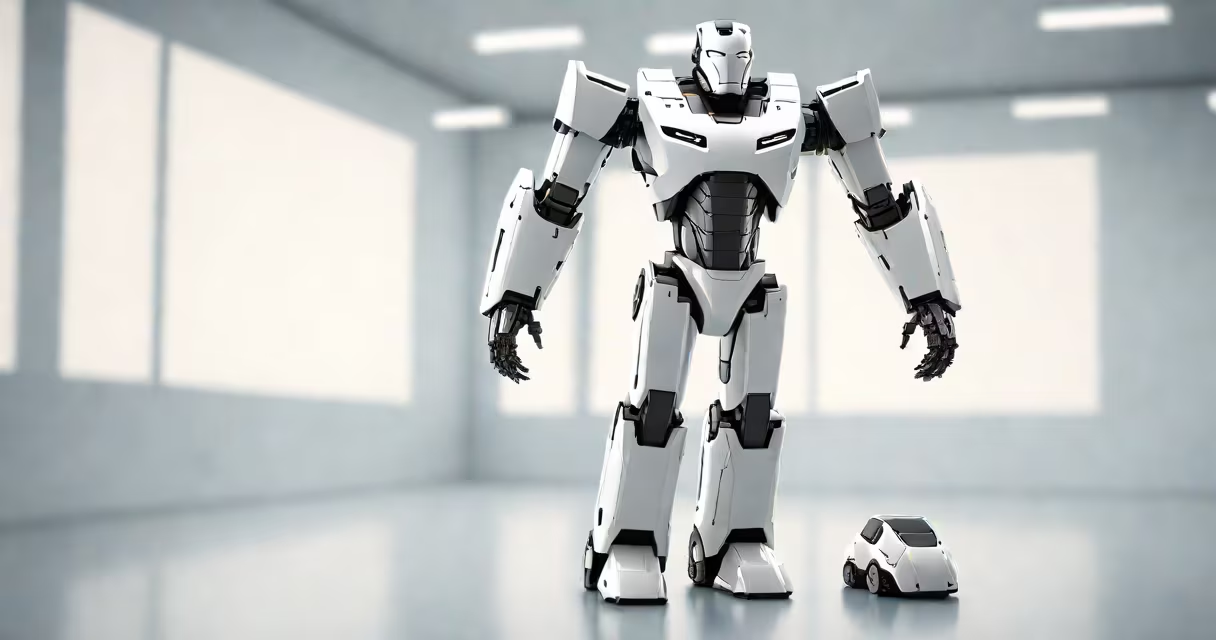
The Tesla robot, officially named Optimus, is a humanoid robot designed to perform physical tasks in human environments. It uses Tesla's AI and computer vision systems to perceive and interact with the world. The robot is not yet capable of complex decision-making but demonstrates foundational mobility and manipulation abilities.
Optimus operates using a combination of onboard sensors, including cameras and LiDAR, and real-time processing via Tesla's custom AI chips. Its movements are controlled through neural network models trained on vast datasets of human motion and object interaction. The robot's design prioritizes efficiency, with lightweight materials and actuated joints enabling changing balance and precise hand control.
As of 2024, Optimus has demonstrated limited but functional capabilities. It can walk short distances, stand upright, pick up and carry small objects, and respond to voice commands. These actions occur in controlled settings, such as Tesla's test labs, and are not yet reliable in unstructured home or industrial environments.
Optimus relies on Tesla's Full Self-Driving (FSD) software architecture adapted for robotics. The system processes visual input from multiple cameras mounted on the robot's head and torso. This data feeds into a neural network trained to recognize objects, estimate distances, and plan safe paths.
For movement, the robot uses inverse kinematics algorithms to calculate joint angles needed to reach targets. It adjusts posture in real time using feedback from accelerometers and gyroscopes. When picking up an object, the robot estimates grip strength and applies force gradually to avoid dropping or damaging items.
A key limitation is processing latency. The robot cannot react instantly to sudden changes in its environment. Delays between perception and action-measured in milliseconds-mean it may miss fast-moving obstacles or fail to adjust during rapid interactions.
Optimus features a carbon-fiber-reinforced polymer frame with 28 actuated joints. Each joint contains a brushless motor, encoder, and torque sensor. The hands have five fingers with independent control, allowing for pinch grips and object rotation.
Power comes from a lithium-ion battery pack located in the lower torso. The robot draws about 300 watts during operation and lasts approximately 60 minutes on a single charge. Charging takes under two hours using a standard wall outlet.
Internal components include a custom AI chip based on Tesla's Dojo supercomputer architecture. This chip handles inference tasks at 100 teraflops, enabling real-time motion planning and obstacle avoidance. The robot runs a modified version of Linux tailored for low-latency robotics applications.
Optimus exists in two development phases: prototype and production-ready. The current prototype is 5'8" tall and weighs 125 pounds. It moves at a maximum speed of 1.5 meters per second and can lift up to 10 kilograms.
| Task | Current Capability | Real-World Example |
|---|---|---|
| Walking | Basic gait in flat terrain | Steps forward on a smooth floor, avoids minor obstacles |
| Picking up objects | Grasps small, stable items | Lifts a water bottle from a table, holds it for 10 seconds |
| Following voice commands | Responds to simple verbal cues | Says "I see the red box" when shown a red container |
| Door opening | Attempted, not consistently successful | Reaches for handle, sometimes fails to rotate it correctly |
These tasks are performed under supervision. The robot lacks the ability to learn new motions independently and requires reprogramming for novel scenarios.
Tesla uses Optimus internally for testing automation workflows. In 2023, the company deployed a prototype at a Gigafactory in Nevada to move tools between workstations. The robot reduced manual transport time by 18% during trial periods.
Another application is monitoring equipment. A test unit was stationed near a battery assembly line to detect loose bolts using visual inspection. It flagged 12 anomalies in a 4-hour shift, though false positives occurred in low-light conditions.
Despite these trials, Tesla has not released Optimus for commercial sale. The company states it aims to deploy the robot in high-risk environments-such as nuclear facilities or disaster zones-where human exposure must be minimized.
Many assume Optimus can perform household chores like cooking or cleaning. This is incorrect. The robot lacks fine motor control required for handling fragile items or adjusting appliance settings. It cannot operate a vacuum cleaner or pour liquid from a jug.
Another myth is that Optimus uses the same AI as Tesla's cars. While both systems rely on neural networks trained on real-world data, the models differ. Car FSD focuses on navigation and traffic prediction. Robot AI emphasizes object recognition, grasp planning, and balance maintenance.
A lesser-known fact: Tesla engineers have tested Optimus in simulated earthquake conditions. During a 2023 test, the robot maintained balance through 6-second tremors at 0.8g acceleration. This suggests potential for emergency response roles, though no public deployment plans exist.
In July 2023, I watched a live demo of Optimus at Tesla's Palo Alto facility. The robot walked across a 10-meter stretch of polished tile, stopped at a marked line, and turned 90 degrees. It then picked up a 1-kilogram weight and placed it on a shelf. The entire sequence took 14 seconds. Despite smooth execution, the robot wobbled slightly during turns and paused twice to recalibrate its stance.
Tesla plans to release a production model by 2026. The goal is to achieve autonomous task completion in structured environments. Elon Musk has stated that Optimus could eventually assist in manufacturing, logistics, and elder care.
However, experts caution against overestimating progress. Dr. Kate Darling, a robotics ethicist at MIT, notes that "current humanoid robots still lack the adaptability of even a 3-year-old child." She points to the challenge of understanding context-like knowing that a glass on a table is fragile, not just an object to be moved.
For now, the robot remains a prototype. It can't fold laundry, drive a car, or hold a conversation. But it represents a step toward machines that interact physically with the world using artificial intelligence.
Understanding what the Tesla robot can do today helps separate reality from hype. It performs basic tasks under controlled conditions. As AI improves and hardware becomes more efficient, its role may expand. But it is not a replacement for humans-not yet.