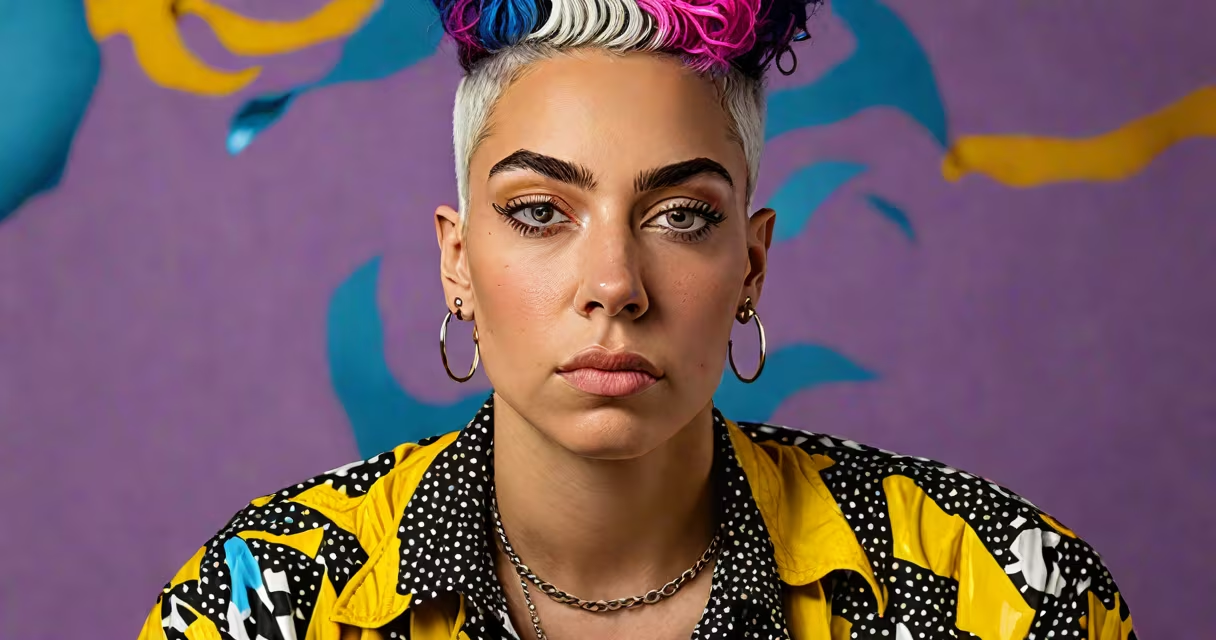
Non binary artists are individuals whose gender identity exists outside the male/female binary and who express that identity through creative work such as visual art, music, performance, or digital media. Their art often reflects personal experiences of gender fluidity, social exclusion, or resistance to rigid categorization.
These creators use their practice to explore identity beyond conventional labels. Unlike artists who may simply depict non binary people, non binary artists are people whose gender is non binary and who produce work rooted in that lived reality. The term applies to anyone whose gender is not exclusively male or female, including those who identify as genderqueer, agender, bigender, or otherwise outside the binary.
According to the Human Rights Campaign, approximately 1.2 million adults in the United States identify as non binary. Among them, many turn to art as a form of validation, community building, and political expression. This makes non binary artists a important part of contemporary cultural discourse.
Art becomes a space where non binary identities can be affirmed and explored without needing external validation. A non binary artist might use mixed media to represent shifting gender roles, or compose music that defies genre expectations-both acts of resistance against normative structures.
For example, artist Araya Rasdjarmrearnsook, based in Thailand, uses performance and installation to interrogate gendered labor and bodily autonomy. Her work often features her own body in altered states-wrapped, suspended, or obscured-challenging viewers' assumptions about gender and physicality. She identifies as non binary and has spoken about how her art allows her to inhabit multiple identities simultaneously.
Another example is the digital artist Daria Kovalenko, known for surreal animated portraits that blend human and mechanical forms. Her series "Fluid Forms" uses AI-generated facial morphing to simulate gender transitions, reflecting her own process of self-discovery. The animations are not meant to represent a single identity but to embody the instability and multiplicity inherent in non binary existence.
Non binary artists work across disciplines. The following table outlines common forms and representative practices:
| Type | Examples | Key Characteristics |
|---|---|---|
| Visual Art | Painting, sculpture, collage | Uses symbolism (e.g., broken mirrors, overlapping figures) to represent internal conflict or fluidity |
| Performance | Live theater, drag, ritual-based acts | Body as site of transformation; audience interaction central |
| Music & Sound | Experimental electronic, spoken word, ambient | Lyrics avoid gendered pronouns; instrumentation resists genre binaries |
| Digital & New Media | Interactive installations, AI art, web-based projects | Allows anonymous participation; enables global reach and experimentation |
Each medium offers different ways to challenge assumptions. For instance, a non binary sculptor might build a figure with no clear face or gendered features, forcing viewers to confront their own biases about how bodies should look.
Many assume that non binary artists are primarily focused on political messaging or activism. While some do engage in advocacy, others create purely aesthetic or introspective work. Not every piece by a non binary artist is a statement on gender-it can be about emotion, memory, or formal experimentation.
A frequent error is equating non binary identity with androgyny. Androgyny describes appearance; non binary is a gender identity. Someone can present androgynously while identifying as cisgender. Conversely, a non binary person may present very femininely or masculinely. The key difference lies in internal experience, not outward presentation.
Another misconception is that non binary art is inherently chaotic or unstructured. In reality, many non binary artists employ rigorous formal techniques-such as symmetry, repetition, or precise color theory-to reinforce themes of balance and disruption. The structure often mirrors the tension between stability and flux that defines non binary experience.
Representation in art shapes public understanding. When non binary artists are visible, they disrupt the idea that gender is fixed or binary. Their presence in galleries, festivals, and online platforms normalizes diversity and fosters empathy.
Research from the Williams Institute shows that LGBTQ+ individuals are disproportionately represented among emerging artists. Among them, non binary creators are more likely to report feeling pressure to conform to commercial expectations. Yet, they continue to innovate-often using low-cost tools like smartphones and free software to bypass gatekeeping in traditional art institutions.
I once attended an exhibition at the Brooklyn Museum titled "Unbound: Gender in Contemporary Art." One piece stood out: a video loop of a performer slowly removing layers of clothing while singing in a language that doesn't have gendered pronouns. The act wasn't performative in the theatrical sense-it was quiet, repetitive, and deeply personal. That moment stayed with me because it showed how non binary expression can be both intimate and universal.
Non binary artists are not a niche category. They are reshaping how we see identity, creativity, and belonging. Their work challenges audiences to reconsider what art can be-and who gets to make it.
Understanding non binary artists requires moving beyond labels. It's about recognizing that gender is not always a lens through which art is interpreted-but sometimes the subject itself. Their contributions are essential to a fuller picture of human expression.