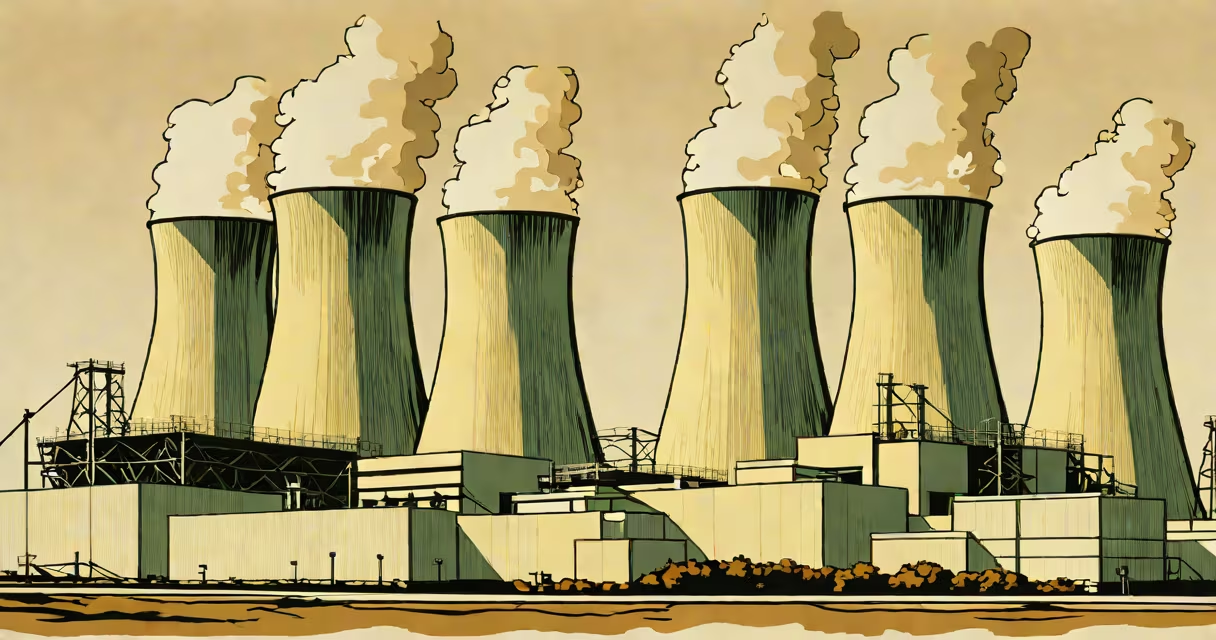
Nuclear energy is the power released during atomic reactions-either when heavy nuclei split (fission) or light nuclei fuse (fusion)-used primarily to generate electricity. This process releases vastly more energy per unit of fuel than fossil fuels, with minimal carbon emissions during operation.
Fission powers all commercial nuclear reactors today. A uranium-235 atom absorbs a neutron, becomes unstable, and splits into lighter elements, releasing heat and additional neutrons. These neutrons trigger further fissions in a chain reaction. The heat produced boils water to create steam, which drives turbines connected to generators. This method generates about 10% of global electricity, according to the International Atomic Energy Agency (IAEA).
Fusion-the process powering the sun-combines light atomic nuclei, such as hydrogen isotopes deuterium and tritium, under extreme heat and pressure. Fusion releases even more energy per reaction than fission but requires temperatures exceeding 100 million degrees Celsius. Controlled fusion remains experimental. The ITER project in France aims to demonstrate net energy gain by 2035, though no fusion reactor currently produces more energy than it consumes.
Nuclear energy starts with a fissile material, typically uranium-235 or plutonium-239. In a reactor core, these materials are arranged in fuel rods. Neutrons bombard the atoms, causing them to split. Each fission event releases energy as heat and two or three new neutrons. Control rods made of boron or cadmium absorb excess neutrons to regulate the reaction rate.
The heat from fission is transferred via a coolant-usually water or liquid sodium-to a secondary loop. There, it turns water into steam. The steam spins a turbine connected to a generator, producing electricity. After passing through the turbine, the steam is cooled and condensed back into water, then recycled.
A key safety feature is the containment structure-a reinforced concrete dome designed to withstand extreme pressures and temperatures. During the 1979 Three Mile Island accident, this structure prevented a major release of radiation despite a partial meltdown. The 2011 Fukushima Daiichi disaster showed that even solid designs can fail under extreme natural events like tsunamis, leading to revised safety standards worldwide.
Two primary processes produce nuclear energy: fission and fusion. Fission is mature and widely deployed. Fusion remains in development but holds long-term promise.
| Type | Process | Energy Source | Current Use | Example |
|---|---|---|---|---|
| Fission | Splitting heavy nuclei | Uranium-235, Plutonium-239 | Commercial power generation | Three Mile Island, France's Flamanville reactor |
| Fusion | Joining light nuclei | Deuterium, Tritium | Experimental research | ITER tokamak, National Ignition Facility (USA) |
Fission reactors operate in over 30 countries. The United States leads with 93 operational reactors, generating about 18% of its electricity. France relies on nuclear power for 68% of its electricity, thanks to a national policy prioritizing low-carbon energy. In contrast, Germany phased out nuclear power by 2023, shifting toward wind and solar.
Fusion experiments have achieved brief bursts of net energy gain. In 2022, the National Ignition Facility in California used 2.05 megajoules of laser energy to initiate a fusion reaction that released 3.15 megajoules-over 150% of input energy. However, this was a single pulse lasting less than a nanosecond. Sustaining fusion for continuous power output remains a challenge due to plasma instability and material degradation.
Nuclear energy is often conflated with nuclear weapons. While both rely on fission or fusion, weapon design focuses on rapid, uncontrolled chain reactions to maximize explosive yield. Power plants use controlled, sustained reactions to produce steady heat. The enrichment level of uranium also differs: weapons-grade uranium exceeds 90% U-235; reactor fuel uses 3-5% U-235.
Another misconception is that nuclear waste is always highly dangerous. Spent fuel rods contain long-lived isotopes like plutonium-239, which remain hazardous for tens of thousands of years. But modern reprocessing techniques can extract usable fuel from spent rods, reducing waste volume by up to 95%. France reprocesses 90% of its spent fuel, minimizing storage needs.
During my visit to the Palo Verde Nuclear Generating Station in Arizona, I observed the control room's real-time monitoring system. Operators track neutron flux, coolant temperature, and pressure in the primary loop. Even minor deviations trigger automated responses. The station's 3 reactors supply power to over 1.3 million homes annually-without emitting CO₂ during operation.
France's nuclear fleet provides a benchmark for large-scale deployment. With 56 reactors across 18 sites, the country produces more than 800 terawatt-hours of electricity yearly. This output meets 68% of domestic demand and allows exports to neighboring nations. The French government attributes this success to centralized planning and public acceptance rooted in decades of stable operation.
In contrast, India's Kudankulam Nuclear Power Plant faced protests over safety concerns. Local residents feared radiation exposure and potential accidents. Despite independent assessments confirming compliance with international safety standards, construction delays and community opposition slowed operations. The plant began commercial service in 2010, with two units now online, contributing 2.7 GW to the grid.
Small modular reactors (SMRs) represent a newer application. Designed for factory assembly and transport, SMRs offer lower upfront costs and enhanced safety. NuScale Power's design, approved by the U.S. Nuclear Regulatory Commission in 2020, features passive cooling systems that require no operator action during emergencies. The first SMR plant is planned for Idaho, with startup expected in 2029.
One non-obvious fact: nuclear power plants emit more radioactivity during normal operation than during accidents. According to the World Nuclear Association, routine emissions from a typical reactor release about 100 times more radionuclides than a worst-case accident scenario. Most of this comes from noble gases like xenon and krypton, which disperse quickly and pose little health risk.
For context, a 1,000-megawatt nuclear plant emits roughly 100 grams of radioactive material annually-mostly noble gases-compared to 10 kilograms from a coal-fired plant of similar size, mainly due to fly ash containing uranium and thorium. This highlights that nuclear energy is not inherently more polluting than fossil fuels; the difference lies in emission type and environmental impact.
Nuclear energy definition and examples show a technology with proven utility, significant challenges, and evolving applications. From large-scale fission plants to experimental fusion projects, the field continues to evolve. Understanding the science behind it separates fact from fear.