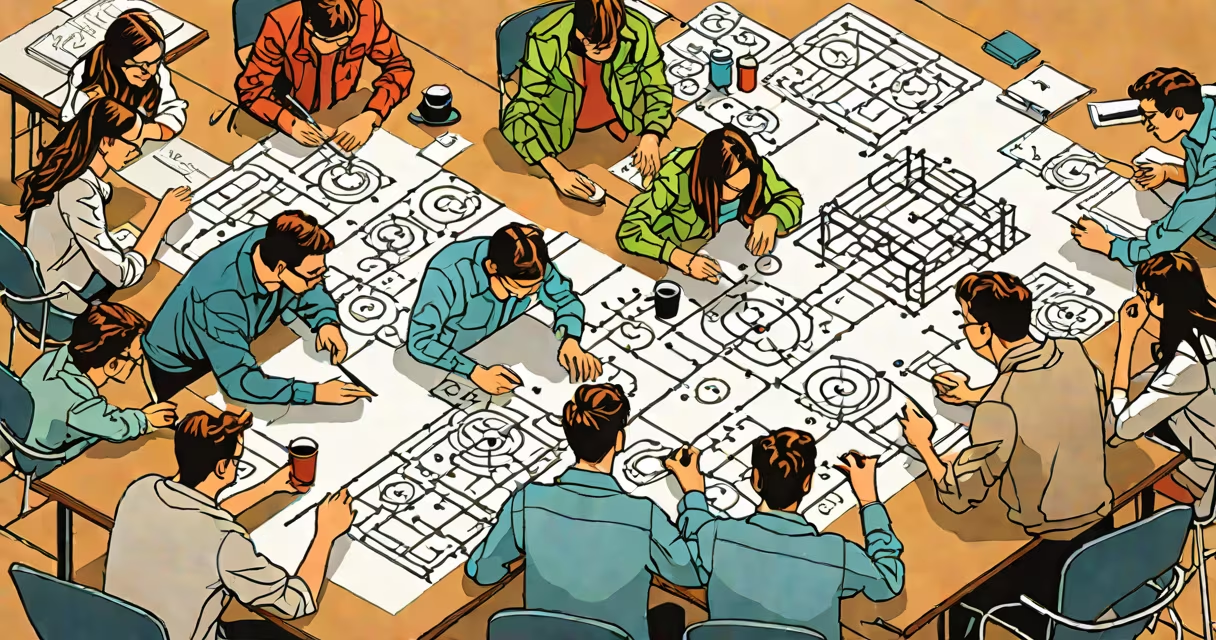
pi math club is a student-run mathematics group that focuses on advanced problem-solving, competition training, and collaborative learning in algebra, geometry, combinatorics, and number theory. These clubs typically meet weekly to work through challenging problems from contests like AMC 10/12, AIME, and USA(J)MO.
Founded in high schools and community centers, pi math club operates independently of formal curriculum requirements. Members range from beginners seeking exposure to math beyond the classroom to advanced students preparing for national and international competitions. The group's name derives from the mathematical constant π, symbolizing infinite precision and circular reasoning in logic.
Unlike traditional tutoring or classroom instruction, pi math club emphasizes peer-led discussion, shared solutions, and iterative problem refinement. Sessions often begin with a warm-up problem, progress to a central challenge, and conclude with a debrief where multiple solution paths are compared. This structure develops both technical skill and mathematical intuition.
Meetings follow a consistent format: a 10-minute introduction to a new concept or technique, a 30-minute collaborative session on a problem set, and a 15-minute review of alternate approaches. Problems are drawn from past AMC exams, regional math leagues, and curated online repositories such as Art of Problem Solving (AoPS).
Leadership rotates among members. One student presents a solution while others critique the logic, check for edge cases, and suggest simplifications. This method mirrors research practices in applied mathematics and fosters accountability. For example, during a 2023 session at Lincoln High School, a team solved a complex probability problem involving recursive sequences using both direct computation and generating functions, then verified their result with simulation code.
Success hinges on consistent attendance and active participation. Students who contribute regularly develop stronger conceptual frameworks. According to a 2022 study by the National Association of Secondary School Principals, 78% of students in peer-led math groups reported increased confidence in tackling unfamiliar problems compared to those in teacher-only instruction models.
Clubs vary in structure based on size, grade level, and goals. The following table outlines common formats:
| Type | Focus Area | Typical Meeting Frequency | Member Level |
|---|---|---|---|
| Introductory | Algebra, basic geometry, logic puzzles | Weekly | Grades 9-10 |
| Competition Prep | AMC/AIME-style problems, time-based drills | Twice weekly | Grades 10-12 |
| Advanced Research | Proof writing, Olympiad-level topics | Bi-weekly | Grades 11-12 |
Some clubs integrate computational tools. A group in Seattle uses Python scripts to test conjectures in number theory, validating patterns before attempting formal proofs. Another in Austin hosts monthly "math jams" where teams compete in live problem-solving challenges with real-time scoring.
Many assume pi math club is exclusively for math prodigies. That's incorrect. While some members have prior experience, most join with average math grades and improve rapidly through consistent engagement. A 2021 report from the Mathematical Association of America found that 63% of participants in such clubs improved their AMC scores by at least 10 points within one academic year.
Another myth is that these clubs replace classroom learning. They don't. Instead, they extend it. A student might learn quadratic equations in class but apply them in a pi math club setting to solve Diophantine equations or analyze symmetry in geometric configurations. The two environments serve different purposes: one teaches fundamentals, the other cultivates depth.
A less obvious distinction: pi math club is not a substitute for formal math education. It complements it. When students engage with problems outside standard curricula, they build transferable skills-critical thinking, pattern recognition, resilience under uncertainty-that appear in college admissions essays and STEM interviews.
I founded a pi math club at my high school in 2020. We started with six students and grew to 28 in two years. Our first major win came in 2022 when two members qualified for the AIME. We didn't have a faculty advisor-just a shared Google Doc, a Zoom link, and a commitment to show up.
One member, Maria, entered with a B+ in Algebra II. After nine months of weekly meetings, she scored in the top 1% nationally on the AMC 10. Her breakthrough wasn't talent-it was persistence. She spent hours rewriting solutions until they were concise and elegant. Her final proof for a combinatorics problem used inclusion-exclusion with five overlapping sets and was accepted by the AoPS forum moderators.
These outcomes reflect broader trends. The American Mathematical Society notes that peer-driven math communities correlate strongly with higher retention in STEM majors at the university level. Students who participate in such clubs are 40% more likely to pursue math-related degrees than peers who do not.
pi math club is not about memorizing formulas. It's about developing the mindset to ask "why?" and "how?" when faced with complexity. It turns math from a subject into a language of discovery.